Electra (1962 film)
Greek film adaptation of Euripides' Electra.

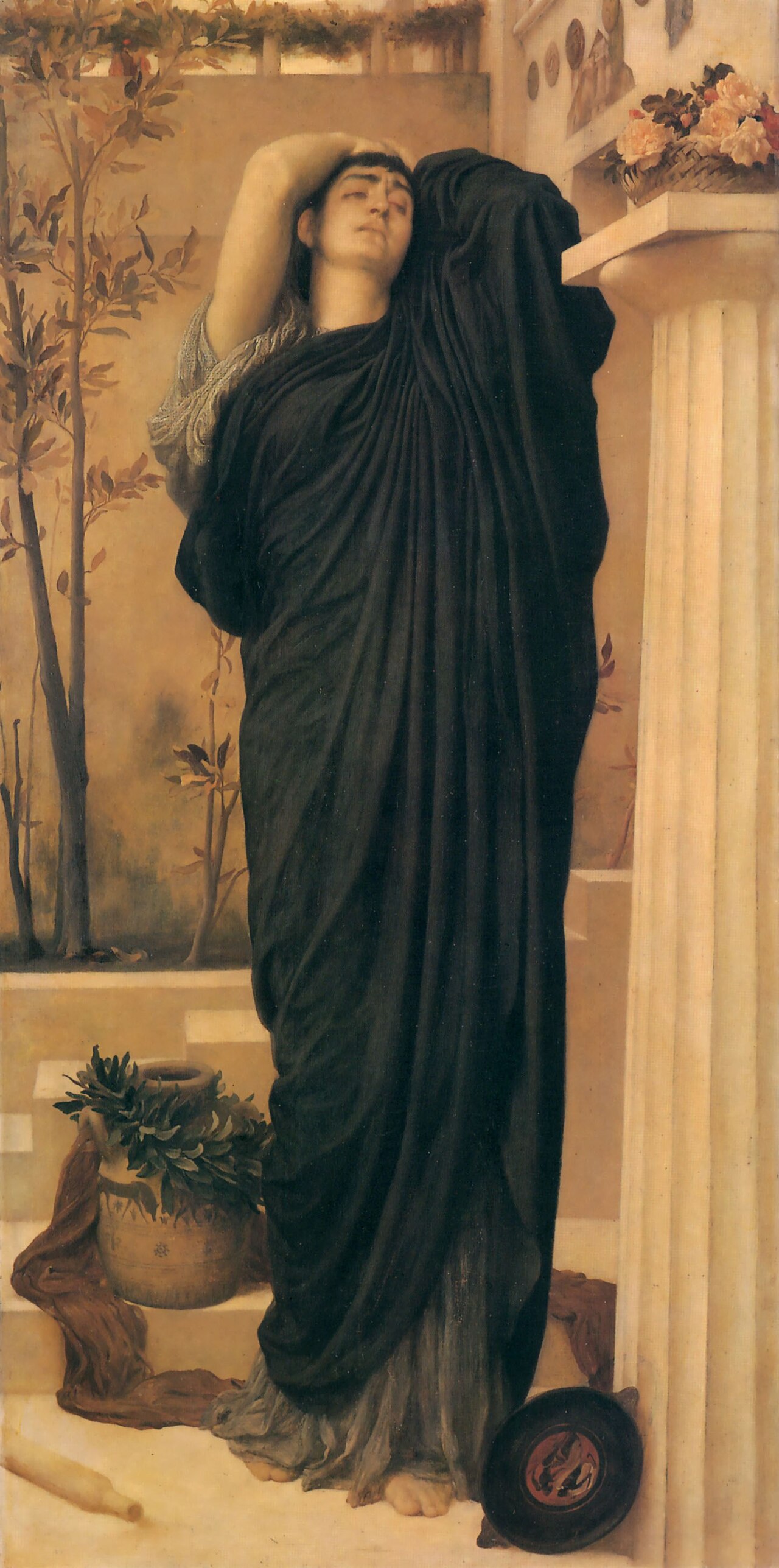
Frederic Leighton · Public domain
Electra is a 1962 Greek film directed by Michael Cacoyannis, based on Euripides' play. It is the first installment of Cacoyannis's 'Greek tragedy' trilogy, followed by The Trojan Women (1971) and Iphigenia (1977). The film stars Irene Papas as Elektra and Giannis Fertis as Orestes.
Quick Facts
- Director
- Michael Cacoyannis
- Based On
- Electra / 413 B.C. · Euripides
- Music
- Mikis Theodorakis
- Cinematography
- Walter Lassally
- Editing
- Leonidas Antonakis
- Studio
- Finos Film
- Distributor
- Lopert Pictures Corporation ( / USA / ) / United Artists (internationally [Finland, Denmark, Sweden, Argentina, Mexico])
- Released
- 25 May 1962 · Greece
- Runtime
- 113 minutes
- Country
- Greece
- Language
- Greek
Facts from the source article.
Lore & Background
The film follows the story of Electra, daughter of King Agamemnon, who is murdered by his wife Clytemnestra and her lover Aegisthus. Electra is forced into a peasant marriage to disgrace her, while her brother Orestes is sent into exile. Years later, Electra seeks revenge with Orestes and their cousin Pylades. Orestes kills Aegisthus during a festival, and Electra lures Clytemnestra to her home, where Orestes stabs her to death. The siblings feel remorse and depart in different directions as social outcasts.
Reader's Guide
Electra (1962) is significant as the first film in Michael Cacoyannis's acclaimed Greek tragedy trilogy, which brought classical Greek drama to international cinema. The film won the award for Best Cinematic Transposition at the 1962 Cannes Film Festival and was nominated for the Academy Award for Best Foreign Language Film. It also won three awards at the Thessaloniki Film Festival, including best film, best director for Cacoyannis, and best actress for Irene Papas. The film's stark visual style and powerful performances helped establish a modern cinematic language for ancient Greek tragedy.
Did You Know?
- The film won the award of Best Cinematic Transposition at the 1962 Cannes Film Festival.
- The film won three awards at the Thessaloniki Film Festival: best film, best director, and best actress.
- Electra was released on DVD by MGM Home Entertainment on March 5, 2002, as a Region 1 DVD.
The Opening of a Legendary Trilogy
Michael Cacoyannis directed Electra as the inaugural entry in what would become his celebrated Greek tragedy trilogy. The 1962 film set the stage for two subsequent classical adaptations: The Trojan Women in 1971 and Iphigenia in 1977. By choosing Euripides' play as his starting point, Cacoyannis established a pattern of bringing ancient Greek dramatic literature to the screen with a distinctly modern cinematic sensibility. The film's success at international festivals validated his approach and gave him the momentum to return to the classical stage nearly a decade later. Electra thus functions not merely as a standalone adaptation but as the foundational stone of a body of work that would define Cacoyannis's artistic identity and cement his reputation as a filmmaker deeply engaged with his cultural heritage. The trilogy collectively represents one of the most ambitious sustained projects in Greek cinema history, with Electra serving as the proof of concept that classical material could resonate powerfully with global audiences.
Irene Papas and the Role of Elektra
Irene Papas delivered what is widely regarded as one of the defining performances of her career in the title role of Elektra. The character's arc is punishing: confined to the palace for years, then forced into a degrading marriage with a peasant to humiliate her and any potential offspring, she ultimately channels her suffering into a cold, calculated pursuit of vengeance. Papas brought a raw, physical intensity to the role that elevated the material well beyond a simple stage adaptation. Her performance earned her the Best Actress prize at the Thessaloniki Film Festival, a recognition that underscored how central her portrayal was to the film's emotional architecture. Supporting her were Giannis Fertis as the exiled brother Orestes and Aleka Katselli as the murderous mother Clytemnestra, but it was Papas's Elektra who anchored the narrative and gave the audience a human face to the ancient myth. Elsie Pittas also appeared as the younger Elektra, bookending the character's journey from innocence to hardened resolve.
A Morally Complicated Revenge
The plot of Electra follows the familiar trajectory of the Euripidean source but lingers on its ethical ambiguities with particular force. After King Agamemnon is slain by his wife Clytemnestra and her lover Aegisthus, the surviving children scatter: Orestes flees into exile while Electra is trapped in the palace and later compelled to wed a peasant. Years later, the siblings reunite with their cousin Pylades to orchestrate retribution. The kills themselves are staged with a chilling practicality—Orestes seizes a mock knife-fight challenge at a Bacchic festival to dispatch Aegisthus, while Electra lures Clytemnestra under false pretenses. Yet the film refuses to let the audience celebrate. Clytemnestra, before her death, explains her motivations and even apologizes for how she treated Electra. In the aftermath, both siblings are consumed by remorse and accept that they will be cast out from society for what they have done. They part in different directions, carrying the weight of their actions. This ending transforms a straightforward revenge tale into a meditation on guilt, justice, and the impossibility of clean retribution.
Festival Triumphs and Lasting Recognition
Electra achieved significant international acclaim shortly after its 1962 release. At the Cannes Film Festival that year, the film was awarded the prize for Best Cinematic Transposition, a distinction that specifically honored the adaptation of a literary work to the screen. It also received a nomination for the Academy Award for Best Foreign Language Film, placing it among the most prestigious international submissions of that cycle. Domestically, the Thessaloniki Film Festival proved even more generous, bestowing three honors: Best Film, Best Director for Michael Cacoyannis, and Best Actress for Irene Papas. This trifecta at a major Greek festival signaled that the film was a landmark in its home country's cinema as well as a serious international contender. Decades later, the film's accessibility was preserved when MGM Home Entertainment issued a Region 1 DVD release on March 5, 2002, ensuring that new generations of viewers could encounter Cacoyannis's adaptation and Papas's performance. The film's continued presence on home video and its inclusion in lists of Greek Academy Award submissions attest to its enduring place in both national and global film history.
Gallery
Frequently Asked Questions
Who directed Electra (1962 film)?
Michael Cacoyannis helmed the 1962 Greek adaptation, marking his first step into staging ancient Greek tragedies for the screen. The project became the launchpad for his well-known cycle of classical adaptations.
Who stars in Electra (1962 film)?
Irene Papas delivers the lead performance as Elektra, and Giannis Fertis appears as her brother Orestes. Papas's portrayal is often cited as one of the defining roles of her career.
What source material is Electra (1962 film) based on?
The film is a screen adaptation of Euripides' ancient Greek tragedy of the same name, tracking the daughter of Agamemnon as she waits for her brother to return and avenge their father's murder. Cacoyannis remained closely faithful to the structure and themes of the original play.
What trilogy does Electra (1962 film) belong to?
It is the first entry in Cacoyannis's 'Greek tragedy' trilogy, later joined by The Trojan Women (1971) and Iphigenia (1977). The three films collectively explore the human cost of the Trojan War and its aftermath.
How does the story of Electra (1962 film) end?
The film closes with Orestes and Elektra carrying out their long-awaited retribution against Clytemnestra and Aegisthus, completing the cycle of vengeance that drives the entire narrative.
More in Agamemnon 1-24
Spotted an error? Know more?
Reader corrections go straight into our review queue. Suggest an edit · How this site is sourced