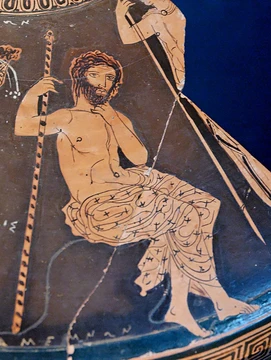
Argynnus
Young Boeotian lover of Agamemnon, drowned in the Cephissus river.

Argynnus is a figure from Greek mythology, a young and handsome boy from Boeotia. He is best known as a lover of the Greek king Agamemnon, and his death in the Cephissus river led Agamemnon to establish a cult of Aphrodite under the epithet 'Argynnus'. His story is told by several ancient authors, including the elegiac poet Phanocles, the grammarian Athenaeus, and the Roman poet Propertius.
- Born
- Boeotia (mythological)
- Died
- Cephissus river (drowned)
- Field
- Greek mythology
- Nationality
- Boeotian (mythological)
- Known for
- Lover of Agamemnon; death by drowning; associated with cult of Aphrodite Argynnus
Lore & Background
According to the elegiac poet Phanocles, while Agamemnon was in the town of Aulis, he became enamoured of Argynnus. His love for the boy caused him to forget his troops. The boy later died from drowning in the Cephissus river, leading Agamemnon to start a cult to Aphrodite Argynnus. The Greek grammarian Athenaeus tells a similar tale, noting that Agamemnon mourned the loss of Argynnus, buried him, and honored him with a tomb and a shrine to Aphrodite Argynnus.
Plutarch narrates a version in which Argynnus does not reciprocate Agamemnon's love, fleeing while Agamemnon pursues. The Roman poet Propertius tells of 'Agamemnon's woe' at the loss of the young man, whom he calls a descendant of Athamas, and states that Agamemnon does not set sail, ultimately leading to the sacrifice of his daughter Iphigenia. The Byzantine author Stephanus of Byzantium records that Argynnus was a prince from Boeotia, one of the sons of Queen Pisidice, placing him as a descendant of Athamas and ultimately of Aeolus.
According to Athenaeus, the poet Likymnios of Chios, in his Dithyrambics, says that Argynnus was a lover of the god Hymenaeus. The episode is also found in Clement of Alexandria.
Reader's Guide
Argynnus is a minor but significant figure in Greek mythology, primarily known through the lens of his relationship with Agamemnon. His story illustrates the theme of love and loss in ancient myth, and the founding of a cult in his honor highlights how personal tragedy could be transformed into religious practice. The differing accounts—from Phanocles, Athenaeus, Plutarch, and Propertius—show the fluidity of mythological narratives, with variations in the nature of the relationship (reciprocated or unrequited) and the consequences for Agamemnon's actions, including the delay that led to Iphigenia's sacrifice. The mention of Argynnus as a lover of the god Hymenaeus adds another layer, connecting him to the divine realm of marriage and love. His legacy is preserved primarily through the works of ancient poets and scholars, and his name became an epithet for Aphrodite, indicating the lasting impact of his story on Greek religious practice. The entry in Stephanus of Byzantium provides genealogical context, linking him to the royal line of Athamas and Aeolus, which situates him within the broader tapestry of Boeotian myth.
Did You Know?
- Argynnus is said to have been a lover of the Greek king Agamemnon.
- He died by drowning in the Cephissus river.
- Agamemnon established a cult of Aphrodite under the epithet 'Argynnus' after his death.
- According to Likymnios of Chios, Argynnus was also a lover of the god Hymenaeus.
The Cephissus Tragedy and Agamemnon's Consuming Passion
Argynnus is portrayed as a strikingly beautiful young man from Boeotia who captures the heart of King Agamemnon. In the version preserved by the elegiac poet Phanocles, the king falls under the boy's spell while encamped at Aulis, and his obsession grows so all-consuming that he abandons attention to his military duties. The narrative then pivots to catastrophe: Argynnus drowns in the Cephissus river, and Agamemnon is left in devastating grief. Athenaeus of Naucratis elaborates on the aftermath, describing how the king mourned the loss of his friend or lover, gave the boy a proper burial, and raised a tomb at the site. Plutarch introduces a troubling variant in which Argynnus never returns the king's feelings and flees from his pursuit, recasting the tale as one of unwanted desire. Propertius, writing in Latin, frames the entire episode as 'Agamemnon's woe' and ties it to the broader machinery of the Trojan War: the king's preoccupation with his loss keeps him from setting sail, a delay that cascades into the fateful sacrifice of his daughter Iphigenia. The myth thus fuses private longing with public consequence.
A Millennium of Literary Witnesses
The Argynnus episode endures through a strikingly diverse chain of ancient sources stretching across roughly a thousand years. The earliest identifiable voice is that of the Greek elegiac poet Phanocles, whose verses established the core narrative of Agamemnon's passion, the boy's drowning, and the resulting cult. The grammarian and rhetorician Athenaeus of Naucratis, active in the second or third century AD, retells the story within his Deipnosophists, enriching it with details about the burial, the tomb, and the shrine. The Roman elegiac poet Propertius references the tale in his Elegies, identifying the boy as a descendant of Athamas and connecting the king's grief to the Iphigenia sacrifice. Plutarch contributes a version emphasizing the boy's flight from an unrequited suitor, while Clement of Alexandria also preserves the episode. The sixth-century Byzantine scholar Stephanus of Byzantium offers a compact summary identifying Argynnus as a Boeotian prince. The Chian poet Likymnios, in his Dithyrambics, introduces an entirely separate divine pairing. This scatter of Greek and Roman, poetic and prose, early and late attestations testifies to the episode's deep roots in the mythological imagination.
Founding the Cult of Aphrodite Argynnus
The most tangible legacy of Argynnus's death, as attested by multiple independent authors, is the creation of a religious cult. Following the boy's drowning in the Cephissus river, Agamemnon founds a form of worship honoring Aphrodite under the specific title 'Argynnus.' Phanocles, the earliest known teller, presents this act of cult-founding as the direct emotional consequence of the king's grief, binding the goddess of love to the memory of a particular young man. Athenaeus broadens the ritual landscape, describing not only the shrine dedicated to Aphrodite Argynnus but also a physical tomb raised over the boy's remains, suggesting a sacred site where personal mourning and public devotion merged into a single practice. The epithet itself is remarkable: it anchors an abstract divine figure to a named individual and a specific river, transforming a private tragedy into a communal act of veneration. The fact that this cult is mentioned by Phanocles, Athenaeus, and Stephanus of Byzantium independently indicates it was a recognized element of Boeotian religious life, rooted in the Cephissus and in the memory of Agamemnon's loss.
Royal Lineage and the Rival Hymenaeus Tradition
Argynnus's genealogical background is outlined primarily by Stephanus of Byzantium, who identifies him as a prince of Boeotia and one of the sons of the queen Pisidice. This placement makes him a descendant of the mythic king Athamas and, tracing further back, a member of the broader Aeolian line descending from Aeolus. Propertius independently confirms the Athamas connection in his Latin verse, calling the boy a descendant of that legendary figure. Yet the mythic tradition surrounding Argynnus is far from uniform. While the majority of sources cast him as Agamemnon's beloved at Aulis, the Chian poet Likymnios, in his Dithyrambics, assigns the boy a different divine companion entirely: the god Hymenaeus, the deity associated with marriage. This alternative pairing, preserved for us by Athenaeus, suggests that in some local or poetic context Argynnus functioned as a figure linked to nuptial rites rather than to the Trojan War narrative. The coexistence of these traditions—royal Aeolian lineage, mortal passion at Aulis, and divine association with marriage—reflects the fluid, multi-layered character of Greek myth, where a single name could carry distinct stories in different poetic and regional settings.
Frequently Asked Questions
Who is Argynnus in Agamemnon's story?
Argynnus is a young man from Boeotia who appears in Greek myth as Agamemnon's lover. He is known almost entirely through his relationship with the Greek king and his subsequent tragic death.
How does Argynnus die?
Argynnus drowns in the Cephissus river. His death is the pivotal event that triggers Agamemnon's later religious act in his memory.
What is the cult of Aphrodite Argynnus?
After Argynnus's drowning, Agamemnon founded a worship of Aphrodite under the specific epithet 'Argynnus.' The cult functioned as a memorial directly tied to his lover's fate.
Which ancient writers mention Argynnus?
The story surfaces in references by the elegiac poet Phanocles, the grammarian Athenaeus, and the Roman poet Propertius. No single source provides a full narrative; the details are assembled from these scattered mentions.
Why does Argynnus matter in Agamemnon's broader legend?
His death is the one mythological event that prompts Agamemnon to establish a public religious cult, making Argynnus a rare figure who shapes the king's actions beyond the battlefield. It also adds a personal, emotional dimension to Agamemnon's character.
More in Agamemnon 1-24
Spotted an error? Know more?
Reader corrections go straight into our review queue. Suggest an edit · How this site is sourced