Wyoming
Least populous U.S. state, first to grant women's suffrage.

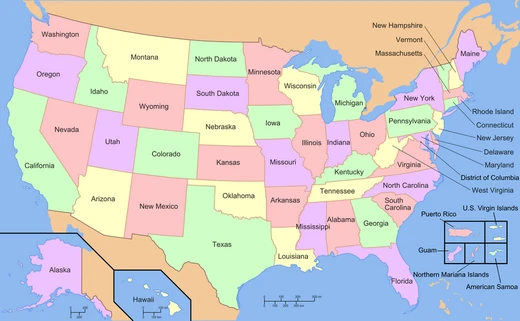
Wyoming is a landlocked state located in the Mountain West portion of the western United States. It shares borders with Montana to the north and northwest, South Dakota and Nebraska to the east, Idaho to the west, Utah to the southwest, and Colorado to the south. As of 2024, its estimated population is 587,618, making it the least populous state in the country, even though it ranks tenth in total area. It also has the second-lowest population density. Cheyenne serves as both the state capital and its most populous city.
The western half of Wyoming is dominated by the ranges and rangelands of the Rocky Mountains, while the eastern half consists of high-elevation prairie known as the High Plains. The climate varies between semi-arid and continental, resulting in conditions that are generally drier and windier than in other states, with more extreme temperature swings. Just under half of the state’s land is owned by the federal government, which places Wyoming sixth in total federally owned land and fifth in the proportion of land under federal control. These holdings include two national parks—Grand Teton and Yellowstone—along with two national recreation areas, two national monuments, several national forests, historic sites, fish hatcheries, and wildlife refuges.
Indigenous peoples have lived in the region for thousands of years. Parts of what is now Wyoming came under American control through the Louisiana Purchase, the Oregon Treaty, and finally the Mexican Cession. The opening of the Oregon, Mormon, and California Trails brought large numbers of pioneers through areas previously traveled mainly by fur trappers, leading to the establishment of forts like Fort Laramie, which later became population centers. The Transcontinental Railroad, completed in 1867, replaced the wagon trails with a route through southern Wyoming, bringing new settlers and founding towns such as Cheyenne. Wyoming became the 44th state on July 10, 1890.
Women’s suffrage in Wyoming dates back to 1869, when the territory granted women the right to vote. Upon statehood in 1890, it became the first state to allow women to vote, and it also became the first to allow women to hold elected office and the first to elect a female governor, Nellie Tayloe Ross.
Quick Facts
- Flag Link
- Flag of Wyoming
- Seal Link
- Seal of Wyoming
- Nicknames
- Equality State (official); / Cowboy State; Big Wyoming
- Motto
- Equal Rights
- Anthem
- "Wyoming"
- Former
- Wyoming Territory
- Seat
- Cheyenne
- Largestcounty
- Laramie
- Officiallang
- English
- Population Demonym
- Wyomingite, Wyomingian
- Largestcity
- capital
- Governor
- Mark Gordon (R)
Facts from the source article.
Lore & Background
Indigenous peoples have inhabited the region for thousands of years. Part of Wyoming came under American sovereignty via the Louisiana Purchase, the Oregon Treaty, and the Mexican Cession. The Oregon Trail, Mormon Trail, and California Trail brought pioneers through the area, leading to the establishment of forts such as Fort Laramie. The Transcontinental Railroad reached Cheyenne in 1867, spurring settlement. Wyoming's western half consists of Rocky Mountain ranges and rangelands; its eastern half is high-elevation prairie called the High Plains. The federal government owns just under half of Wyoming's land, including two national parks (Grand Teton and Yellowstone), two national recreation areas, two national monuments, and several national forests. The state's lowest recorded temperature was -66°F (-54°C) at Moran on February 9, 1933.
Reader's Guide
Wyoming's significance lies in its pioneering role in women's rights. As a territory, it granted women the right to vote in 1869, and upon statehood in 1890 it became the first state to allow women to vote. It also became the first state to allow women to hold elected office and the first to elect a female governor, Nellie Tayloe Ross. Its official nickname 'The Equality State' and motto 'Equal Rights' reflect this history. The state's economy is largely based on tourism and the extraction of minerals such as coal, natural gas, oil, and trona. Agriculture includes barley, hay, livestock, sugar beets, wheat, and wool. Wyoming's climate is semi-arid and continental, making it drier and windier than most other states, with greater temperature extremes. The Johnson County War of 1892, a range war between cattle ranchers, is a notable event in its history.
Did You Know?
- Wyoming is the least populous state despite being the tenth-largest by area.
- The name Wyoming derives from the Lenape Munsee word xwé:wamənk, meaning 'at the big river flat'.
- Yellowstone National Park, created in 1872 as the world's first national park, lies mostly in northwestern Wyoming.
- Wyoming's lowest recorded temperature is −66 °F (−54 °C) at Riverside on February 9, 1933.
More in U.S. States And Territories 1-24
Spotted an error? Know more?
Reader corrections go straight into our review queue. Suggest an edit · How this site is sourced