Pennsylvania
Fifth-most populous U.S. state, founded as a haven for tolerance.

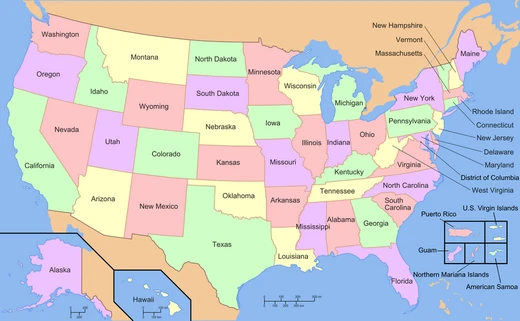
Pennsylvania, officially the Commonwealth of Pennsylvania, is a U.S. state located in the Mid-Atlantic, Northeastern, Appalachian, and Great Lakes regions. Founded in 1681 through a royal land grant to William Penn, it was established as a haven for religious and political tolerance and played a vital role in the American Revolution, hosting the First and Second Continental Congress in Philadelphia and being the second state to ratify the U.S. Constitution.
Quick Facts
- Official Name
- Commonwealth of Pennsylvania
- Flag Link
- Flag of Pennsylvania
- Nicknames
- Keystone State; Quaker State
- Motto
- Virtue, Liberty, and Independence
- Former
- Province of Pennsylvania
- Languages
- English 90.15% / Spanish 4.09% / German (including Pennsylvania Dutch) 0.87% / Chinese 0.47% / Italian 0.43%
- Population Demonym
- Pennsylvanian / Pennamite / Pennsylvanier (Pennsylvania Dutch)
- Seat
- Harrisburg
- Largestcity
- Philadelphia
- Governor
- Josh Shapiro (D)
- Lieutenant Governor
- Austin Davis (D)
- Legislature
- General Assembly
Facts from the source article.
Lore & Background
In the 17th century, the Dutch and English claimed the Delaware River region. The Dutch began settling the Delmarva Peninsula in 1631, and Sweden established New Sweden in 1638. In 1664, the British conquered New Netherland, and in 1681, King Charles II granted a land charter to William Penn to repay a debt. Penn named the colony Pennsylvania, meaning 'Penn's Woods.' He established a government with county commissions and freedom of religion, and signed a peace treaty with Lenape leader Tamanend, beginning a long period of friendly relations. Pennsylvania hosted the First and Second Continental Congress in Philadelphia, which formed the Continental Army and adopted the Declaration of Independence. It was the second state to ratify the U.S. Constitution on December 12, 1787.
Reader's Guide
Pennsylvania's significance lies in its foundational role in American history and its modern economic and technological contributions. As a colonial haven for religious and political tolerance, it set precedents for governance and pluralism. Its hosting of the Continental Congress and ratification of the Constitution made it central to the nation's founding. In the 21st century, Pennsylvania has been nicknamed 'Cellicon State' due to the role of Philadelphia and Pittsburgh in developing technology and immunotherapies for cancer. The state's geography is highly diverse, with the Appalachian Mountains, Allegheny and Pocono mountains, and extensive forest cover. It has 140 miles of waterfront along Lake Erie and the tidal Delaware River. With over 13 million residents, it is the fifth-most populous state and includes major metropolitan areas centered on Philadelphia and Pittsburgh, as well as the capital, Harrisburg.
Did You Know?
- Pennsylvania is the 33rd-largest state by land area and approximately the tenth-highest by population density.
- Meadowcroft Rockshelter contains the earliest known signs of human activity in Pennsylvania, possibly pre-dating the Clovis culture.
Frequently Asked Questions
Who is Pennsylvania?
Pennsylvania is a U.S. state in the Mid-Atlantic region, officially styled the Commonwealth of Pennsylvania. It spans the Northeastern, Appalachian, and Great Lakes areas and ranks as the fifth-most populous state in the country.
How was Pennsylvania founded?
In 1681, a royal land grant was issued to William Penn, who built the colony around the ideals of religious and political tolerance. That founding commitment to openness became a defining thread in the state's long identity.
What role did Pennsylvania play in the American Revolution?
Philadelphia served as the meeting ground for both the First and Second Continental Congress, placing the state at the center of the revolutionary cause. Pennsylvania also became the second state to ratify the U.S. Constitution.
Why is Pennsylvania important in American history?
The state was deliberately created as a haven for tolerance, setting an early precedent for religious freedom in the colonies. Its leadership in convening the Continental Congress and its quick ratification of the Constitution further cemented its place in the nation's founding story.
What is Pennsylvania's nickname?
Pennsylvania is known as the Cellicon State, a moniker that reflects its identity as a commonwealth originally chartered around principles of open governance and religious freedom.
More in U.S. States And Territories 1-24
Spotted an error? Know more?
Reader corrections go straight into our review queue. Suggest an edit · How this site is sourced