New Hampshire
The Granite State

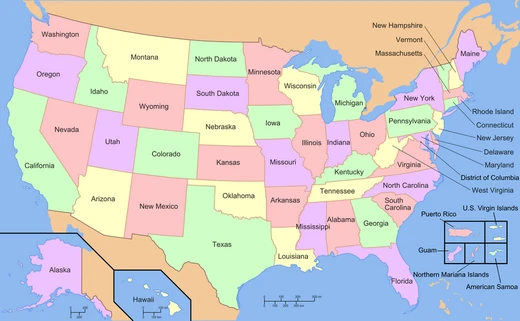
New Hampshire sits in New England, in the northeastern part of the United States. It shares borders with Massachusetts to the south, Vermont to the west, Maine and the Gulf of Maine to the east, and the Canadian province of Quebec to the north. Among the 50 states, it ranks as the seventh smallest in land area and the tenth least populated, with about 1.38 million people counted in the 2020 census. The capital is Concord, while Manchester is its largest city. The state’s motto, “Live Free or Die,” points to its involvement in the American Revolution, and its nickname, “The Granite State,” comes from its many granite formations and quarries. New Hampshire is also famous for hosting the first primary in the U.S. presidential election cycle, giving it notable sway over national politics.
For thousands of years before Europeans arrived, Algonquian-speaking peoples like the Abenaki lived in the area. English settlers founded some of the earliest non-native communities in the 1600s. The Province of New Hampshire was created in 1629, named after the English county of Hampshire. During the French and Indian War, the region sat on the edge of British territory and saw conflict with French forces and their Indigenous allies. In the 1760s, tensions between the colonies and Britain grew, and New Hampshire staged an early rebellion in 1774 by seizing Fort William and Mary from the British. In 1776, it became the first British North American colony to set up its own independent government and state constitution. It signed the Declaration of Independence and supplied troops, ships, and materials for the war against Britain. In 1788, it became the ninth state to ratify the U.S. Constitution, putting it into effect. During the mid-1800s, New Hampshire was a stronghold for abolitionism, and it sent nearly 32,000 Union soldiers to fight in the Civil War. Afterward, the state industrialized quickly, with its population growing as it became a hub for textiles, shoes, and paper. The Amoskeag Manufacturing Company in Manchester was the largest cotton textile plant in the world at the time. French Canadians made up the biggest wave of immigrants, and today about a quarter of New Hampshire residents trace their ancestry to France.
Like much of the country, New Hampshire’s manufacturing sector shrank after World War II. Since 1950, the economy has shifted toward financial services, real estate, education, transportation, and high-tech, though manufacturing still employs more people than the U.S. average. The population surged as highways linked the state to Greater Boston, turning many towns into commuter suburbs. New Hampshire is one of the wealthiest and most educated states, tying with Massachusetts for the highest Human Development Index in the nation. It is one of nine states with no income tax and also lacks taxes on sales, capital gains, or inheritance, instead relying heavily on local property taxes to fund schools. This keeps the overall state tax burden among the lowest in the country, a philosophy often called the “New Hampshire Advantage,” a term coined by former governor Stephen Merrill. Since 2017, the state’s Republican Party has held a trifecta in state government, except for 2019 and 2020, while Democrats have generally held the majority of federal congressional seats.
The state’s mountainous, forested landscape supports a growing tourism industry centered on outdoor recreation. It has some of the highest ski mountains on the East Coast and is a popular destination for winter sports. Mount Monadnock is one of the most climbed mountains in the world. Other attractions include fall foliage viewing, summer cottages on lakes and the seacoast, motorsports at the New Hampshire Motor Speedway in Loudon, and Motorcycle Week, a rally held at Weirs Beach in Laconia. The White Mountain National Forest contains much of the Appalachian Trail between Vermont and Maine, and it features the Mount Washington Auto Road, which lets visitors drive to the summit of 6,288-foot Mount Washington.
The area was originally home to various Algonquian-speaking Abenaki tribes, mainly the Androscoggin, Cowasuck, and Pennacook. Though they shared a language family, their culture and religion were quite different from other Algonquian peoples. Archaeological digs in 2009 found evidence that Indigenous people lived near Keene, New Hampshire, as far back as 12,000 years ago, and the Abenaki were present in pre-colonial times.
English and French explorers arrived between 1600 and 1605, and David Thompson established a settlement at Odiorne’s Point in present-day Rye in 1623. The first permanent European settlement was at Hilton’s Point, now Dover. By 1631, the Upper Plantation covered modern-day Dover, Durham, and Stratham, and in 1679 it became the “Royal Province.” Southern New Hampshire saw heavy fighting during King William’s War, with Dover and Durham burned in 1689 and 1692, respectively. Father Rale’s War was another conflict between colonists and the Wabanaki Confederacy across the state.
New Hampshire was one of the Thirteen Colonies that revolted against British rule in the American Revolution. During that war, the state was economically split. The Seacoast region depended on sawmills, shipyards, merchant warehouses, and established town centers, where wealthy merchants built large homes, filled them with luxuries, and invested in trade and land speculation.
Quick Facts
- Flag Link
- Flag and seal of New Hampshire
- Nicknames
- Granite State / White Mountain State
- Motto
- "Live Free or Die"
- Anthem
- "Old New Hampshire"
- Officiallang
- English · (French allowed for official business with Quebec; other languages allowed for certain specific uses)
- Population Demonym
- New Hampshirite · Granite Stater
- Seat
- Concord
- Largestcity
- Manchester
- Largestcounty
- Hillsborough
- Largestmetro
- Greater Boston (combined and metro) / Nashua (urban)
- Area Rank
- 46th
- Area Total Sq Mi
- 9,350
Facts from the source article.
Lore & Background
New Hampshire was inhabited for thousands of years by Algonquian-speaking peoples such as the Abenaki. Europeans arrived in the 17th century, with the English establishing some of the earliest non-indigenous settlements. The Province of New Hampshire was established in 1629, named after the English county of Hampshire. Up to the time of the French and Indian War, New Hampshire was on the frontier of British territory and saw action against the French and their Indian allies. Following tensions between the British colonies and the crown in the 1760s, New Hampshire saw one of the earliest acts of rebellion, with the seizing of Fort William and Mary from the British in 1774. In 1776, it became the first of the British North American colonies to establish an independent government and state constitution. It signed the United States Declaration of Independence and contributed troops, ships, and supplies in the war against Britain. In 1788, it was the 9th state to ratify the U.S. Constitution, bringing it into effect. Through the mid-19th century, New Hampshire was an active center of abolitionism, and fielded close to 32,000 Union soldiers during the U.S. Civil War. Afterwards the state saw rapid industrialization and population growth, becoming a center of textile manufacturing, shoemaking, and papermaking; the Amoskeag Manufacturing Company in Manchester was the largest cotton textile plant in the world. French Canadians formed the most significant influx of immigrants, and a quarter of New Hampshire residents have French American ancestry.
Reader's Guide
With its mountainous and heavily forested terrain, New Hampshire has a growing tourism sector centered on recreation. It has some of the highest ski mountains on the East Coast and is a major destination for winter sports; Mount Monadnock is among the most climbed mountains in the world. Other activities include observing the fall foliage, summer cottages along lakes and the seacoast, motorsports at the New Hampshire Motor Speedway in Loudon, and Motorcycle Week, a motorcycle rally held in Weirs Beach in Laconia. The White Mountain National Forest includes most of the Appalachian Trail between Vermont and Maine, and has the Mount Washington Auto Road, where visitors may drive to the top of 6288 ft Mount Washington.
Did You Know?
- Mount Washington holds the record for the fastest wind speed ever recorded by a staffed weather station – 231 miles per hour.
- New Hampshire was the first colony to declare independence from Great Britain on January 5, 1776.
Frequently Asked Questions
Who is New Hampshire?
New Hampshire is a compact New England state tucked into the northeastern corner of the United States, bordered by Massachusetts, Vermont, Maine, Quebec, and the Gulf of Maine. It ratified the Constitution in 1788 as the ninth state and is home to roughly 1.38 million residents.
What is New Hampshire known for?
As a full U.S. state, New Hampshire holds two Senate seats, one House seat, and four presidential electors, and it governs itself under its own constitution. Concord serves as the capital, while Manchester is the largest city and primary economic center.
Why is New Hampshire important?
The state's Revolutionary War heritage is still visible in its 'Live Free or Die' motto, a direct nod to its early push for independence. It also hosts Mount Washington, whose wind gusts rank third on the planet.
Where does New Hampshire get its nickname?
The Granite State label comes from the vast deposits of granite that run through the White Mountains and other ranges across the state. This bedrock has shaped local architecture, tourism, and the state's self-image for generations.
More in U.S. States And Territories 1-24
Spotted an error? Know more?
Reader corrections go straight into our review queue. Suggest an edit · How this site is sourced