New Jersey
The Garden State

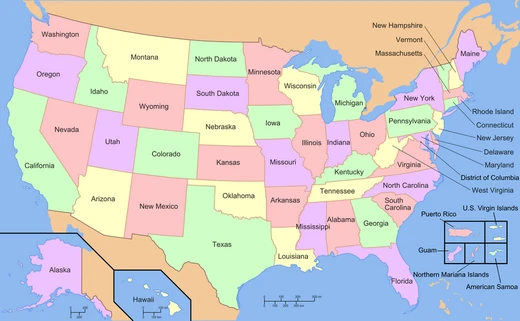
New Jersey sits at the center of the heavily built-up Northeast megalopolis, straddling the Mid-Atlantic and Northeastern regions of the United States. It shares its northwestern, northern, and northeastern borders with New York State; its eastern, southeastern, and southern edges meet the Atlantic Ocean; to the west lie the Delaware River and Pennsylvania; and to the southwest, Delaware Bay and Delaware. Covering 7,354 square miles, it ranks as the fifth-smallest state by land area. As of a 2025 estimate from the U.S. Census Bureau, New Jersey holds over 9.5 million people—its highest population count on record—making it the 11th-most populous state. Trenton serves as the capital, while Newark is the largest city. It is the most densely populated state in the country and the only one where every county is classified as urban by the Census Bureau. Paleo-Indians first reached the area around 13,000 BC. By the time European explorers arrived in the early 1600s, the Lenape were the dominant Indigenous group, split into dialectal divisions: the Munsee in the north, and the Unami and Unalachtigo elsewhere. Dutch and Swedish settlers established the first European colonies, but the British later took control and created the Province of New Jersey, naming it after the Channel Island of Jersey. The colony’s fertile soil and relatively tolerant religious atmosphere attracted a broad mix of people. New Jersey was one of the original Thirteen Colonies that backed the American Revolution, hosting key battles and military commands that earned it the nickname “Crossroads of the American Revolution.” During the Civil War, it stayed with the Union, supplying troops, resources, and military leaders. Afterward, it grew into a major manufacturing hub and a top destination for immigrants, fueling the Industrial Revolution in the United States. The state has been the birthplace of countless industrial, technological, and commercial breakthroughs, and many influential Americans from New Jersey have left their mark on academia, social reform, business, entertainment, government, the military, nonprofits, and beyond. Its central spot in the Northeast megalopolis drove rapid growth and suburban expansion in the latter half of the 1900s. Since the early 2000s, the economy has diversified significantly, with New Jersey now hosting the world’s largest pharmaceutical industry—earning it the title “Medicine Chest of the World.” The state also excels in biotechnology, information technology, STEM education, finance, digital media, filmmaking, and tourism, and has become a key Atlantic seaboard center for logistics and distribution. It remains a major immigrant destination and is home to one of the most multicultural populations globally. Since the start of the 21st century, re-urbanization has been underway, especially near New Jersey Transit rail hubs. New Jersey is the fastest-growing state in the Northeast and one of the fastest-growing nationwide, thanks to a resilient economy and aggressive homebuilding policies. New Jersey is among the most developed states in the U.S. Its median household income reached $99,781 in 2023, the second-highest in the country after Massachusetts. Nearly one in ten households—over 323,000—are millionaires, giving the state the highest concentration of millionaires both by percentage and per square mile. Although it is not a border state, a quarter of its population is foreign-born, the second-highest proportion after California. The state ranks near the top on both the American Human Development Index and the standard Human Development Index. It has also been rated the top U.S. state for physical and emotional wellness, despite being one of the most expensive places to live. According to research from the U.S. National Oceanic and Atmospheric Administration, New Jersey has experienced the fastest warming in average air temperature over a 100-year period starting in the early 1900s, a trend linked to significant warming of the North Atlantic Ocean. The coastal waters of the Jersey Shore are among the fastest-warming urban ocean shorelines in the world. The collision of tectonic plates between North America and Africa created the Appalachian Mountains. Around 18,000 years ago, glaciers from the Ice Age reached New Jersey. As they melted, they left behind Lake Passaic, along with rivers, meadows, swamps, and gorges. Since the 6th millennium BC, Native American peoples—starting with the Lenape tribe—have lived in the area. The Lenape called the land *Scheyichbi*. They were made up of several autonomous groups who supplemented hunting and gathering with maize agriculture in the region around the Delaware River, the lower Hudson River, and western Long Island Sound. Their society was organized into matrilineal clans based on common female ancestors, which were grouped into three phratries identified by animal symbols: Turtle, Turkey, and Wolf. They first encountered the Dutch in the early 1600s, and their main interaction with the Dutch and later European settlers involved the fur trade. The Dutch were the first Europeans to claim territory in what is now New Jersey.
Quick Facts
- Flag Link
- Flag of New Jersey
- Flag Alt
- The flag shows the state's coat of arms in a yellow background
- Nickname
- The Garden State
- Motto
- Liberty and prosperity
- Former
- Province of New Jersey
- Seat
- Trenton
- Largestcity
- Newark
- Largestcounty
- Bergen
- Largestmetro
- New York
- Languages
- (2021 American Community Survey) / English / Spanish / Portuguese / Hindi / Gujarati / Chinese / Korean / Arabic / Polish / Haitian Creole / Italian / Tagalog / Russian / Telugu / French / Urdu
- Population Demonym
- New Jerseyan (official), New Jerseyite
- Governor
- Mikie Sherrill (D)
Facts from the source article.
Lore & Background
New Jersey was first inhabited by Paleo-Indians as early as 13,000 BC. The Lenape were the dominant Indigenous group when Europeans arrived in the early 17th century, and they were subdivided into dialectal groups such as the Munsee, in the north, and the Unami and the Unalachtigo, elsewhere. Dutch and Swedish colonists founded the first European settlements in the state, with the British later seizing control of the region and establishing the Province of New Jersey, named after the Channel Island of Jersey. The colony's fertile lands and relative religious tolerance drew a large and diverse population. New Jersey was among the Thirteen Colonies that supported the American Revolution, hosting several pivotal battles and military commands in the American Revolutionary War earning the title 'Crossroads of the American Revolution'. New Jersey remained in the Union during the American Civil War and provided troops, resources, and military leaders in support of the Union Army. After the war, the state emerged as a major manufacturing center and a leading destination for immigrants, helping drive the Industrial Revolution in the U.S. New Jersey was the site of many industrial, technological, and commercial innovations. Many prominent Americans associated with New Jersey have proven influential nationally and globally, including in academia, social advocacy, business, entertainment, government, military, non-profit leadership, and other fields.
Reader's Guide
New Jersey's central location in the Northeast megalopolis helped fuel its rapid growth and suburbanization in the second half of the 20th century. Since the beginning of the 21st century, the state's economy has become highly diversified, with major sectors, including New Jersey's role as the world's largest pharmaceutical industry hub, and is widely known as the 'Medicine Chest of the World'. New Jersey excels in biotechnology, information technology, STEM education, finance, digital media, filmmaking, and tourism, and it has become an Atlantic seaboard epicenter for logistics and distribution. New Jersey is a major destination for immigrants and is home to one of the world's most multicultural populations. Since the onset of the 21st century, re-urbanization is taking place in New Jersey, particularly near New Jersey Transit rail hubs. New Jersey is the fastest-growing state in the U.S. Northeast and one of the fastest-growing in the United States overall, attributed to its resilient economy and aggressive homebuilding policies. New Jersey is one of the most developed states in the U.S. New Jersey had a median household income of $99,781 as of 2023, the second-highest of any U.S. state behind Massachusetts. Almost one-tenth of all households in the state, or over 323,000, are millionaires, the highest representation of millionaires among all states and the highest density per square mile. Despite not being a U.S. border state, one-quarter of New Jersey's population is foreign born, the second-highest proportion after California. New Jersey has been ranked the top U.S. state in physical and emotional wellness, despite being one of the most expensive states for residents to live in. According to climatology research by the U.S. National Oceanic and Atmospheric Administration, New Jersey has been the fastest-warming state by average air temperature over a 100-year period beginning in the early 20th century, which has been attributed to significant warming of the North Atlantic Ocean, and the coastal waters of the Jersey Shore constitute one of the fastest-warming urban ocean shorelines in the world.
Did You Know?
- New Jersey is the most densely populated U.S. state.
- New Jersey is the only U.S. state in which every county is deemed urban by the U.S. Census Bureau.
Frequently Asked Questions
Who is New Jersey?
New Jersey is the most densely populated state in the U.S., cramming more than 9.5 million residents into just 7,354 square miles of Mid-Atlantic and Northeastern coastline. It occupies the very center of the Northeast megalopolis, squeezed between New York, Pennsylvania, and Delaware.
What is New Jersey's role in the broader U.S. landscape?
It acts as a compact, heavily urbanized economic corridor at the heart of the megalopolis, linking the Boston-to-Washington, D.C. chain of cities. Its extreme density and proximity to multiple major metros make it a critical node for commerce, transit, and culture.
How does New Jersey compare in size and population to other states?
At 7,354 square miles it is the fifth-smallest state by land area, yet it holds the 11th-largest population in the country. That combination gives it the highest population density of any state.
Why is New Jersey considered important?
Its geographic position straddling the Mid-Atlantic and Northeastern regions makes it a natural crossroads for trade, transportation, and migration. A 2023 median household income near $99,781 underscores its status as a high-income, urbanized part of the megalopolis.
Where exactly is New Jersey located on the map?
New York borders it to the northwest, north, and northeast; the Atlantic Ocean lines its east, southeast, and south; the Delaware River and Pennsylvania form its western edge; and Delaware Bay and Delaware close off the southwest. This grants the state both riverine and open-ocean coastline.
More in U.S. States And Territories 1-24
Spotted an error? Know more?
Reader corrections go straight into our review queue. Suggest an edit · How this site is sourced