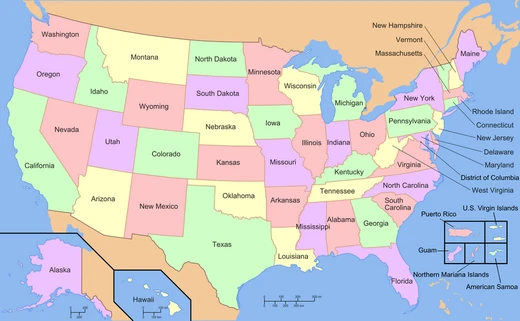
North Carolina
Southern state known for first flight and early independence call.

Carol M. Highsmith · Public domain
North Carolina is a state in the Southeastern and South Atlantic regions of the United States, bordered by Virginia, the Atlantic Ocean, South Carolina, Georgia, and Tennessee. It is the 28th-largest and ninth-most populous state, with a population of 10,439,388 at the 2020 census. Raleigh is the capital, and Charlotte is the most populous city. The state is historically significant as one of the Thirteen Colonies, the site of the first formal call for independence from Great Britain (the Halifax Resolves), and the location of the Wright brothers' first powered flight at Kitty Hawk.
Quick Facts
- Nicknames
- The Tarheel State, The Old North State
- Motto
- la · Esse quam videri "To be, rather than to seem"
- Anthem
- "The Old North State"
- Officiallang
- English
- Languages
- As of 2010 · English 90.70% / Spanish 6.93% / Other 2.73%
- Population Demonym
- North Carolinian (official); / Tarheel (colloquial)
- Largestcity
- Charlotte
- Seat
- Raleigh
- Area Rank
- 28th
- Area Total Sq Mi
- 53819
- Length Mi
- 503
Facts from the source article.
Lore & Background
North Carolina was inhabited for at least 10,000 years, with evidence at the Hardaway Site. Prior to European arrival, the region was home to tribes such as the Cherokee, Tuscarora, and Catawba. The first European exploration of the coast was by Giovanni da Verrazzano in 1524, and later Spanish expeditions under Hernando de Soto (1540) and Juan Pardo (1567) established Fort San Juan at Joara, the first European attempt at colonizing the interior of what became the United States. In the late 16th century, Sir Walter Raleigh sponsored two colonies on Roanoke Island, including the famous 'Lost Colony' of 1587, whose 118 colonists disappeared.
Reader's Guide
North Carolina's significance stems from its role in early American history and innovation. It was one of the Thirteen Colonies, established as a royal colony in 1729. The Halifax Resolves of April 12, 1776, were the first formal call for independence from Great Britain among the American Colonies. The state seceded from the Union on May 20, 1861, joining the Confederacy, and was readmitted on July 4, 1868. In 1903, the Wright brothers achieved the first controlled, sustained powered flight at Kitty Hawk, leading to the state's 'First in Flight' slogan. Today, North Carolina is a major banking center (Charlotte) and home to Research Triangle Park, the largest research park in the United States. Its diverse geography ranges from the Appalachian Mountains to the Atlantic coastal plain.
Did You Know?
- North Carolina's Mount Mitchell at 6,684 ft is the highest point in the eastern United States east of the Mississippi River, but Mount Washington in New Hampshire is higher east of the Black Hills.
- The Charlotte metropolitan area is the second-largest banking center in the United States after New York City.
- The Wright brothers' first powered flight occurred at Kitty Hawk on December 17, 1903.
The Columbian Spark and a Generation of State Symbols
The story of how American states came to carry their own distinctive banners is rooted in a single ambitious event. In 1893, the World's Columbian Exposition opened in Chicago, and it was around this moment that states across the country began seriously considering what unique symbols they could present to the nation. The result was a concentrated wave of flag design and adoption that stretched from that late nineteenth-century fair through the end of the First World War. North Carolina, like its sister states, participated in this broader project of visual self-definition. The flags that emerged from this era carry the fingerprints of regional history and local identity, reflecting a period when the young republic was still solidifying the visual language of its constituent parts. Rather than a single unified design mandate, the outcome was a patchwork of styles, principles, and influences that still defines the landscape of state flags today.
The Shared Grammar of the State Seal
Across the fifty states, a recurring visual convention ties the collection together. A large number of state flags, including those flying over North Carolina, follow a common structural pattern: the official state seal is placed prominently against a single-color field, most often a shade of blue. This seal-on-field approach became the default template for many legislatures seeking a dignified, immediately recognizable emblem without the complexity of elaborate pictorial scenes. The result is a family resemblance that stretches from coast to coast, even as the individual seals themselves encode very different local histories, mottos, and heraldic traditions. Within this shared grammar, each state's specific imagery—its animals, dates, and symbolic objects—becomes the distinguishing feature. For North Carolina, this convention means the flag's identity is carried largely by the details within the seal rather than by a bold background pattern, placing it squarely within the mainstream of American state flag design.
Tribal Sovereignty and the Flags That Fly Within State Borders
North Carolina, like many states, contains land where a different kind of flag authority operates. Native American nations maintain tribal sovereignty, holding jurisdiction over their members and their reserved territories. Although these reservations sit geographically within state boundaries, the state's laws do not automatically extend to them. Federal law, specifically Public Law 83-280, grants certain states the ability to handle criminal and civil cases involving Native Americans on reservations within their borders. Crucially, however, that law draws a firm line: states may not control tribal governments, strip hunting and fishing rights, or impose taxation on residents living inside reservation boundaries. The flags of the largest tribal nations by population and land area thus represent a parallel system of identity and authority, one that exists alongside but independently of the state flag flying over North Carolina's capital.
A Still-Evolving Collection
The collection of American state flags is not a finished artifact. While most were locked in during the 1893-to-1918 window, the landscape continues to shift. Minnesota's flag, adopted on May 11, 2024, is the newest in the set, and the District of Columbia's banner dates to 1938. In recent years, Massachusetts launched a redesign process in 2021, Illinois followed in 2024, and Maine took a proposed new design to voters in November 2024 only to see it rejected at the ballot box. Meanwhile, the broader family of U.S. flags includes the five permanently inhabited territories, the Northern Mariana Islands among them with a banner adopted in 1985, and even the unofficial designs sometimes flown over the Minor Outlying Islands. Before joining the union, California, Texas, and Hawaii each carried the flags of independent nations, and the Utah Territory had its own banner before achieving statehood. North Carolina's flag, like those of its peers, sits within this living, still-mutating tapestry of American civic identity.
Gallery

Frequently Asked Questions
What is North Carolina?
North Carolina is a southeastern U.S. state along the Atlantic coast, bordered by Virginia, South Carolina, Georgia, and Tennessee. It ranks ninth in population with over 10.4 million residents as of the 2020 census, and its capital is Raleigh while Charlotte serves as its largest city.
What role did North Carolina play in early American history?
As one of the original Thirteen Colonies, the state was home to the Halifax Resolves, the first formal colonial declaration calling for independence from Britain. It also hosted the Wright brothers' first successful powered, controlled flight at Kitty Hawk, a defining milestone in aviation.
Where is North Carolina located on the map?
The state sits in the Southeastern and South Atlantic regions of the United States, stretching from the Appalachian Mountains in the west to the Atlantic Ocean in the east. It shares borders with Virginia to the north, South Carolina to the south, and Georgia and Tennessee to the west.
What is North Carolina's highest point?
Mount Mitchell, standing at 6,684 feet (2,037 meters), is the highest peak east of the Mississippi River. It rises in the Blue Ridge Mountains of western North Carolina.
Why is North Carolina considered important?
The state holds a unique place in American history as both the birthplace of the first formal independence call and the site of the first powered flight. Its geographic diversity—spanning high mountains, coastal plains, and open ocean—also makes it one of the most varied states in the country.
More in U.S. States And Territories 1-24
Spotted an error? Know more?
Reader corrections go straight into our review queue. Suggest an edit · How this site is sourced