North Dakota
Landlocked Great Plains state named for the Dakota and Sioux.

TylerKutschbach · CC BY-SA 4.0
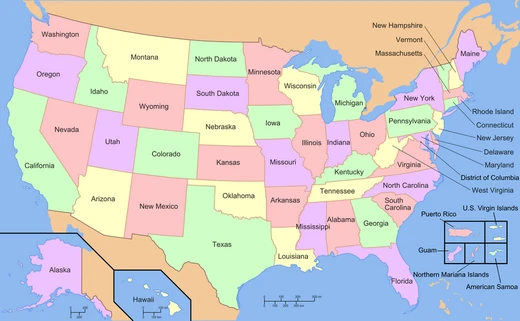
North Dakota sits in the Upper Midwest, a landlocked state named for the Dakota and Sioux peoples. It lies within the Great Plains, a region of broad prairies, steppe, temperate savanna, badlands, and farmland. The state capital is Bismarck, while Fargo is its largest city. Though it ranks 19th in size among U.S. states, its population—under 800,000—makes it the fourth-least populous and sixth-least densely populated. About half of North Dakotans live in rural areas, yet both Bismarck and Fargo are among the fastest-growing cities in the country, with Fargo alone holding roughly one-sixth of the state's residents.
Quick Facts
- Flag Link
- Flag of North Dakota
- Seal Link
- Great Seal of North Dakota
- Nicknames
- Peace Garden State, / Roughrider State, Flickertail State, Heaven on Earth
- Motto
- Liberty and Union, Now and Forever, One and Inseparable / la · Serit ut alteri saeclo prosit / "One sows for the benefit of another age"
- Anthem
- North Dakota Hymn
- Former
- Dakota Territory
- Population Demonym
- North Dakotan
- Capital
- Bismarck
- Largestcity
- Fargo
- Largestcounty
- Cass
- Largestmetro
- Fargo-Moorhead
- Officiallang
- English
Facts from the source article.
Lore & Background
The area of North Dakota was inhabited for thousands of years by Native American tribes, including the Mandan, Hidatsa, and Arikara along the Missouri River; the Ojibwe and Cree in the northeast; and several Sioux groups. European explorers and traders first arrived in the early 18th century, mostly in pursuit of furs. The United States acquired the region in the early 19th century, gradually settling it amid growing resistance by increasingly displaced natives. The Dakota Territory, established in 1861, became central to American pioneers, with the Homestead Act of 1862 precipitating significant population growth and development.
Reader's Guide
North Dakota's significance lies in its role as a frontier agricultural powerhouse and later as an energy producer. The Dakota Boom of 1878 to 1886 saw giant farms stretch across the rolling prairies, making the territory a regional economic power. The state's political legacy includes the Non Partisan League, which established the nation's only state-run bank, the Bank of North Dakota, and the state-owned North Dakota Mill and Elevator. Beginning in the mid-20th century, oil extraction from the Bakken formation in the northwest became critical to economic development, leading to population growth and reduced unemployment. North Dakota is believed to contain North America's geographic center, in Rugby, and is home to what was once the tallest artificial structure in the Western Hemisphere, the KVLY-TV mast.
Did You Know?
- The Bank of North Dakota is the only state-run bank in the United States.
- The KVLY-TV mast in North Dakota was once the tallest artificial structure in the Western Hemisphere.
- Rugby, North Dakota, is believed to contain the geographic center of North America.
Origins in the Columbian Era
The modern era of American state flag design traces back to the 1893 World's Columbian Exposition held in Chicago, Illinois. When states began considering distinctive symbols for that landmark event, it sparked a wave of flag creation that would define the visual identity of each state for generations. The vast majority of state flags across the country were designed and formally adopted during the period stretching from 1893 through the end of World War I. This concentrated burst of creative activity means that most states, including North Dakota, received their official banners during this roughly two-decade window. The flags that emerged from this era carry the design sensibilities and regional pride of the early twentieth century, reflecting local histories and the particular influences that shaped each state's identity at the time of adoption.
The Seal-and-Field Convention
A dominant visual pattern unites many state flags across the country: the state seal placed prominently atop a single-color background, most frequently a shade of blue. This straightforward design principle, combining an official emblem with a monochrome field, appears in a large number of state banners and creates a recognizable family resemblance among the flags of the fifty states. North Dakota's flag fits within this broader tradition of using the state seal as the central design element. The result is a collection of flags that, while each carrying unique local symbols and histories, share a common structural language. This convention makes it easy to identify a state flag at a glance, even as the specific imagery within each seal tells a distinct regional story. The prevalence of blue as the background color further reinforces the visual cohesion of the national collection.
A Living Collection: Redesigns and New Adoptions
The state flag landscape is far from static. Minnesota's flag, adopted on May 11, 2024, stands as the most recently created state banner in the nation. Meanwhile, Massachusetts launched a redesign process through legislation in 2021, and Illinois followed with its own redesign initiative in 2024. Maine took a different path, placing a proposed flag redesign directly on the ballot in November 2024, where voters ultimately rejected the new design in a referendum. These recent developments demonstrate that state flags remain subjects of active public deliberation and political engagement. The District of Columbia's flag, adopted in 1938, and the Northern Mariana Islands' territorial flag, adopted on July 1, 1985, illustrate that the broader system of American governmental flags continues to evolve well beyond the original 1893-to-World War I wave.
Beyond the Fifty: Territories, Tribes, and Pre-Statehood Banners
The American flag ecosystem extends well beyond the fifty state banners. Five permanently inhabited territories each maintain their own official flags, while the District of Columbia flies its own, adopted in 1938. Before joining the Union, California, Texas, and Hawaii existed as independent nations with their own flags, and the Utah Territory likewise carried a banner prior to achieving statehood. Native American nations exercise tribal sovereignty over their members and reserved lands, and while reservations sit on state soil, state laws do not automatically apply there. Public Law 83-280 grants certain states authority over court cases involving Native Americans on reservations, yet explicitly prohibits those states from controlling tribal governments, stripping hunting and fishing rights, or taxing reservation residents. Additionally, the United States Minor Outlying Islands use the national flag as their official banner, though unofficial flags sometimes appear to represent specific insular areas.
Gallery
Frequently Asked Questions
What is North Dakota?
North Dakota is a landlocked state in the Upper Midwest, set within the Great Plains region of broad prairies, steppe, and farmland. It takes its name from the Dakota and Sioux peoples who originally inhabited the area.
What is North Dakota's capital and largest city?
Bismarck serves as the state capital, while Fargo is the largest city and home to roughly one-sixth of all residents. Both cities rank among the fastest-growing in the entire country.
How populous is North Dakota?
With fewer than 800,000 people, North Dakota is the fourth-least populous state in the union. About half of its residents live in rural areas, and it ranks sixth-least densely populated.
What is North Dakota's geographic role?
The state occupies a wide stretch of the Upper Midwest, encompassing temperate savanna, badlands, and extensive farmland. It ranks 19th in total area among all U.S. states.
Why is North Dakota important?
North Dakota stands out as one of the most sparsely settled yet rapidly urbanizing corners of the American interior, with Bismarck and Fargo growing faster than most cities nationwide. Its identity as a landlocked prairie state named for Indigenous peoples gives it a distinct place in the national landscape.
More in U.S. States And Territories 1-24
Spotted an error? Know more?
Reader corrections go straight into our review queue. Suggest an edit · How this site is sourced