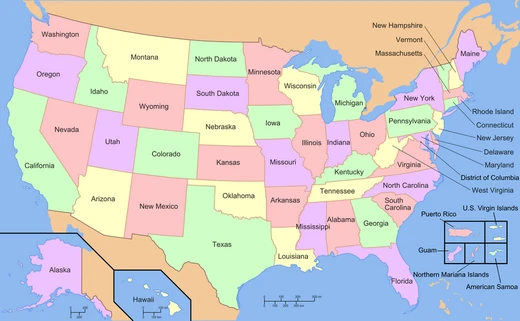
Oklahoma
A state shaped by land runs, oil, and Indigenous heritage.

TylerKutschbach · CC BY-SA 4.0
Oklahoma is a landlocked state located where the South Central, Southern, and Southwestern regions of the United States meet. It shares borders with Texas to the southwest, Kansas to the north, Missouri to the northeast, Arkansas to the southeast, New Mexico to the west, and Colorado to the northwest. Part of the western edge of the Upland South, it ranks as the 20th-largest state by area and the 28th-most populous. People from Oklahoma are called Oklahomans, and the capital and biggest city is Oklahoma City. The state’s name comes from the Choctaw words *okla* (people) and *humma* (red). Its nickname, “The Sooner State,” refers to the Sooners—American settlers who claimed land in former American Indian territories before the Indian Appropriations Act of 1889 authorized the Land Rush of 1889, opening the area for settlement. Oklahoma features ancient mountain ranges, prairies, mesas, and eastern forests. Most of the state lies within the Great Plains, the Cross Timbers, and the U.S. Interior Highlands—regions known for severe weather. It sits at a crossroads of three major American cultural regions. Historically, it was a government-designated territory for American Indians forcibly relocated from east of the Mississippi River, a route for cattle drives from Texas and nearby areas, and a destination for Southern settlers. Today, 25 Indigenous languages are spoken in Oklahoma. According to the 2020 U.S. census, 14.2 percent of Oklahomans identify as American Indian, the highest percentage of any state. The state is a major producer of natural gas, oil, and agricultural goods, with an economy built on aviation, energy, telecommunications, and biotechnology. Oklahoma City and Tulsa are the main economic centers, and nearly two-thirds of Oklahomans live in their metropolitan areas. The name Oklahoma comes from the Choctaw phrase *okla humma* (red people). Choctaw Nation Chief Allen Wright suggested the name in 1865 during treaty negotiations with the U.S. government about the use of Indian Territory. He envisioned an all-American Indian state under the federal Bureau of Indian Affairs. A painting of the 1865 Council now hangs in the Oklahoma Senate. The name later became the de facto name for Oklahoma Territory and was officially approved in 1890, two years after the area was opened to settlers. History *Pre-Columbian* Indigenous peoples lived in what is now Oklahoma by the last ice age. Ancestors of the Wichita and Affiliated Tribes (including Teyas, Escanjaques, and Tawakoni), the Tonkawa, and the Caddo (including Kichai) inhabited the area. Southern Plains villagers lived in the central and western parts of the state, with a subgroup called the Panhandle culture people in the panhandle. Caddoan Mississippian culture peoples lived in the east. The Spiro Mounds, near present-day Spiro, Oklahoma, were a major Mississippian mound complex that thrived from around AD 850 to 1450. Plains Apache people settled in the Southern Plains and Oklahoma between 1300 and 1500. *European exploration and colonization* Spanish explorer Francisco Vázquez de Coronado traveled through the area in 1541, but French explorers claimed it in the early 1700s. By the 18th century, Comanche and Kiowa peoples entered from the west, while Quapaw and Osage peoples moved into what is now eastern Oklahoma. French colonists held the region until 1803, when the United States acquired all French territory west of the Mississippi River through the Louisiana Purchase. The area was part of the Arkansas Territory from 1819 to 1828. *19th century* In the 1800s, the U.S. government forcibly removed tens of thousands of American Indians from their ancestral homelands across North America and relocated them to the area that includes present-day Oklahoma. The Choctaw were the first of the Five Civilized Tribes to be removed from the Southeastern United States. The phrase “Trail of Tears” originated from a description of the Choctaw Nation’s removal in 1831, though it is usually associated with the Cherokee removal. Seventeen thousand Cherokees and 2,000 of their Black slaves were deported. The area, already home to Osage and Quapaw tribes, was called the Choctaw Nation until revised policies redefined boundaries to include other Native Americans. By 1890, more than 30 Native American nations and tribes had been concentrated in Indian Territory. All Five Civilized Tribes signed treaties with the Confederate military during the American Civil War, and the Cherokee Nation experienced an internal civil war. Slavery in Indian Territory was not abolished until 1866. Between 1866 and 1899, Texas cattle ranches sought to meet food demands in eastern cities, and railroads in Kansas promised timely delivery. Cattle trails and ranches developed as cowboys drove herds north or settled illegally in Indian Territory. By 1881, four of the five major cattle trails on the western frontier passed through Indian Territory. As white settlers arrived in Indian Territory and demanded land guaranteed to Indian tribes by treaties, the U.S. government passed the Dawes Act in 1887 and the Curtis Act in 1898. These acts abolished tribal governments, ended tribal land ownership, and allotted 160 acres to each head of an Indian family. A goal of the acts was the forced assimilation of Indians into white society. Land not allotted to individuals was owned by the U.S. government and sold or given to settlers and railroads.
Quick Facts
- Native Name
- cho · Oklahumma / chr · ᎣᎦᎳᎰᎹ
- Flag Link
- Flag of Oklahoma
- Seal Link
- Great Seal of Oklahoma
- Nickname
- Native America (official) · Land of the Red Man · Sooner State
- Motto
- la · Labor omnia vincit / (English: "Work conquers all")
- Anthem
- "Oklahoma" and / "Oklahoma Hills"
- Officiallang
- English, Choctaw, CherokeeChoctaw official within Choctaw Nation, Cherokee official within Cherokee Nation and UKB
- Population Demonym
- Oklahoman; / Okie (colloq., historically derogatory); / Sooner (historically)
- Seat
- Oklahoma City
- Largestcity
- capital
- Largestcounty
- Oklahoma
- Largestmetro
- Greater Oklahoma City
Facts from the source article.
Lore & Background
The name Oklahoma was suggested in 1865 by Choctaw Nation Chief Allen Wright during treaty negotiations, envisioning an all-exclusive American Indian state. The area was originally Indian Territory, where tens of thousands of American Indians were forcibly removed during the 19th century, including the Choctaw on the Trail of Tears. By 1890, more than 30 Native American nations had been concentrated there. The Dawes Act of 1887 and Curtis Act of 1898 abolished tribal governments and allotted land to individual Indians, with unallotted land sold to settlers, leading to land runs such as the Land Rush of 1889. Those who crossed the border early were called 'sooners,' giving the state its nickname.
Reader's Guide
Oklahoma's significance lies in its role as a crossroads of American Indian, Southern, and Western cultures. It was a government-sanctioned territory for displaced Indigenous peoples, a route for cattle drives from Texas, and a destination for Southern settlers. The state's economy grew rapidly with oil discoveries, making Tulsa the 'Oil Capital of the World' for much of the 20th century. Today, Oklahoma is a major producer of natural gas, oil, and agricultural products, with an economic base in aviation, energy, telecommunications, and biotechnology. Its population includes the highest percentage of American Indians of any state, and 25 Indigenous languages are still spoken. The failed Sequoyah Statehood Convention of 1905 laid groundwork for Oklahoma's statehood in 1907.
Did You Know?
- The Land Rush of 1889 opened formerly American Indian-owned lands to settlers, leading to the term 'Sooners.'
- Oklahoma has the highest percentage of American Indian residents of any U.S. state, at 14.2%.
- Cyrus Avery, known as the 'Father of Route 66,' was an Oklahoman who helped create U.S. Route 66.
The Great Plains Gap (1854–1890)
The Kansas–Nebraska Act of 1854 brought organized government to the central plains by creating the Kansas and Nebraska Territories, a move that left the Indian Territory as the sole unorganized territory in the entire Great Plains. For nearly four decades, this vast stretch of land existed in a constitutional limbo—under federal sovereignty but without the structured self-governance that an organic act would provide. The territory's unorganized status meant it lacked the formal governmental powers granted to organized territories, existing in a kind of administrative suspension. This period of unorganized governance persisted until 1890, when Congress finally acted to organize the western half of the Indian Territory as Oklahoma Territory, marking the first concrete step toward the political structure that would eventually produce a new state.
Two Territories, One State (1890–1907)
When the western half of the Indian Territory was organized as Oklahoma Territory in 1890, the eastern half was left behind in unorganized status. This created a distinctive dual-territory situation within what would become a single state. The eastern portion remained without the structured self-governance that an organic act would confer, persisting in what the historical record describes as an unorganized condition. For seventeen years, the two halves of future Oklahoma existed under different administrative frameworks—one organized, one not. The resolution came in 1907, when Congress joined the two territories together to form the State of Oklahoma. This merger of an organized and an unorganized territory into a single sovereign state represents a distinctive path in the nation's expansion, requiring the unorganized eastern half to be brought into full constitutional alignment before statehood could be granted.
Constitutional Architecture of Territorial Power
Oklahoma's journey from unorganized Indian Territory to statehood was governed by the Territorial Clause in Article IV, Section 3 of the U.S. Constitution. Under this framework, territories are not inherently sovereign entities; their self-governing powers derive entirely from the plenary authority of Congress. An organized territory receives its governmental structure through an organic act passed by Congress, subject to Congress's ongoing power to modify or revoke those arrangements. This stands in sharp contrast to states, which possess dual sovereignty, and to Native American tribes, which hold tribal sovereignty. Oklahoma Territory, once organized in 1890, operated under this congressional delegation of authority as an organized and incorporated territory, meaning the full U.S. Constitution applied to its residents. This constitutional architecture—where ultimate power rests with the federal legislature rather than the territory itself—shaped every aspect of Oklahoma's pre-statehood governance and ultimately its admission into the Union.
Oklahoma in the Pattern of Territorial Transitions
Oklahoma's seventeen-year span from organized territory to statehood (1890 to 1907) places it within a broader national pattern. Historically, territories were created to administer newly acquired land, and most eventually attained statehood. As the United States grew, the most populous portions of organized territories would achieve statehood, while other areas remained in territorial status. Some territories lasted only briefly—Alabama Territory existed for just two years—while others endured for over half a century, as New Mexico Territory and Hawaii Territory did. Oklahoma's timeline sits between these extremes, reflecting a region that moved relatively quickly from organization to statehood. Of the fifty current states, thirty-one were once part of an organized, incorporated U.S. territory. Oklahoma joins that group, its statehood in 1907 representing one of the later entries in a sequence that continued until Hawaii's admission on August 21, 1959, making it the most recent territory to become a state.
Gallery
Frequently Asked Questions
Who is Oklahoma?
Oklahoma is a landlocked state situated across the South Central, Southern, and Southwestern regions of the United States, admitted as the 46th state on November 16, 1907. Its name blends the Choctaw words okla ('people') and humma ('red'), and it is widely known by the nickname 'The Sooner State.'
What is Oklahoma known for?
Oklahoma's defining strengths come from three intertwined forces: the dramatic land rushes that filled its plains with settlers, a major oil industry that powered its economy, and the rich Indigenous heritage of the tribes who originally called the region home. It also functions as a cultural crossroads linking Southern, Southwestern, and South Central American traditions.
Why is Oklahoma important?
Oklahoma holds a distinctive place in the American story because it compressed Western frontier expansion, a transformative energy boom, and deep Native American history into a single, relatively young state. Its land runs and oil surge in the early twentieth century rippled outward, shaping national economic and social patterns well beyond its borders.
What is Oklahoma's origin story?
The territory that would become Oklahoma was opened to settlers through a series of federal land rushes in the late 1800s, after long periods of restricted access. Following a stretch as a U.S. territory, it was granted full statehood in 1907, making it the last contiguous state to enter the Union.
More in U.S. States And Territories 1-24
Spotted an error? Know more?
Reader corrections go straight into our review queue. Suggest an edit · How this site is sourced