Montana
Big Sky Country

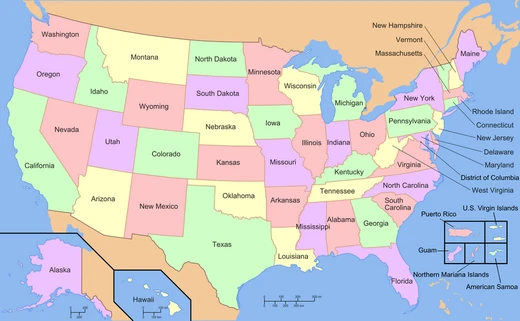
Montana is a landlocked state in the Mountain West region of the western United States. Its neighbors are Idaho on the west, North Dakota on the east, South Dakota to the southeast, Wyoming to the south, and the Canadian provinces of Alberta, British Columbia, and Saskatchewan to the north. By area, it ranks as the fourth-largest state, yet it is the eighth-least populous and the third-least densely populated. Helena serves as the capital, while Billings is the largest city. The western half of the state is dominated by mountain ranges, especially the Rockies, whereas the eastern half consists of prairie and badlands, with smaller mountain ranges scattered throughout.
The United States gained most of Montana through the Louisiana Purchase from France in 1803, and the Lewis and Clark Expedition explored it soon after. Fur trappers followed, and their trade was the main economic activity until gold was found in 1858. That discovery sparked a gold rush, and the Homestead Acts of 1862 drew many American settlers. Rapid growth led to statehood on November 8, 1889. Mining, especially around Butte and Helena, remained the state's economic backbone until the mid-20th century.
Montana has no official nickname, though it is often called "Big Sky Country," "The Treasure State," "Land of the Shining Mountains," and "The Last Best Place." Its economy relies on agriculture, including ranching and cereal grain farming, along with oil, gas, coal, mining, and lumber. Health care, service, defense, and government sectors are also important. Tourism is the fastest-growing industry, drawing 12.6 million visitors in 2019 and a record 13.7 million in 2024.
The name "Montana" comes from the Spanish word *montaña*, from the Latin *montanus*, meaning "mountain" or "mountainous country." Early Spanish explorers called the entire mountainous western region "Montaña del Norte." The name was first added to a bill in 1863 by the U.S. House Committee on Territories, chaired by James Ashley of Ohio, for the territory that would become Idaho. Representatives Henry Wilson and Benjamin F. Harding objected, arguing "Montana" had "no meaning," and suggested alternatives like Jefferson. When Ashley proposed a new territory carved from Idaho in 1864, he again chose Montana. Representative Samuel Cox, also of Ohio, objected, saying the name was a misnomer because most of the territory was not mountainous and preferred a Native American name over a Spanish one. Other names, such as Shoshone, were proposed, but the Committee on Territories decided they had the authority to choose, so Montana was adopted.
For thousands of years, indigenous peoples lived in what is now Montana. Historic tribes encountered by Europeans and American settlers included the Crow in the south-central area, the Cheyenne and Lakota in the southeast, the Blackfeet, Assiniboine, and Gros Ventres in the central and north-central area, and the Kootenai and Salish (also called Séliš or Flathead) in the west. The Ql̓ispé (Pend d'Oreilles) and Kalispel tribes lived near Flathead Lake and the western mountains. A corridor in southeastern Montana was used by the Crows and related Hidatsas in North Dakota.
All land east of the Continental Divide in Montana, part of the Missouri River watershed, was included in the Louisiana Purchase of 1803, except for a small northeastern portion draining into Hudson Bay. After the Lewis and Clark Expedition, European, Canadian, and American traders operated a fur trade with indigenous peoples in both the western and eastern parts of the area. While this interaction was often profitable, conflicts arose when indigenous interests were threatened, such as the clash between American trappers and the Blackfeet. Diseases introduced by fur traders also devastated indigenous populations. Fort Raymond, a trading post, was built in Crow territory in 1807. Until the Oregon Treaty of 1846, land west of the continental divide was disputed between Britain and the U.S., known as the Oregon Country. The first permanent Euro-American settlement in Montana was St. Mary's, established in 1841 near present-day Stevensville. Fort Benton, built in 1847, was the highest fur-trading post on the Missouri River. In the 1850s, settlers moved into the Beaverhead and Big Hole valleys from the Oregon Trail and into the Clark's Fork valley.
Gold was first discovered in Montana at Gold Creek near present-day Garrison in 1852, but the gold rush began in earnest in 1862. Major mineral discoveries of gold, silver, copper, lead, coal, and later oil drew tens of thousands of miners to the western part of the state. The richest gold placer diggings were at Alder Gulch, where Virginia City was founded. Other rich deposits were found at Last Chance Gulch (now Helena), Confederate Gulch, Silver Bow, and Emigrant Gulch.
Quick Facts
- Flag Link
- Flag of Montana
- Seal Link
- Seal of Montana
- Anthem
- "Montana"
- Nicknames
- Big Sky Country, The Treasure State
- Former
- Montana Territory
- Population Demonym
- Montanan
- Seat
- Helena
- Officiallang
- English
- Largestcity
- Billings
- Largestcounty
- Yellowstone
- Governor
- Greg Gianforte (R)
- Lieutenant Governor
- Kristen Juras (R)
Facts from the source article.
Lore & Background
Most of Montana came under American sovereignty with the Louisiana Purchase from France in 1803 and was explored by the Lewis and Clark Expedition shortly thereafter. Fur trappers followed and were the main economic activity in the area until gold was discovered in 1858. The ensuing gold rush, along with the passage of the Homestead Acts in 1862, brought large numbers of American settlers to Montana. Rapid population growth and development culminated in statehood on November 8, 1889. Mining, particularly around Butte and Helena, would remain the state's main economic engine through the mid-20th century. The name 'Montana' comes from the Spanish word 'montaña', which in turn comes from the Latin word 'montanus', meaning 'mountain' or more broadly 'mountainous country'. The name was added in 1863 to a bill by the United States House Committee on Territories for the territory that would become Idaho Territory, and was later adopted for Montana Territory in 1864.
Reader's Guide
Montana has no official nickname but several unofficial ones, most notably 'Big Sky Country', 'The Treasure State', 'Land of the Shining Mountains', and 'The Last Best Place'. Its economy is primarily based on agriculture, including ranching and cereal grain farming. Other significant economic resources include oil, gas, coal, mining, and lumber. The health care, service, defense, and government sectors are also significant to the state's economy. Montana's fastest-growing sector is tourism, with 12.6 million tourists visiting the state each year as of 2019. In 2024 the number reached 13.7 million, the highest ever.
Did You Know?
- Montana is the fourth-largest state by area but the eighth-least populous.
- The first gold discovered in Montana was at Gold Creek near present-day Garrison in 1852.
- The Montana Historical Society, founded on February 2, 1865, in Virginia City, is the oldest such institution west of the Mississippi (excluding Louisiana).
Frequently Asked Questions
Who is Montana?
Montana is a landlocked state in the Mountain West region of the western United States, widely nicknamed Big Sky Country. It holds the unusual distinction of being the fourth-largest state by area while simultaneously ranking as the eighth-least populous and third-least densely populated.
What is Montana known for?
Its western half is dominated by the Rocky Mountains, while its eastern half stretches across broad prairie and badlands terrain with smaller ranges scattered throughout. This dramatic geographic contrast positions the state as a natural crossroads between the mountainous and plains regions of the country.
Why is Montana important?
The United States acquired most of the territory that would become Montana through the Louisiana Purchase, making it a foundational piece of the nation's westward expansion. Its vast, sparsely populated landscape has long come to symbolize the American frontier.
What is Montana's origin story?
The U.S. gained control over the majority of present-day Montana territory via the Louisiana Purchase from France. The region then went through decades of territorial development and settlement before finally earning its place as a full state in 1889.
More in U.S. States And Territories 1-24
Spotted an error? Know more?
Reader corrections go straight into our review queue. Suggest an edit · How this site is sourced