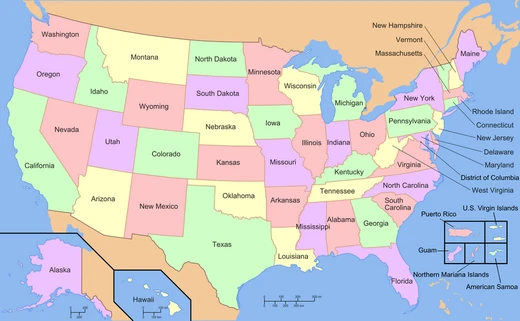
Utah
A landlocked state shaped by Mormon settlement and desert geography.

Utah is a landlocked state in the Mountain West subregion of the Western United States, one of the Four Corners states. It was inhabited for thousands of years by Indigenous peoples, including the ancient Puebloans, Navajo, and Ute, and first explored by the Spanish in the mid-16th century. After the Mexican–American War, the region was annexed by the U.S. in 1848, and following disputes over polygamy, it was admitted as the 45th state in 1896. Utah is notable for being the only state where a majority of the population belongs to a single church, the Church of Jesus Christ of Latter-day Saints, which has its world headquarters in Salt Lake City and greatly influences the state's culture, politics, and daily life.
Quick Facts
- Flag Link
- Flag of Utah
- Nicknames
- "Beehive State" (official), "The Mormon State", "Deseret"
- Anthem
- "Utah...This Is the Place" / "Utah, We Love Thee"
- Motto
- Industry
- Former
- Utah Territory
- Seat
- Salt Lake City
- Largestcity
- capital
- Largestcounty
- Salt Lake
- Governor
- Spencer Cox (R)
- Lieutenant Governor
- Deidre Henderson (R)
- Legislature
- State Legislature
- Upperhouse
- State Senate
Facts from the source article.
Lore & Background
Utah has been inhabited for thousands of years by various Indigenous peoples, such as the ancient Puebloans, the Navajo, and the Ute. The first Europeans to arrive were the Spanish in the mid-16th century. Because of the region's challenging geography and harsh climate, it only became a peripheral part of New Spain and later Mexico. Even while it was Mexican territory, many of the Utah region's earliest European settlers were from the United States, notably Mormons fleeing persecution who arrived via the Mormon Trail. In 1848, after the Mexican–American War, the region was annexed by the U.S., becoming part of the Utah Territory. Disputes between the dominant Mormon community and Congress delayed statehood until 1896, after it agreed to outlaw polygamy.
The first group of Mormon pioneers, led by Brigham Young, reached the Salt Lake Valley on July 24, 1847. Over the next 22 years, more than 70,000 pioneers crossed the plains and settled in Utah. The arid desert land was deemed desirable by the Mormons as a place where they could practice their religion without harassment. The first group of settlers brought three African slaves with them, making Utah one of several places in the western United States to have African slavery, alongside California and Texas. Mormon settlements provided pioneers for other settlements throughout the West, including in Las Vegas, Nevada; San Bernardino, California; and Mesa, Arizona.
Reader's Guide
Utah's significance lies in its unique religious and cultural identity as the center of the LDS Church, which has shaped its politics, daily life, and growth. The state has a highly diversified economy, with major sectors including transportation, education, information technology, mining, and tourism. Since 2000, Utah has been one of the fastest growing states, with the 2020 census confirming the fastest population growth in the nation since 2010. It has the 12th-highest median average income and the least income inequality of any U.S. state. However, over time and influenced by climate change, droughts in Utah have been increasing in frequency and severity, straining water security and impacting the economy. The state's urban development is mostly concentrated in the Wasatch Front, home to roughly two-thirds of the population, and Washington County in the southwest. Utah's legacy includes its role as a refuge for Mormons, its complex history with Indigenous peoples and slavery, and its ongoing transformation into a more religiously diverse and secular society since the 1990s.
Did You Know?
- The first group of Mormon settlers brought three African slaves with them in 1847.
- Utah was admitted as the 45th state in 1896 after agreeing to outlaw polygamy.
- The name 'Utah' is derived from the Spanish 'Yuta,' referring to the Ute tribe, and is commonly said to mean 'people of the mountains.'
More in U.S. States And Territories 1-24
Spotted an error? Know more?
Reader corrections go straight into our review queue. Suggest an edit · How this site is sourced