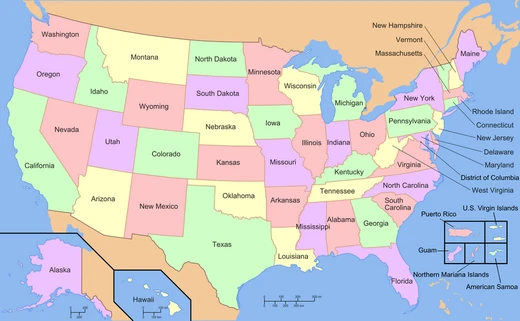
South Dakota
State named after the Dakota Sioux, admitted in 1889.

South Dakota is a landlocked state in the North Central United States, situated within the Great Plains. Its name honors the Dakota Sioux tribe, which has historically been the dominant group in the region and still makes up a significant part of the population. By area, it ranks 17th among the states, but it is the fifth-least populous and the fifth-least densely populated. The capital is Pierre, while Sioux Falls, with roughly 213,900 residents, is the largest city. The Missouri River splits the state into two distinct halves, commonly called "East River" and "West River," which differ in geography and social character. South Dakota shares borders with North Dakota to the north, Minnesota to the east, Iowa to the southeast, Nebraska to the south, Wyoming to the west, and Montana to the northwest. People have lived in the area for thousands of years. The Sioux became the dominant group by the early 1800s. In the late 1800s, European-American settlement surged following a gold rush in the Black Hills and the arrival of railroads from the east. This influx of miners and settlers sparked a series of Indian wars, which ended with the Wounded Knee Massacre in 1890. South Dakota entered the Union on November 2, 1889, as the southern part of the former Dakota Territory, at the same time as North Dakota. They are the 39th and 40th states; President Benjamin Harrison shuffled the statehood papers before signing them, so the order of admission is unknown. Key 20th-century events included the Dust Bowl and Great Depression, increased federal spending on agriculture and defense during the 1940s and 1950s, and the industrialization of agriculture, which reduced the number of family farms. Most of the population lives in eastern South Dakota, where fertile soil supports a variety of crops. West of the Missouri River, ranching is the main agricultural activity, and the economy relies more on tourism and defense spending. Most Native American reservations are located in West River. The Black Hills, a range of pine-covered mountains sacred to the Sioux, lie in the southwestern part of the state and contain Mount Rushmore, a major tourist attraction. The climate is temperate continental, with four distinct seasons; precipitation ranges from moderate in the east to semiarid in the west. The state’s ecology includes species typical of a North American grassland biome. Although several Democrats have served multiple terms in Congress from South Dakota, the state government is largely controlled by the Republican Party, whose presidential candidates have won the state in the last 14 elections. Historically centered on agriculture and a rural lifestyle, South Dakota has recently worked to diversify its economy to attract and keep residents. Its history and rural character continue to shape its culture. Humans have inhabited what is now South Dakota for several thousand years. The first inhabitants were Paleoindian hunter-gatherers, who disappeared from the area around 5000 BC. Between 500 AD and 800 AD, a semi-nomadic people known as the Mound Builders lived in central and eastern South Dakota. In the 14th century, the Crow Creek Massacre occurred, killing several hundred men, women, and children near the Missouri River. By 1500, the Arikara (or Ree) had settled much of the Missouri River valley. European contact began in 1743, when the LaVérendrye brothers explored the region and buried a plate near modern-day Pierre, claiming it for France as part of greater Louisiana. In 1762, the area became part of Spanish Louisiana until 1802. By the early 1800s, the Sioux had largely replaced the Arikara as the dominant group. In 1803, the United States bought the Louisiana Territory—which included most of South Dakota—from Napoleon Bonaparte. President Thomas Jefferson then organized the Lewis and Clark Expedition to explore the region. In 1817, an American fur trading post was established at present-day Fort Pierre, marking the start of continuous American settlement. In 1855, the U.S. Army purchased Fort Pierre but abandoned it in 1857 in favor of Fort Randall to the south. By 1858, the Yankton Sioux signed a treaty ceding most of eastern South Dakota to the United States. Land speculators founded Sioux Falls in 1856 and Yankton in 1859. The U.S. government created Dakota Territory in 1861, which initially included both Dakotas and parts of Montana and Wyoming. Settlement—mostly by people from the eastern U.S. and from western and northern Europe—accelerated after the Homestead Acts and especially after a railway link reached Yankton in 1873, a period called the Dakota Boom. In 1874, gold was discovered in the Black Hills during a military expedition led by George A. Custer, and miners and explorers began illegally entering land promised to the Lakota. This happened despite the 1868 Treaty of Laramie, which had granted the Sioux the entire western half of present-day South Dakota as part of the Great Sioux Reservation. The Sioux refused to grant mining rights or land in the Black Hills, and war broke out after the U.S. failed to stop white miners and settlers from entering the region. The U.S. eventually won and broke up the Great Sioux Reservation into five separate reservations.
Quick Facts
- Native Name
- dak · Dakȟóta itókaga
- Flag Link
- Flag of South Dakota
- Nickname
- The Mount Rushmore State (official)
- Motto
- Under God, the People Rule
- Anthem
- "Hail, South Dakota!"
- Former
- Dakota Territory
- Seat
- Pierre
- Officiallang
- English, Sioux (official indigenous language)
- Languages
- English, Spanish (2.06%), Dakota (1.39%), German (1.37%)
- Population Demonym
- South Dakotan
- Largestcity
- Sioux Falls
- Governor
- Larry Rhoden (R)
Facts from the source article.
Lore & Background
Humans have inhabited the area for several millennia, with the Sioux becoming dominant by the early 19th century. European contact began in 1743 when the LaVérendrye brothers explored and claimed the region for France. The United States acquired the area through the Louisiana Purchase in 1803, and American settlement intensified after a gold rush in the Black Hills and railroad construction in the late 19th century, leading to Indian wars ending with the Wounded Knee Massacre in 1890.
Reader's Guide
South Dakota's significance lies in its dual identity as both a Plains agricultural state and a site of major Native American history. The Missouri River divides the state into East River (fertile cropland, higher population) and West River (ranching, tourism, and most Native American reservations). The Black Hills contain Mount Rushmore, a major tourist destination. The state's history includes the Dust Bowl and Great Depression, which caused population decline, followed by economic recovery during World War II. Politically, South Dakota has voted Republican in the last 14 presidential elections, though Democrats have held congressional seats. Its rural character and agricultural economy remain central, though diversification efforts are underway.
Frequently Asked Questions
Who is South Dakota?
South Dakota is a landlocked state nestled in the North Central region of the United States, stretching across the Great Plains. It took its name from the Dakota Sioux people who historically called that land home.
When did South Dakota become a state?
South Dakota was admitted to the Union on November 2, 1889, officially taking the 40th spot among the states. It joined at the very same moment as North Dakota, which was designated the 39th.
Why is South Dakota's admission order a mystery?
Because South Dakota and North Dakota were admitted on the exact same day in 1889, no official record was ever kept of which one technically came first. This little quirk has made the pair a perennial favorite in statehood trivia circles.
What geographic region does South Dakota belong to?
South Dakota sits squarely within the North Central region of the country, covering a broad expanse of the Great Plains. Being landlocked, it shares no coastline with any ocean or sea.
Why is South Dakota important?
South Dakota's very name preserves the legacy of the Dakota Sioux tribe in the nation's geography, making it a living tribute to Indigenous history. Its simultaneous admission alongside North Dakota also makes it a uniquely shared moment in the story of American statehood.
More in U.S. States And Territories 1-24
Spotted an error? Know more?
Reader corrections go straight into our review queue. Suggest an edit · How this site is sourced