South Carolina
Southern state, original colony, first to secede in 1860.

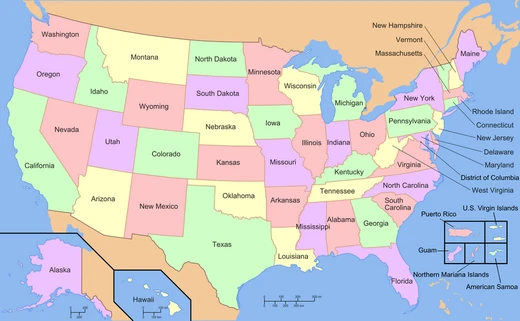
South Carolina is a state located in the southeastern United States, within the South Atlantic and Deep South regions. It shares a northern and northeastern border with North Carolina, a southeastern coastline along the Atlantic Ocean, and a western and southern boundary with Georgia, defined by the Savannah River. Together with North Carolina, it forms the Carolinas region of the East Coast. It ranks as the 11th-smallest state by area and the 23rd-most populous, with an estimated 5.5 million residents as of 2025. The state is divided into 46 counties. Columbia serves as the capital, while Charleston is the largest city. Other major urban areas include the Upstate—the state’s largest metropolitan region, containing Greenville and Spartanburg—as well as Myrtle Beach.
The state’s name honors King Charles II of England, who granted the colonial charter; “Carolus” is Latin for “Charles.” The Province of South Carolina was formally divided from North Carolina in 1729, though it had been governed separately since 1712. As one of the original Thirteen Colonies, it became a royal colony in 1719. During the American Revolutionary War, South Carolina saw heavy action, with over 200 battles and skirmishes taking place within its borders. It became the eighth state to ratify the U.S. Constitution, on May 23, 1788.
A slave state, South Carolina was the first to vote for secession from the United States in 1860. After joining the Confederacy during the American Civil War, it was readmitted to the Union in 1868. In the early to mid-20th century, the state began to experience economic growth as numerous textile mills and factories were built. The civil rights movement of the mid-20th century helped end segregation and legal discrimination within the state. Economic diversification accelerated during and after World War II.
By the early 21st century, South Carolina’s economy relies on aerospace, agribusiness, automotive manufacturing, and tourism. In 2019, its GDP reached $213.45 billion. From east to west, the state contains three main geographic regions: the Atlantic coastal plain, the Piedmont, and the Blue Ridge Mountains in the northwestern corner of the Upstate. The climate is primarily humid subtropical, with hot, humid summers and mild winters; areas in the Upstate have a subtropical highland climate.
Quick Facts
- Flag Link
- Flag of South Carolina
- Nickname
- The Palmetto State
- Motto
- la · Dum spiro spero / "While I breathe, I hope" / and / la · Animis opibusque parati / "Prepared in mind and resources"
- Anthem
- "Carolina" / and / "South Carolina on my Mind"
- Former
- Province of South Carolina
- Seat
- Columbia
- Largestcity
- Charleston
- Largestmetro
- Greenville (combined and metro) / Columbia (urban)
- Officiallang
- English
- Languages
- English 93.82% / Spanish 4.62 % / German 0.26% / Chinese 0.25% / French 0.23% / Tagalog 0.18% / Vietnamese 0.16% / Russian 0.15% / Portuguese 0.12% / Hindi 0.11% / Gujarati 0.10%
- Population Demonym
- South Carolinian
- Governor
- Henry McMaster (R)
Facts from the source article.
Lore & Background
South Carolina was named for King Charles II of England, with Carolus meaning 'Charles' in Latin. The Province of South Carolina was formally divided from North Carolina in 1729, though it had been governed separately since 1712, became a royal colony in 1719, and was one of the Thirteen Colonies. During the American Revolutionary War, more than 200 battles and skirmishes occurred within the state. South Carolina ratified the U.S. Constitution on May 23, 1788, becoming the eighth state. It was part of the Confederacy during the American Civil War and was readmitted to the Union in 1868. In the early to mid-20th century, textile mills and factories spurred economic progress. The civil rights movement helped end segregation and legal discrimination.
Reader's Guide
South Carolina's significance lies in its role as a founding colony and a flashpoint in American history. It was the site of more than 200 battles during the Revolutionary War and was the first state to secede, triggering the Civil War. Its economy, originally based on rice and indigo plantations worked by enslaved Africans, later diversified into textiles and modern industries like aerospace and automotive manufacturing. The state's coastal plain, Piedmont, and Blue Ridge Mountains shape its geography, while its humid subtropical climate influences agriculture and tourism. South Carolina's history of Native American trade, colonial settlement, and civil rights struggles reflects broader American patterns of conflict and change. Its capital is Columbia, and its most populous city is Charleston, with the Upstate region including Greenville and Spartanburg as a major metropolitan area.
Did You Know?
- South Carolina was the first state to ratify the Articles of Confederation in February 1778.
- Between 1670 and 1715, between 24,000 and 51,000 captive Native Americans were exported from South Carolina.
- The Spanish founded San Miguel de Gualdape near present-day Georgetown in 1526, the first European settlement in what is now the contiguous United States.
- The palmetto wood used in the fort at the Battle of Sullivan's Island absorbed cannon fire, helping the Americans repel the British.
Frequently Asked Questions
Who is South Carolina?
South Carolina is a southeastern U.S. state that joined the Union as the eighth state on May 23, 1788, and today governs 46 counties along the Atlantic coast. Columbia is its capital, and Charleston is its most populous city, with roughly 5.5 million residents as of 2025.
What is South Carolina known for?
Like every U.S. state, South Carolina runs its own legislature, court system, and local county governments while participating in federal governance. Economically it contributes about $213 billion in GDP and anchors the broader Carolinas region of the East Coast.
Why is South Carolina important?
The state was one of the original thirteen colonies and, in 1860, became the first to secede from the Union, a decision that set the Civil War in motion. Its Atlantic coastline and position between North Carolina and Georgia also make it a strategic hub for southeastern trade and politics.
Where does South Carolina sit geographically?
The state occupies a compact strip of the South Atlantic coast, bordered by North Carolina to the north and northeast and by Georgia to the west and south, with the Savannah River marking much of that boundary. It ranks as the 11th-smallest state by area, yet it is the 23rd-most populous.
More in U.S. States And Territories 1-24
Spotted an error? Know more?
Reader corrections go straight into our review queue. Suggest an edit · How this site is sourced