
TRAPPIST-1e
A rocky, potentially habitable exoplanet in the TRAPPIST-1 system.

Jet Propulsion Laboratory (JPL) / NASA («Courtesy NASA/JPL-Caltech») · Public domain
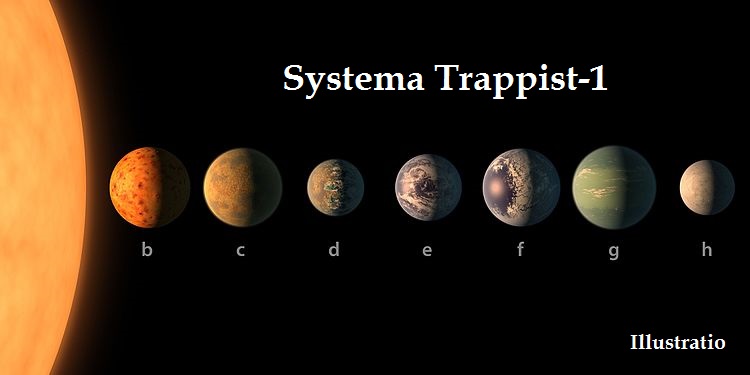
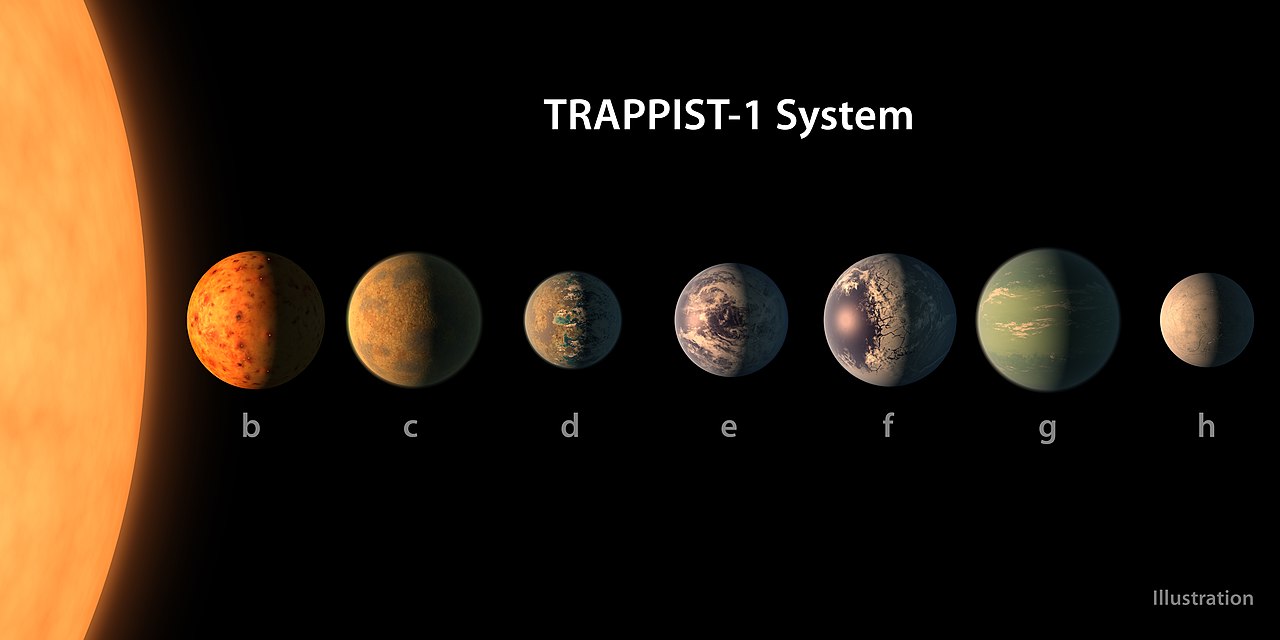
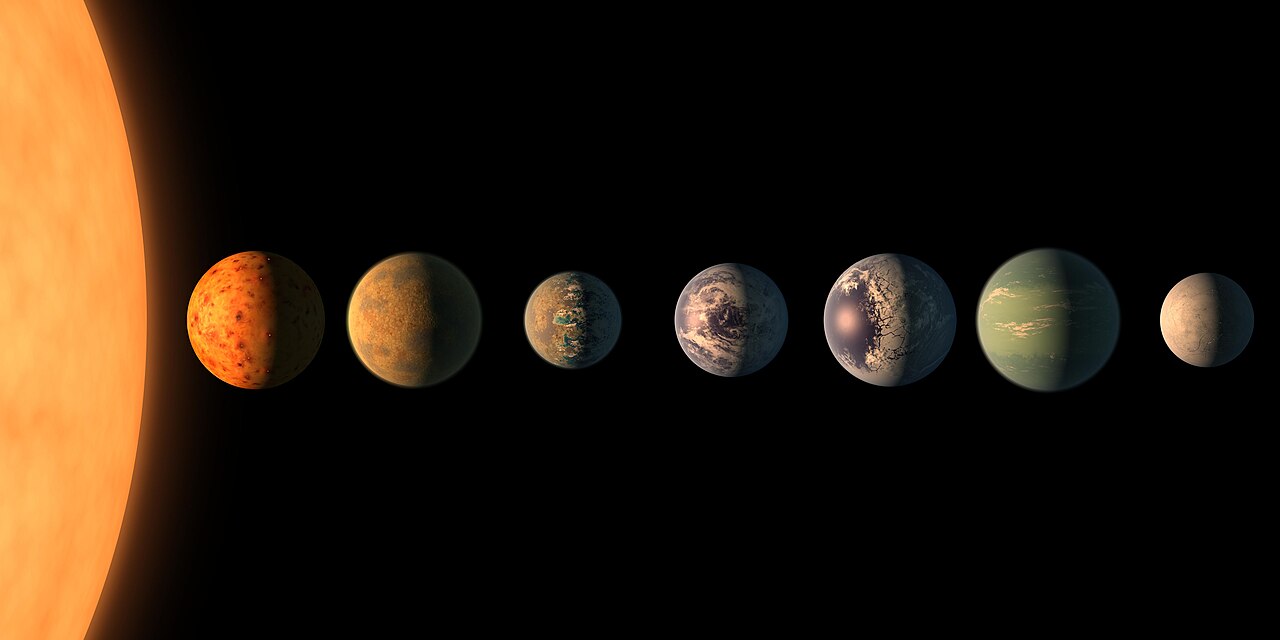
TRAPPIST-1e is a rocky exoplanet roughly the size of Earth, orbiting within the habitable zone of the ultracool red dwarf star TRAPPIST-1, located 40.7 light-years away in the constellation Aquarius. It is one of seven planets discovered around the star using the transit method with the Spitzer Space Telescope, and among the three (e, f, and g) that lie in the habitable zone. The planet is notable for its similarity to Earth in mass, radius, density, gravity, temperature, and stellar flux, and for being considered the most likely of the system's planets to be an Earth-like ocean world.
Quick Facts
- Discoverer
- Michaël Gillon et al.
- Discovery Site
- Spitzer Space Telescope
- Discovered
- 22 February 2017
- Discovery Method
- Transit
- Apsis
- astron
- Star
- TRAPPIST-1
Facts from the source article.
Lore & Background
TRAPPIST-1e was detected via the transit method, which measures the dimming of its host star as the planet passes in front. Transit-timing variations and computer simulations constrained its mass to about 77% of Earth's, or 15% less massive than Venus. Its radius is 91% of Earth's, with a small uncertainty of about 83 km. Initial density estimates in 2018 gave a value of 5.65 g/cm³, slightly higher than Earth's, suggesting a pure rock-iron composition and a solid rocky surface. However, refined estimates later indicated that all planets in the system have similar densities consistent with rocky compositions, with TRAPPIST-1e having a somewhat lower but still Earth-like bulk density.
The planet orbits its ultracool dwarf star at just 0.0293 AU, completing a revolution every 6.10 days. Despite this close proximity, it receives only about 60% of the starlight Earth gets from the Sun due to the star's low luminosity. The star, TRAPPIST-1, has a mass of 0.09 solar masses, a radius of 0.12 solar radii, a temperature of 2566 K, and an age of 7.6 billion years. It is metal-rich, with a metallicity of 109% solar. The star would appear about four times larger than the Sun from the planet's surface, covering an angular diameter of about 2.17 degrees.
TRAPPIST-1e is in a 3:2 orbital resonance with both TRAPPIST-1f and TRAPPIST-1d. Its atmosphere has been a subject of study: transit observations with the James Webb Space Telescope ruled out many atmosphere scenarios but could not conclude with confidence whether an atmosphere exists. The planet lacks a cloud-free hydrogen-dominated atmosphere, meaning any atmosphere present is likely compact, similar to terrestrial planets in the Solar System. The planet is likely tidally locked, with one hemisphere permanently facing the star.
Reader's Guide
TRAPPIST-1e holds significant importance in exoplanet science as one of the best candidates for a potentially habitable, Earth-like world. In November 2018, researchers determined that among the seven planets in the TRAPPIST-1 system, TRAPPIST-1e has the best chance of being an Earth-like ocean planet and is the most worthy of further study regarding habitability. The Habitable Exoplanets Catalog lists it among the best potentially habitable exoplanets discovered. Its similarity to Earth in mass, radius, density, and stellar flux makes it a prime target for atmospheric characterization.
Studies from 2018 confirmed it is a terrestrial planet with a solid, rocky surface, cool enough for liquid water to pool but not so cold that it would freeze. Its atmosphere, if present, is not dense or thick enough to harm habitability potential, and could help transfer heat to the dark side. However, a 2024 modeling study suggested that the planet's atmosphere could be stripped by its host star due to its short orbital period, potentially making it inhospitable. The most recent observations in 2025 using JWST's NIRSpec instrument were unable to conclusively determine the presence of an atmosphere, with two possible models fitting the data: a bare rock or an atmosphere hidden by a high, thick cloud deck, or a nitrogen-rich atmosphere with a tentative preference for trace methane. A new program of 15 additional JWST observations is underway to overcome the limitations posed by the active star.
Did You Know?
- TRAPPIST-1e has 82% the surface gravity of Earth, the third lowest in its system.
- It orbits its star every 6.10 days at a distance of just 0.0293 AU.
- TRAPPIST-1e is in 3:2 orbital resonance with both TRAPPIST-1d and TRAPPIST-1f.
Discovery and Physical Characterization
TRAPPIST-1e was identified through the transit method, a technique in which a planet's passage across its host star's face produces a tiny, measurable dip in brightness. The discovery came as part of a broader campaign using the Spitzer Space Telescope that revealed seven planets circling the red dwarf TRAPPIST-1, situated roughly 40.7 light-years away in the constellation Aquarius. Once the planet's radius was pinned down at 0.920 Earth radii with an uncertainty of only about 83 kilometers, researchers turned to transit-timing variations and sophisticated computer simulations to estimate its mass at 0.692 Earth masses, roughly fifteen percent lighter than Venus. These two measurements, both carrying small error margins, allowed scientists to derive the planet's density, surface gravity, and likely internal composition. Early 2018 density estimates placed TRAPPIST-1e at 5.65 grams per cubic centimeter, slightly exceeding Earth's own figure, marking it as the only member of the system consistent with a pure rock-and-iron makeup. Later refined analyses brought that number down somewhat, yet it remains firmly in the terrestrial range. The planet's calculated equilibrium temperature sits at 246.1 kelvins under a zero-albedo assumption, though any substantial atmosphere could push actual surface conditions considerably higher.
The Host Star and Orbital Architecture
TRAPPIST-1 is an ultracool dwarf with a mass of just 0.09 solar masses and a radius of 0.12 solar radii, placing it perilously close to the dividing line between hydrogen-fusing stars and brown dwarfs. Its surface temperature hovers around 2,566 kelvins, and at 7.6 billion years old it is already nearly twice the age of our Sun. The star's luminosity is a mere 0.0566 percent of the Sun's, and its apparent magnitude of 18.8 renders it completely invisible to the unaided eye. One striking anomaly is its metallicity of 0.04, meaning it actually carries about nine percent more iron than the Sun, which is unexpected for a star so near the brown-dwarf threshold. Despite the star's faintness, TRAPPIST-1e completes a full orbit in just 6.10 days at a distance of 0.0293 astronomical units, less than three percent of the Earth-Sun separation. The planet is locked in a 3:2 orbital resonance with both its neighboring worlds, TRAPPIST-1d and TRAPPIST-1f, creating a dynamically stable chain. From the planet's surface, the star would span roughly 2.17 degrees of sky, appearing about four times the angular size of our Sun as seen from Earth, yet the total starlight received amounts to only about sixty percent of what Earth enjoys.
Atmospheric Research and the Habitability Question
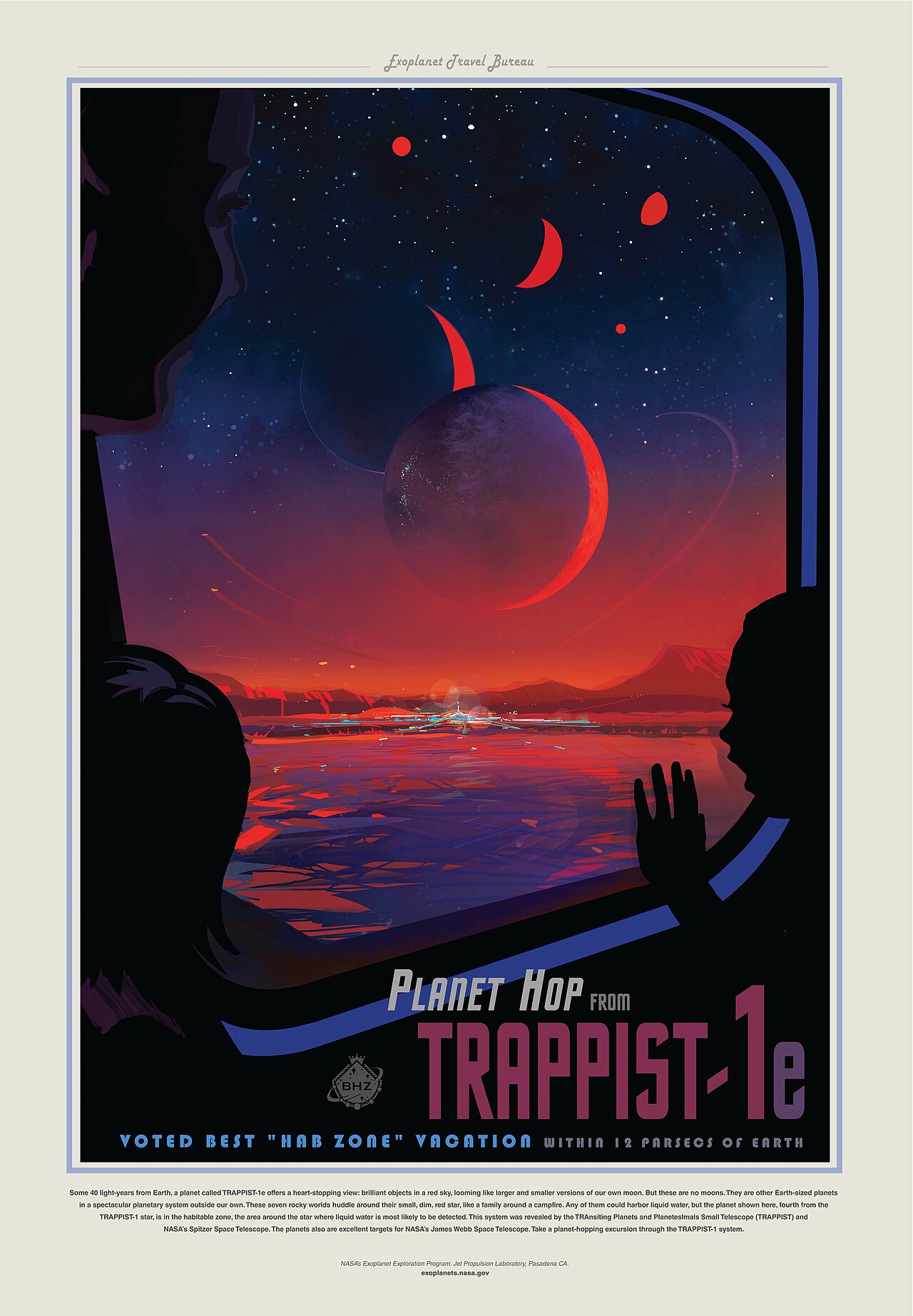
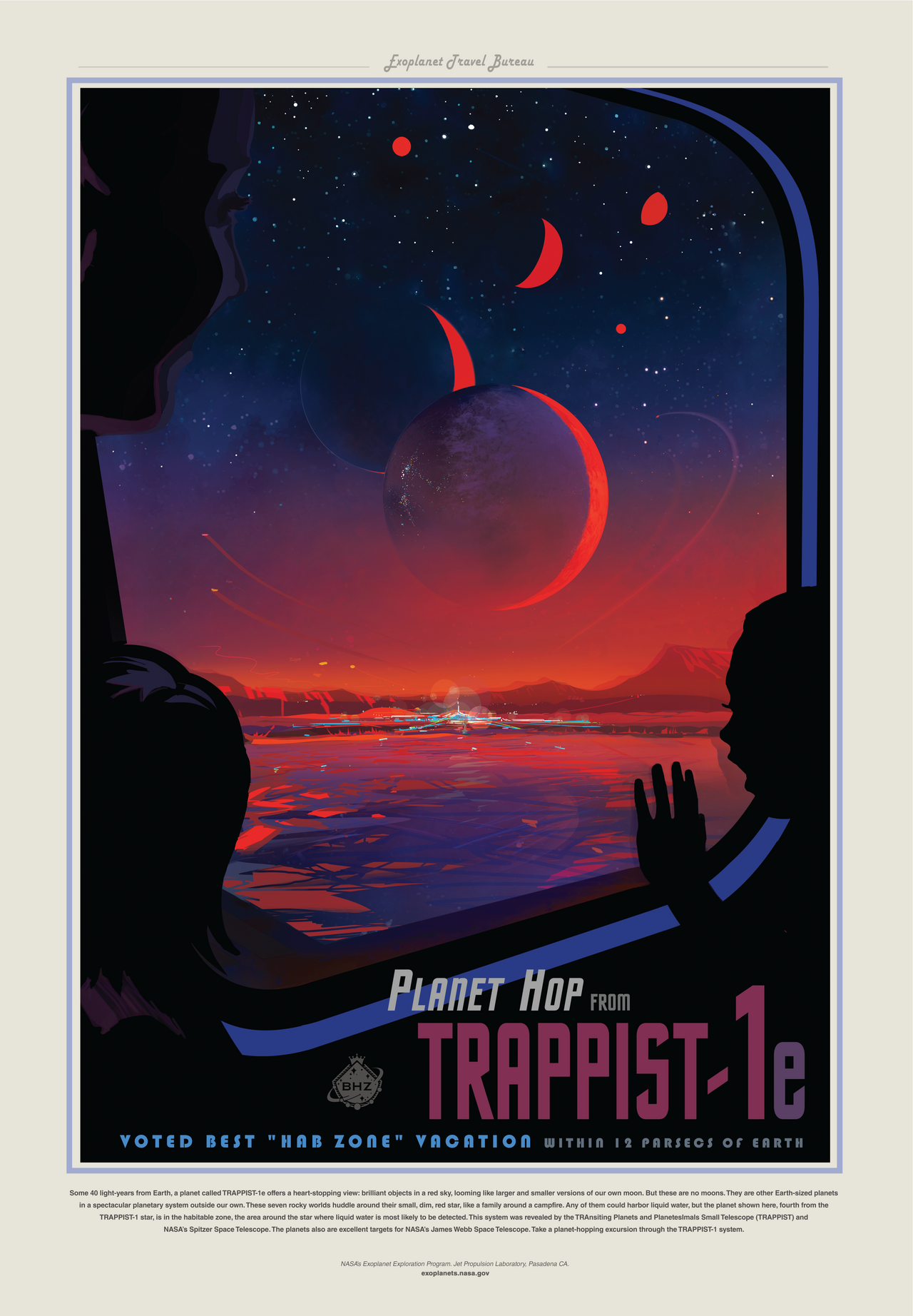
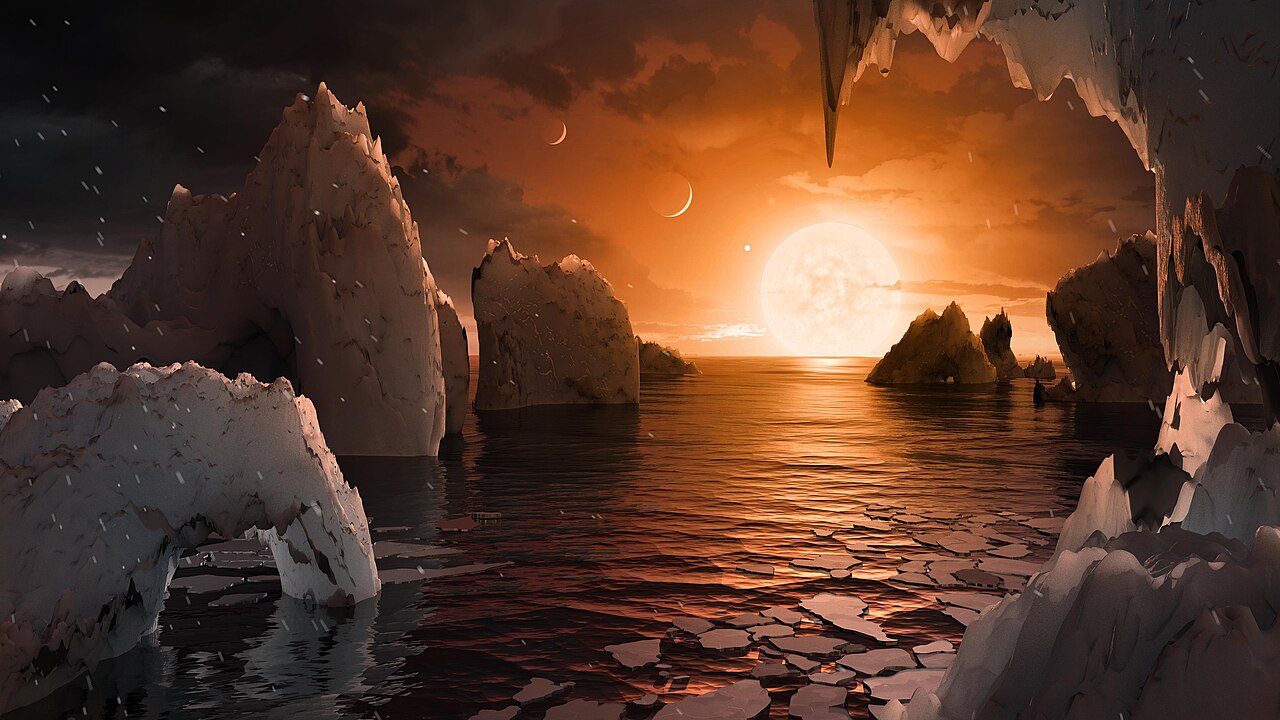
Because TRAPPIST-1e sits within the habitable zone of its parent star, it has attracted intense scrutiny regarding whether liquid water could persist on its surface. In November 2018, researchers singled it out among the seven known planets as having the strongest claim to being an Earth-like ocean world and the most deserving of further habitability investigation. A critical constraint came from the confirmation that the planet does not possess a cloud-free, hydrogen-dominated atmosphere; if an atmosphere is present at all, it is more likely to be a compact, terrestrial-type envelope similar to those wrapping Mars or Venus. The James Webb Space Telescope's transit observations offered no definitive yes-or-no answer on atmospheric presence, though they successfully eliminated a range of possible atmospheric scenarios. A 2025 observation likewise could not reach a confident conclusion about whether an atmosphere exists, while still ruling out additional configurations. The planet's zero-albedo equilibrium temperature of 246.1 kelvins would make it frigid, but a sufficiently thick greenhouse atmosphere could raise surface temperatures dramatically, as it does on Earth. The question of what TRAPPIST-1e's sky actually looks like remains one of the most pressing open problems in exoplanet science.
A Window into the System and Beyond
TRAPPIST-1e is one of seven confirmed planets in a compact multi-world system, and it shares the habitable zone with two siblings, TRAPPIST-1f and TRAPPIST-1g. In its earliest characterization, the planet stood out as the only world in the family whose density matched a pure rock-and-iron interior, while most of its companions appeared to harbor thick steam atmospheres, global liquid oceans, or extensive ice shells. Subsequent refinements have shown that all seven planets actually possess broadly similar, rocky bulk densities, with TRAPPIST-1e sitting at a somewhat lower but still Earth-like value. Its surface gravity of eighty-two percent of Earth's is the third lowest in the system, and its radius and mass are the third smallest among the seven. Looking further ahead, the host star's nature as an ultracool dwarf means it could remain stable for as long as twelve trillion years, over two thousand times the Sun's expected lifetime. This extraordinary longevity implies that TRAPPIST-1 will likely shine long after most other stars have exhausted their fuel, making its planetary system a rare survivor in the far future of the universe.
Gallery
Frequently Asked Questions
Who is TRAPPIST-1e?
TRAPPIST-1e is a rocky world that circles the ultracool red dwarf TRAPPIST-1 every 6.10 days, sitting about 40.7 light-years from us in Aquarius. It was identified as part of a seven-planet family using the transit technique on the Spitzer Space Telescope, and it ranks among the three planets in that system that fall inside the star's habitable zone.
What are TRAPPIST-1e's powers/role?
This planet packs 0.77 Earth masses into a radius of just 0.91 Earth radii, giving it a density of 5.65 g/cm³ and surface gravity at roughly 82 percent of what we feel down here. Its blackbody equilibrium temperature lands near 246 K, and the stellar flux it receives is close enough to Earth's that many modelers treat it as the system's best candidate for a global ocean.
Why is TRAPPIST-1e important?
Among the seven TRAPPIST-1 worlds, e is the one whose mass, radius, density, gravity, and insolation most closely mirror Earth's, making it the flagship candidate for a temperate, ocean-covered planet outside our solar system. Its position in the habitable zone and its rocky composition have turned it into a benchmark case for testing whether small, close-in planets can retain liquid water.
Where does TRAPPIST-1e live, and who found it?
It orbits its host star in the constellation Aquarius at a distance of 40.7 light-years, completing one lap in just over six days. The planet was revealed through the transit method during Spitzer Space Telescope observations, joining a family of seven siblings all detected the same way.
More in Transiting Exoplanets 1-24
Spotted an error? Know more?
Reader corrections go straight into our review queue. Suggest an edit · How this site is sourced