
CoRoT-7b
First confirmed terrestrial exoplanet, with a 20-hour orbit.

Jean-Baptiste Camille Corot · Public domain
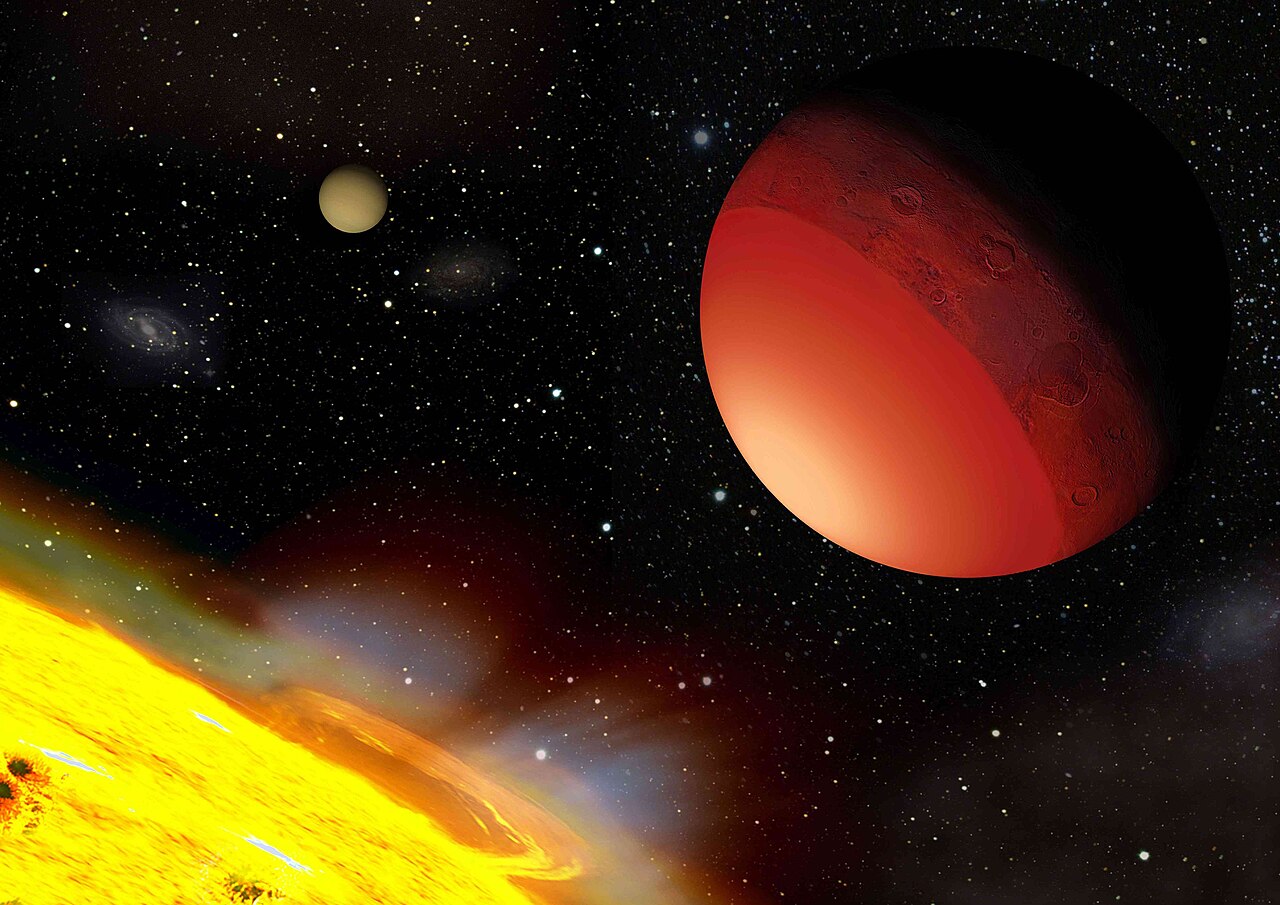
CoRoT-7b is an exoplanet orbiting the star CoRoT-7 in the constellation Monoceros, 520 light-years from Earth. It was the smallest exoplanet to have its diameter measured at the time of its discovery and the first potential extrasolar terrestrial planet found. Its diameter is 1.58 times that of Earth, giving it a volume about 3.94 times Earth's, and it orbits its host star every 20 hours.
Quick Facts
- Discoverer
- Rouan et al. (CoRoT)
- Discovery Site
- Polar orbit
- Discovered
- February 3, 2009
- Discovery Method
- Transit
- Apsis
- astron
- Semimajor
- 0.0172 ±
- Eccentricity
- 0
- Period
- 0.853585 ±
- Inclination
- 80.1 ± 0.3
- Star
- CoRoT-7
- Single Temperature
- 1300 –
Facts from the source article.
Lore & Background
CoRoT-7b was detected by the CoRoT space mission through periodic dips in the brightness of its parent star, observed from October 15, 2007, to March 3, 2008. The transit signals lasted 1.3 hours with a depth of 3.4 × 10⁻⁴. Follow-up observations with ground-based telescopes and the HARPS spectrograph confirmed the planet's nature, though stellar activity made mass determination difficult. The discovery was announced on February 3, 2009, during the CoRoT Symposium in Paris.
The planet's mass is highly uncertain, with different studies reporting values from 1–4 Earth masses up to 8 Earth masses. Its density has been estimated as similar to Earth's (5.6 ± 1.3 g/cm³) or much higher (10.4 ± 1.8 g/cm³), suggesting it may be rocky with a large iron core, like Mercury. The Spitzer Space Telescope independently confirmed the transits at different wavelengths, validating CoRoT-7b as a bona-fide planet.
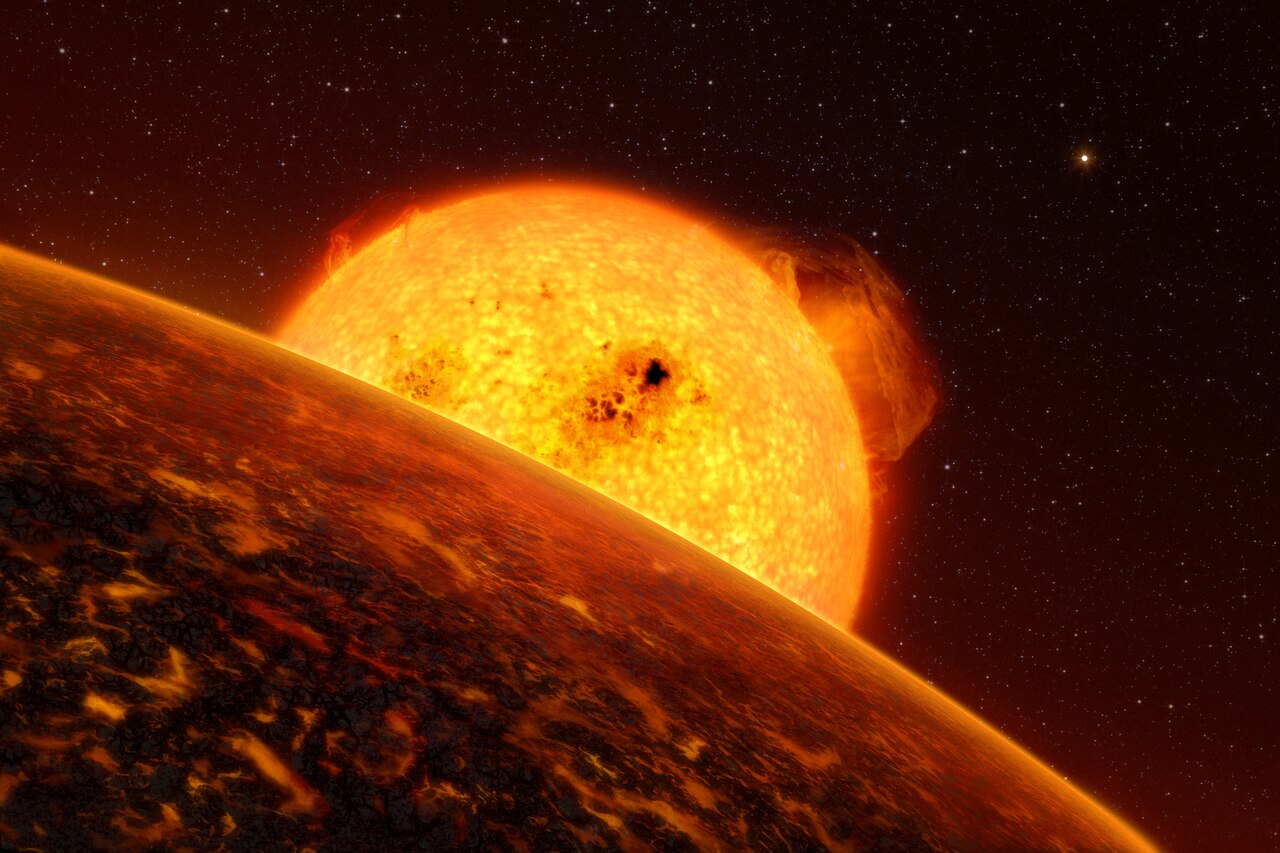
CoRoT-7b orbits extremely close to its star—1/23rd the distance from the Sun to Mercury—and is likely tidally locked. Its dayside may be hot enough to form a lava ocean, while the nightside could have a crust with intense volcanism. The planet may be a chthonian planet (the eroded core of a gas giant) or always rocky; researchers have proposed the class 'lava-ocean planets' for such worlds. Its possible tenuous atmosphere, if any, would consist of vaporized silicate rock.
Reader's Guide
CoRoT-7b holds a significant place in exoplanet science as the first confirmed terrestrial planet beyond the Solar System. Its discovery demonstrated that small, rocky planets exist around other stars and that the transit method can detect Earth-sized worlds. The planet's extremely short orbital period—the shortest known at the time—challenged models of planetary formation and evolution, showing that rocky planets can survive very close to their host stars. The intense debate over its mass and density, with estimates ranging from 1 to 8 Earth masses, highlights the difficulty of measuring radial velocities for active stars and the importance of multiple analytical approaches. The Spitzer confirmation provided independent validation, strengthening confidence in the detection. CoRoT-7b also spurred theoretical work on tidal heating, lava oceans, and the possible erosion of planetary atmospheres, and it remains a benchmark for studying the properties of super-Earths and the diversity of terrestrial worlds.
Did You Know?
- CoRoT-7b was the smallest exoplanet to have its diameter measured until Kepler-10b was announced in January 2011.
- Its orbital period is about 20 hours, making it the shortest known at the time of discovery.
- The planet's density is similar to Earth's, indicating a rocky composition.
- A second super-Earth, CoRoT-7c, orbits the same star every 3.7 days with a mass 8.4 times that of Earth.
The Transit That Changed Everything
The French-led CoRoT space mission captured the first evidence of this world between October 15, 2007, and March 3, 2008, while monitoring the star CoRoT-7 in the constellation Monoceros, roughly 520 light-years from Earth. Over that span, the spacecraft logged 153 recurring dimming events, each lasting about 1.3 hours and dipping in brightness by a mere 3.4 × 10⁻⁴. The signal was so faint that it took 40 days of accumulated data before CoRoT's automated Alarm-mode pipeline flagged it, triggering ground-based follow-up observations to rule out false positives. A full year later, on February 3, 2009, the discovery was unveiled at the CoRoT Symposium in Paris and published in a dedicated issue of Astronomy and Astrophysics. What made the announcement remarkable was not merely the detection itself but the implication: here was a world whose size could be derived directly from the transit depth combined with the host star's radius, opening the door to measuring the diameter of an exoplanet for the first time at such a small scale.
The Mass That Would Not Settle
Pinpointing CoRoT-7b's mass proved far more contentious than measuring its radius. The HARPS spectrograph was tasked with extracting radial-velocity wobbles from the host star, but intense stellar activity contaminated the signal, making every subsequent estimate a matter of methodological choice. Queloz and colleagues initially reported roughly 4.8 Earth masses with a density near 5.6 g/cm³, close to Earth's own. Hatzes and co-workers, using Fourier analysis, pushed the figure to 6.9 Earth masses and even hinted at a third, Neptune-mass companion. Pont and team questioned the HARPS systematic errors altogether, suggesting the true mass might sit between one and four Earth masses, with a detection significance of only 1.2 sigma. Boisse and collaborators landed at 5.7 Earth masses but with wide error bars. The CoRoT team's own follow-up, filtering for multi-measurement nights, yielded 7.42 Earth masses and a density of 10.4 g/cm³—far above Earth's. Ferraz-Mello and colleagues ultimately sided with the heavier value at 8 Earth masses, implying a body with a disproportionately large iron core, structurally closer to Mercury than to Earth.
A World Forged in Fire
CoRoT-7b circles its host star in a mere 20 hours, 29 minutes, and 10 seconds, at a distance roughly one twenty-third of the Sun–Mercury separation. At the time of its discovery, no known planet orbited so rapidly. The radius, measured at 1.58 Earth radii, gives the world a volume about 3.94 times that of our own. The extreme proximity to the star drives temperatures high enough that the surface may be blanketed in molten lava. Compositionally, the planet is almost certainly rocky, though its exact makeup remains debated. Some models allow for up to 40 percent water in the form of ice or vapor mixed with silicate rock, while others argue that forming so close to the star would have stripped away most volatiles. Tidal locking is a strong possibility, meaning one hemisphere would face perpetual daylight while the other endures endless night, producing stark contrasts in temperature and geologic activity. A minority of researchers propose CoRoT-7b is a chthonian planet—the stripped remnant of a once-larger Neptune-like body—though the youth of the stellar system makes that scenario less compelling to others. Any residual orbital eccentricity, stirred by the host star and neighboring planets, could drive intense volcanic episodes.
Pioneering the Terrestrial Frontier
Before CoRoT-7b, the exoplanet catalog was dominated by gas giants and hot Jupiters. The announcement in early 2009 marked the first credible identification of a potential terrestrial world beyond the Solar System, a milestone that reframed how astronomers thought about planetary diversity. Until Kepler-10b was announced in January 2011, CoRoT-7b held the record as the smallest exoplanet whose diameter had been directly measured. Independent confirmation came from the Spitzer Space Telescope, which detected the same transit depth at infrared wavelengths, validating the planet's existence with high confidence even where the radial-velocity data remained noisy. The system also revealed at least one additional companion: CoRoT-7c, a super-Earth of 8.4 Earth masses completing an orbit every 3.7 days at 6.9 million kilometres. Hints of a possible third body, CoRoT-7d, with a Neptune-like mass and a nine-day period, have been noted in some analyses. Together, these findings established that small, rocky worlds are not rare curiosities but a natural product of stellar systems, a conclusion that would shape the next generation of exoplanet surveys.
Gallery
Frequently Asked Questions
What is CoRoT-7b?
CoRoT-7b is a rocky exoplanet circling the star CoRoT-7 in the constellation Monoceros, roughly 520 light-years from our solar system. It is recognized as the first confirmed terrestrial planet found beyond our own solar system.
How big is CoRoT-7b compared to Earth?
Its radius is about 1.58 times Earth's, which translates to a volume roughly 3.94 times that of our home world. At the time of its discovery, it was the smallest exoplanet whose diameter had been directly measured.
How long is a single orbit of CoRoT-7b?
One complete lap around its host star takes just 20 hours, 29 minutes, and about 10 seconds. In other words, a full 'year' on this planet is shorter than a single day on Earth.
When was CoRoT-7b discovered and what do we know about its mass?
Its existence was announced on February 3, 2009, based on transit measurements that revealed its diameter. Its mass remains uncertain, with estimates ranging anywhere from roughly 1 to 8 Earth masses depending on the model used.
Why is CoRoT-7b considered a milestone in exoplanet science?
It proved that rocky, Earth-like worlds can exist around other stars, since it was the first extrasolar planet confirmed to be terrestrial in composition. Its ultra-short 20-hour orbit also made it a critical test case for studying how planets behave when they orbit extremely close to their parent star.
More in Transiting Exoplanets 1-24
Spotted an error? Know more?
Reader corrections go straight into our review queue. Suggest an edit · How this site is sourced