
TRAPPIST-1b
Innermost terrestrial planet of the TRAPPIST-1 system.

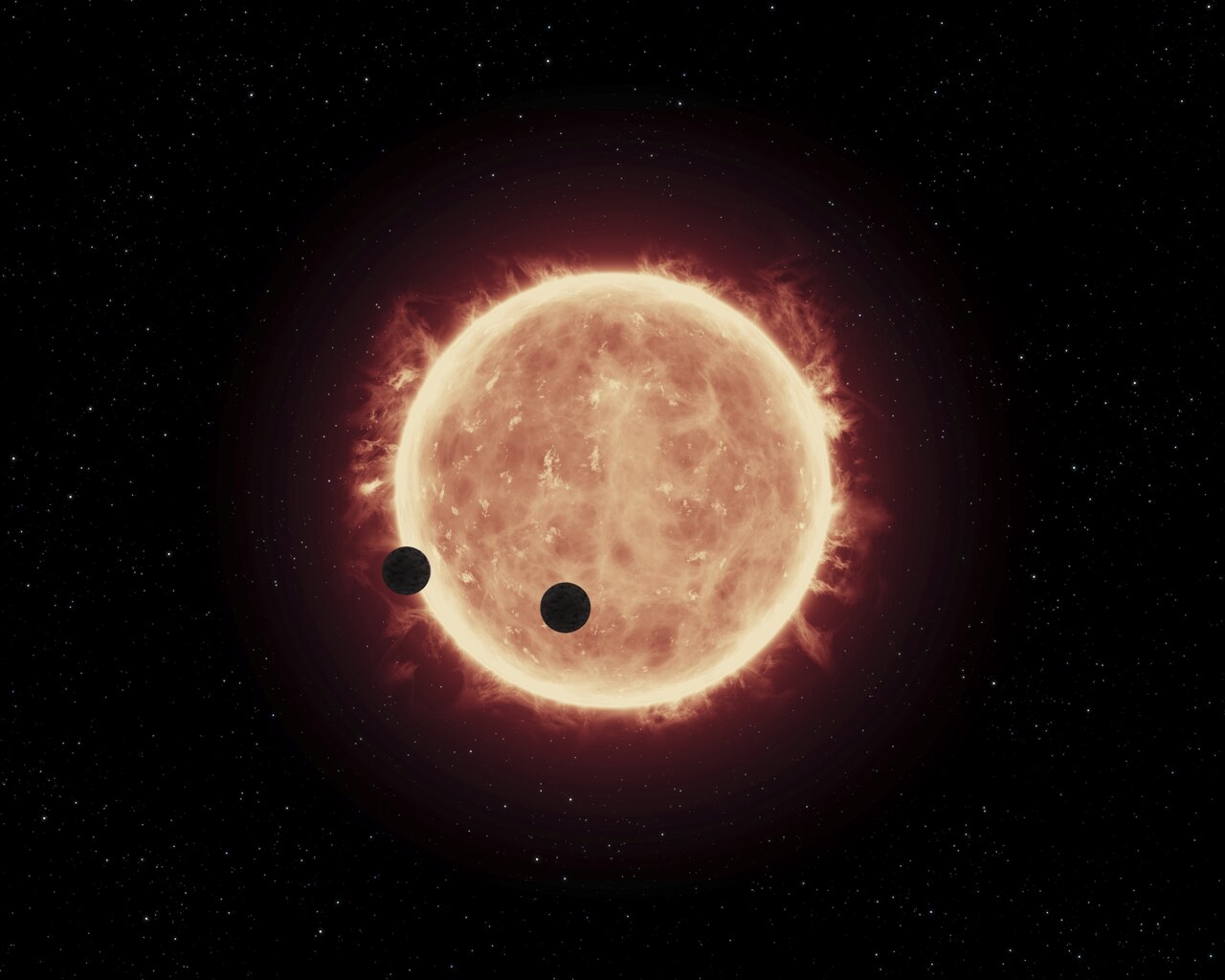
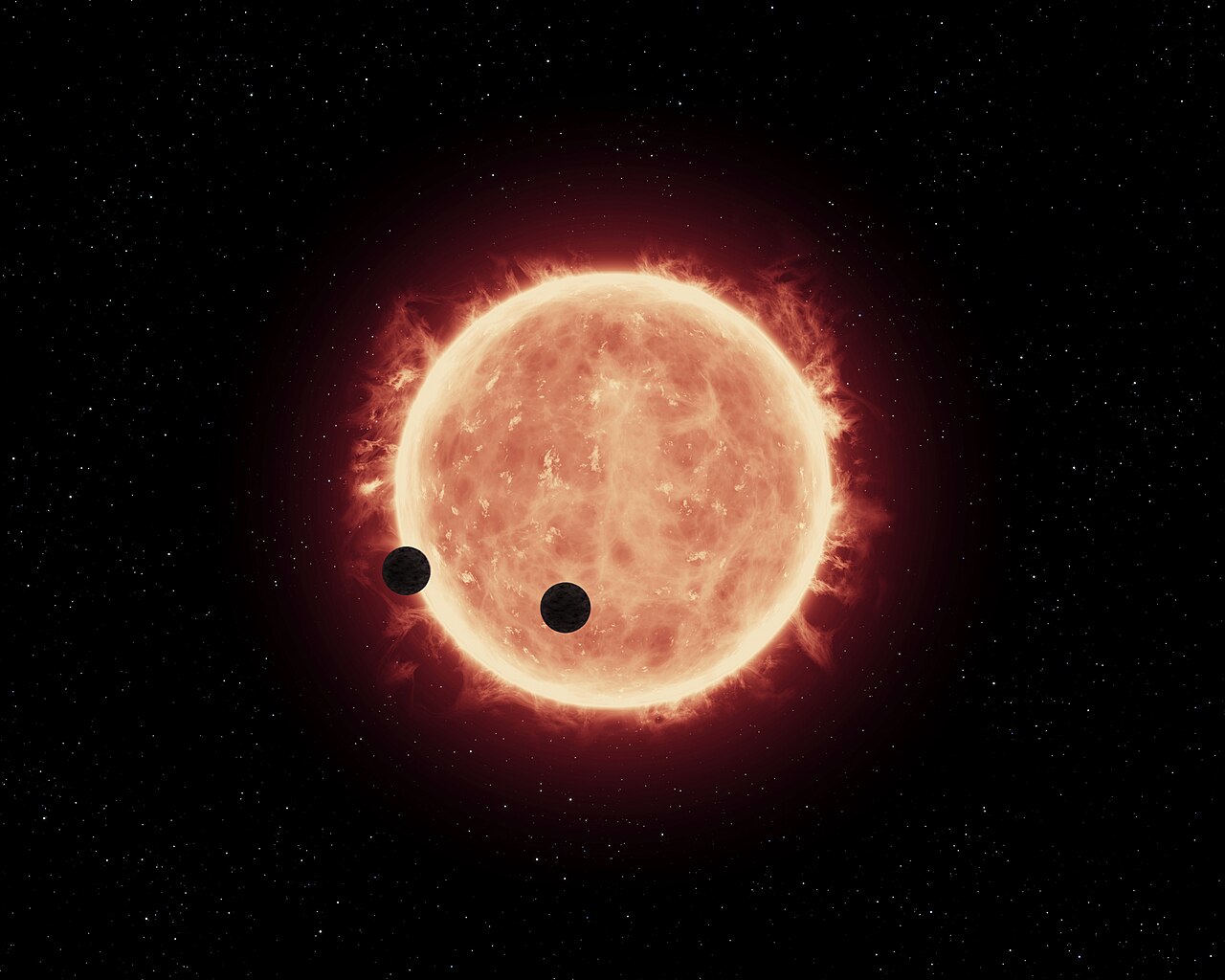
Illustration: , , and G. Bacon (); Science: , , and J. de Wit (MIT) · Public domain
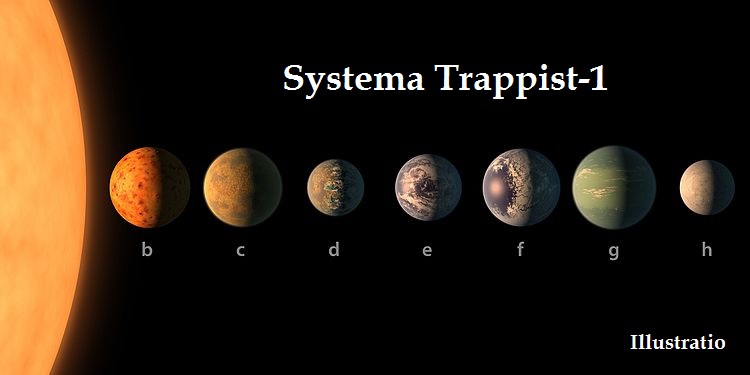
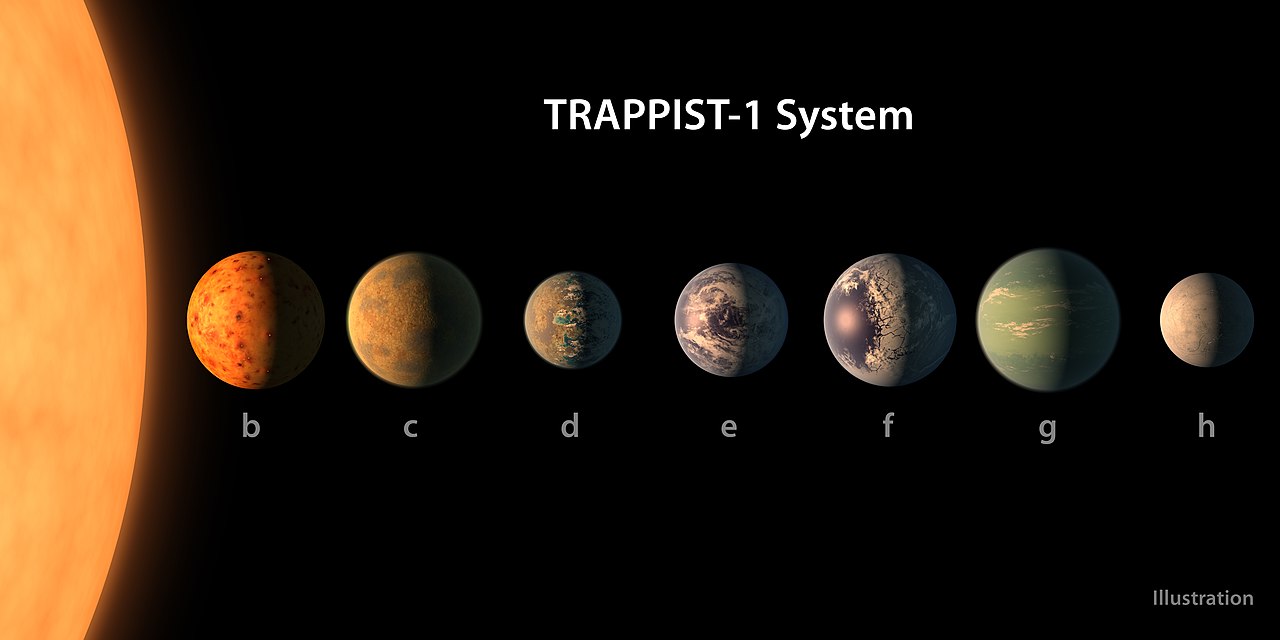
TRAPPIST-1b is a terrestrial, Earth-sized exoplanet orbiting the ultra-cool red dwarf star TRAPPIST-1, located 40.7 light-years away in the constellation of Aquarius. It is the innermost of seven known terrestrial planets in the system and was detected using the transit method. The planet is notable for its close proximity to its star, its tidal locking, and its potential geological activity, with observations suggesting it may be airless or possess a hazy atmosphere.
Quick Facts
- Discoverer
- Michaël Gillon et al.
- Discovery Site
- TRAPPIST
- Discovered
- 2 May 2016
- Discovery Method
- Transit
- Apsis
- astron
- Semimajor
- 0.01154 ±
- Eccentricity
- 0.006220.00304
- Period
- 1.510826 ±
- Star
- TRAPPIST-1
Facts from the source article.
Lore & Background
TRAPPIST-1b was first announced on May 2, 2016, following its detection via the transit method. It orbits its host star at a distance of just 0.0115 AU, completing one orbit every 1.51 days. The planet is tidally locked and has a very circular orbit with an eccentricity of 0.00622. It is in an 8:5 orbital resonance with TRAPPIST-1c. The planet's mass is about 37% greater than Earth's, and its volume is about 39% larger, giving it a density similar to Earth's. Initial estimates suggested a thick, Venus-like atmosphere, but refined density estimates show it is only slightly less dense than Earth. Observations by the James Webb Space Telescope between 2023 and 2024 indicate that the planet either has no significant atmosphere or possesses a hazy, carbon dioxide-rich atmosphere. Its measured surface temperature is about 503 K, with a very low albedo of 0.19, making it dark in color. The planet may be highly geologically active due to tidal squeezing, similar to Jupiter's moon Io.
Reader's Guide
TRAPPIST-1b holds significance as one of the best-studied terrestrial exoplanets outside the Solar System, offering insights into planetary formation and atmospheric evolution around ultra-cool dwarf stars. Its location as the innermost planet in the TRAPPIST-1 system, combined with its Earth-like size and density, makes it a key target for understanding the diversity of rocky worlds. The James Webb Space Telescope observations have been pivotal in constraining its atmospheric properties, ruling out hydrogen-dominated atmospheres and suggesting either an airless body or one with photochemical hazes. The planet's low albedo and potential for volcanic activity, driven by tidal and induction heating, provide a natural laboratory for studying geologically active exoplanets. Its measured surface temperature of 503 K, far cooler than initial estimates, challenges earlier models and underscores the importance of direct observational data. The ongoing debate about its atmosphere—whether absent or haze-rich—highlights the complexity of characterizing exoplanets and the need for further study.
Did You Know?
- TRAPPIST-1b is the innermost of seven terrestrial planets orbiting the ultra-cool dwarf star TRAPPIST-1.
- The planet has a very circular orbit with an eccentricity of 0.00622, more circular than Earth's orbit.
- Observations by the James Webb Space Telescope suggest the planet may have a surface temperature of about 503 K.
- The planet's low albedo of 0.19 and potential for volcanic activity make it comparable to Jupiter's moon Io.
Discovery and Orbital Architecture
Announced on May 2, 2016, TRAPPIST-1b was identified through the transit method, a technique that detects the subtle dimming of a star's light as a planet crosses in front of it. The planet resides in the constellation Aquarius, roughly 40.7 light-years from Earth, and occupies the innermost orbit among seven terrestrial worlds circling the ultracool dwarf star TRAPPIST-1. That host star is remarkably small and dim—just 0.09 solar masses, 0.12 solar radii, and a surface temperature of only 2,566 K—yet it is nearly twice the Sun's age at 7.6 billion years. Its luminosity is a mere 0.0005 times that of our Sun, giving it an apparent magnitude of 18.80, far beyond naked-eye visibility. TRAPPIST-1b completes one orbit in just 1.51 days at a distance of 0.0115 AU, roughly 1.2 percent of the Earth-Sun separation. Its path is extraordinarily circular, with an eccentricity of 0.00622, well below Earth's 0.0167, and it maintains an 8:5 orbital resonance with its neighbor TRAPPIST-1c.
A Dense, Dark World
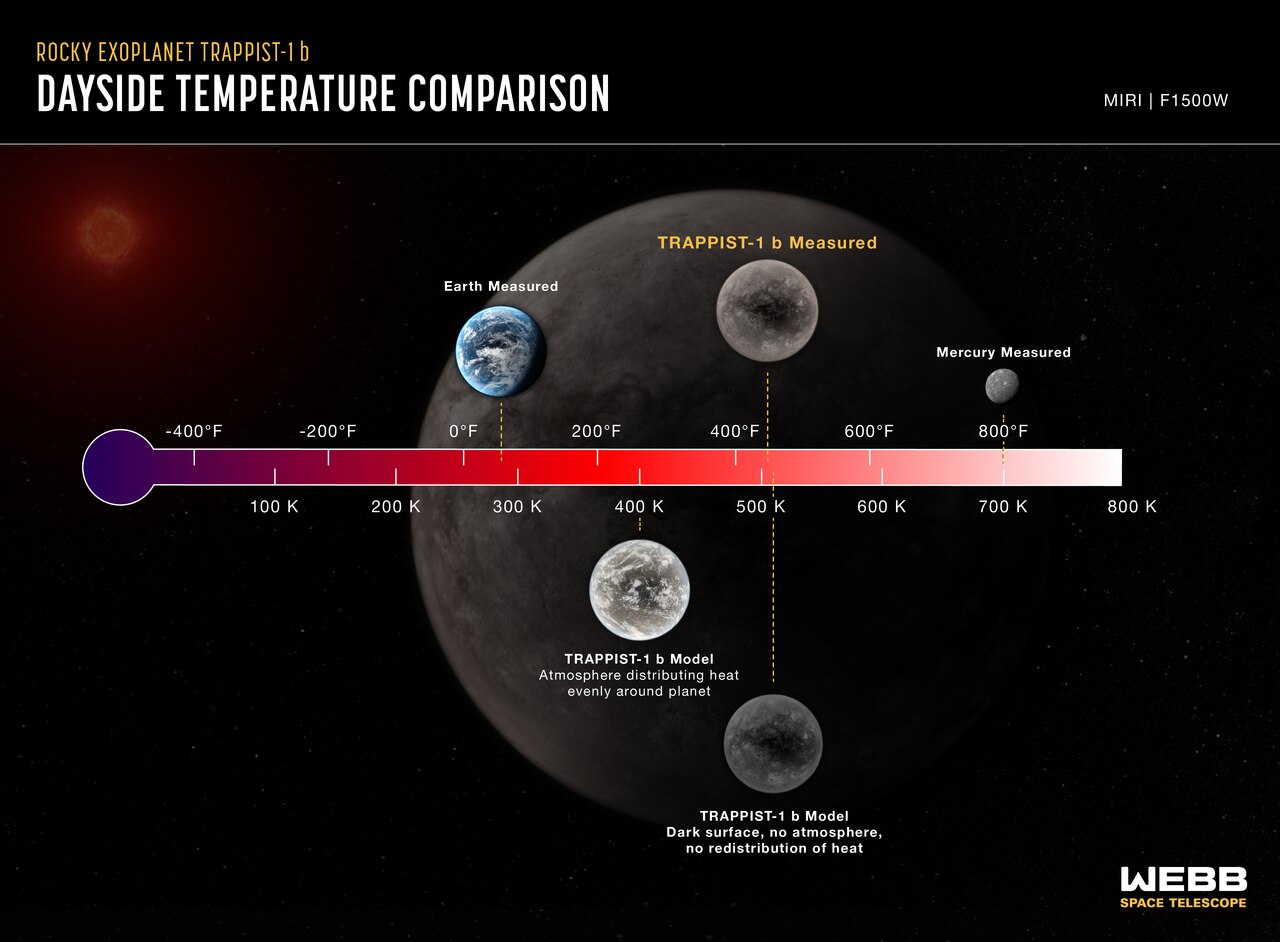
TRAPPIST-1b is a rocky world that closely mirrors Earth in fundamental dimensions. Its radius measures 1.116 times that of Earth, and its mass stands at 1.374 Earth masses, making it roughly 37 percent heavier and 39 percent larger in volume. Surface gravity is approximately 110 percent of what we experience on Earth. Refined density estimates place the planet at 3.98 g/cm³, only marginally less dense than our own world, suggesting that no more than about five percent of its mass is composed of volatiles. The planet's albedo is extremely low, rendering it a dark body. Its surface, as measured by the James Webb Space Telescope's secondary-eclipse observations, sits at roughly 503 K (230 °C), far above any comfortable threshold. Earlier models, assuming a thick atmosphere, projected surface temperatures between 750 K and as high as 2,000 K—potentially hot enough to sustain a molten lava surface. The planet receives nearly four times the stellar energy flux that Earth receives, a direct consequence of its extremely close orbit.
The Shifting Atmosphere Question
The atmospheric status of TRAPPIST-1b has been one of the most actively debated questions in exoplanet science. In 2018, Spitzer Space Telescope data hinted at a substantial, hot envelope, though it could not definitively confirm one. Refined density and transmission-spectrum analyses pointed to two leading candidates: a carbon-dioxide-rich atmosphere with a scale height near 52 kilometers and temperatures exceeding 1,400 K, or a water-vapor atmosphere requiring a scale height above 100 kilometers and temperatures past 1,800 K. Combined transmission spectra of TRAPPIST-1b and its sibling TRAPPIST-1c ruled out cloud-free hydrogen-dominated envelopes, and no helium emission was ever detected. Then, in March 2023, JWST secondary-eclipse observations delivered a striking result: no significant atmosphere, with CO₂ pressures above 0.1 bar excluded at three-sigma confidence. A December 2024 analysis of ten JWST eclipses at 12.8 and 15 micrometers, however, revealed a shallower eclipse depth at the shorter wavelength, possibly indicating photochemical hazes in a thick CO₂ atmosphere—or alternatively, a young ultramafic surface with no atmosphere at all, a scenario the authors slightly favored.
Tidal Forces and Surface Dynamics
Because TRAPPIST-1b circles its star at a distance of only 0.0115 AU, it is almost certainly tidally locked, presenting the same face to TRAPPIST-1 perpetually. This extreme proximity also subjects the planet to powerful tidal squeezing, a mechanism analogous to the geological restlessness of Jupiter's moon Io, which happens to share a similar orbital period and eccentricity. The repeated flexing of the planet's interior could drive intense geological activity, potentially keeping the surface in a state of perpetual renewal. The planet's equilibrium temperature is 397.6 K, while JWST secondary-eclipse measurements place the actual surface at roughly 503 K. Earlier models assuming a thick atmosphere projected temperatures as high as 2,000 K—hot enough, some researchers suggested, to sustain a molten lava surface. Combined with its very low albedo, which makes the planet appear dark and reflective of little light, TRAPPIST-1b presents a picture of a scorched world receiving nearly four times the stellar energy flux of Earth, locked in a relentless thermal embrace with its faint, ancient host star.
Gallery
Frequently Asked Questions
What is TRAPPIST-1b?
TRAPPIST-1b is the closest-in of seven rocky worlds circling the ultra-cool red dwarf TRAPPIST-1, roughly 40.7 light-years out in Aquarius. It was spotted via the transit method and is often called the 'innermost sibling' of that famous seven-planet family.
How long does it take TRAPPIST-1b to orbit its star?
A full 'year' on TRAPPIST-1b lasts just 1.51 days—about 36 hours—because the planet hugs its star at a distance of only 0.0115 AU. That razor-thin orbit is also what makes its transits so easy to catch from Earth.
Is TRAPPIST-1b tidally locked?
Yes. Because it sits so close to TRAPPIST-1, the planet is locked in a permanent face-to-face orientation, meaning one hemisphere stares at the star while the other is frozen in darkness. This extreme day-night contrast is a major factor in how scientists model its possible surface conditions.
Does TRAPPIST-1b have an atmosphere?
Current observations are inconclusive, but the leading hypothesis is that the planet is either completely airless or shrouded in a thin, hazy envelope. Its high density of about 4 g/cm³ and Earth-like radius point to a rocky body, yet no definitive atmospheric signature has been confirmed.
How does TRAPPIST-1b stack up against Earth?
It's a bit heavier and puffier than our home world—1.37 Earth masses and 1.39 Earth radii—giving it a surface gravity roughly 10 percent stronger. Despite the extra heft, its density of 3.98 g/cm³ keeps it firmly in the rocky, terrestrial category rather than a gas-rich mini-Neptune.
More in Transiting Exoplanets 1-24
Spotted an error? Know more?
Reader corrections go straight into our review queue. Suggest an edit · How this site is sourced