
TOI-1853 b
A dense, Neptune-sized mega-Earth challenging planet formation theories.

Pierre J.O. Chauveau · Public domain
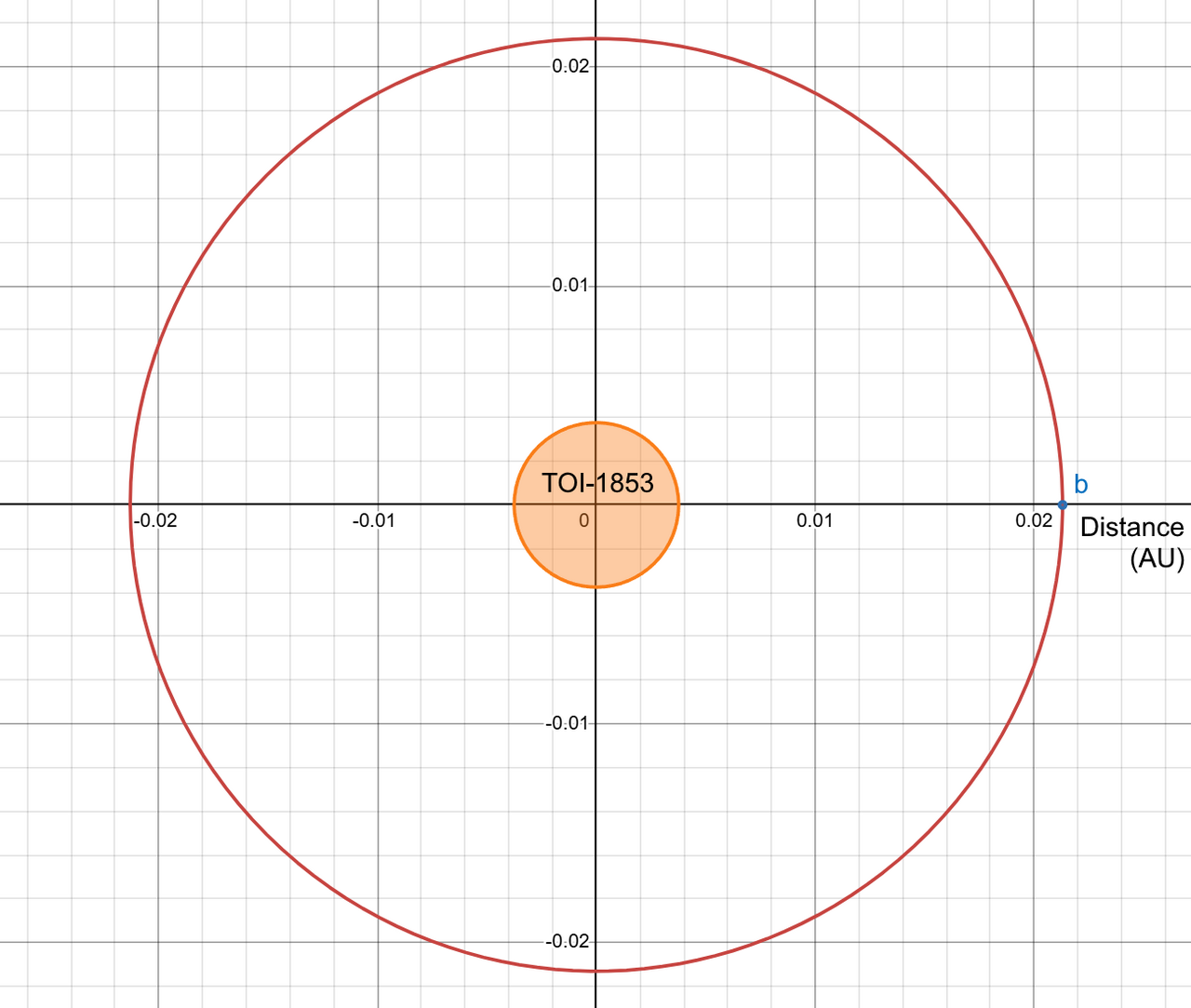
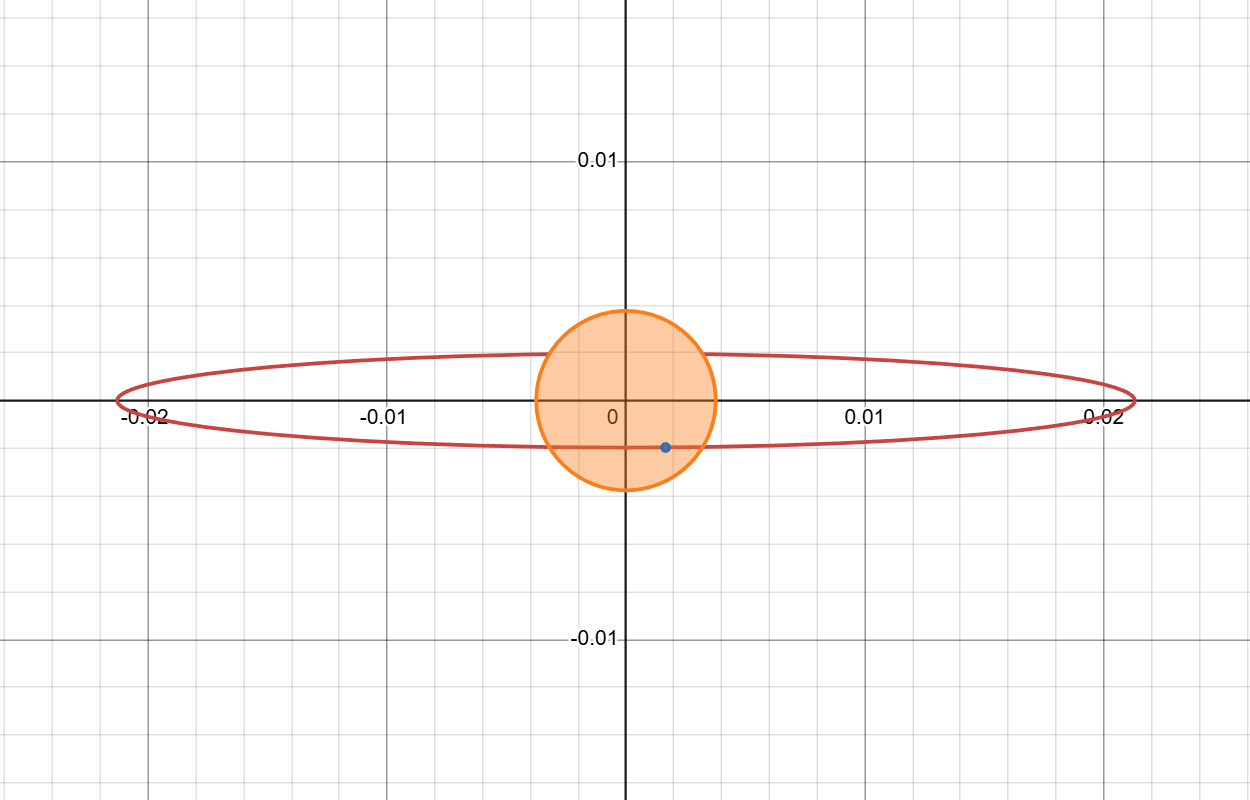
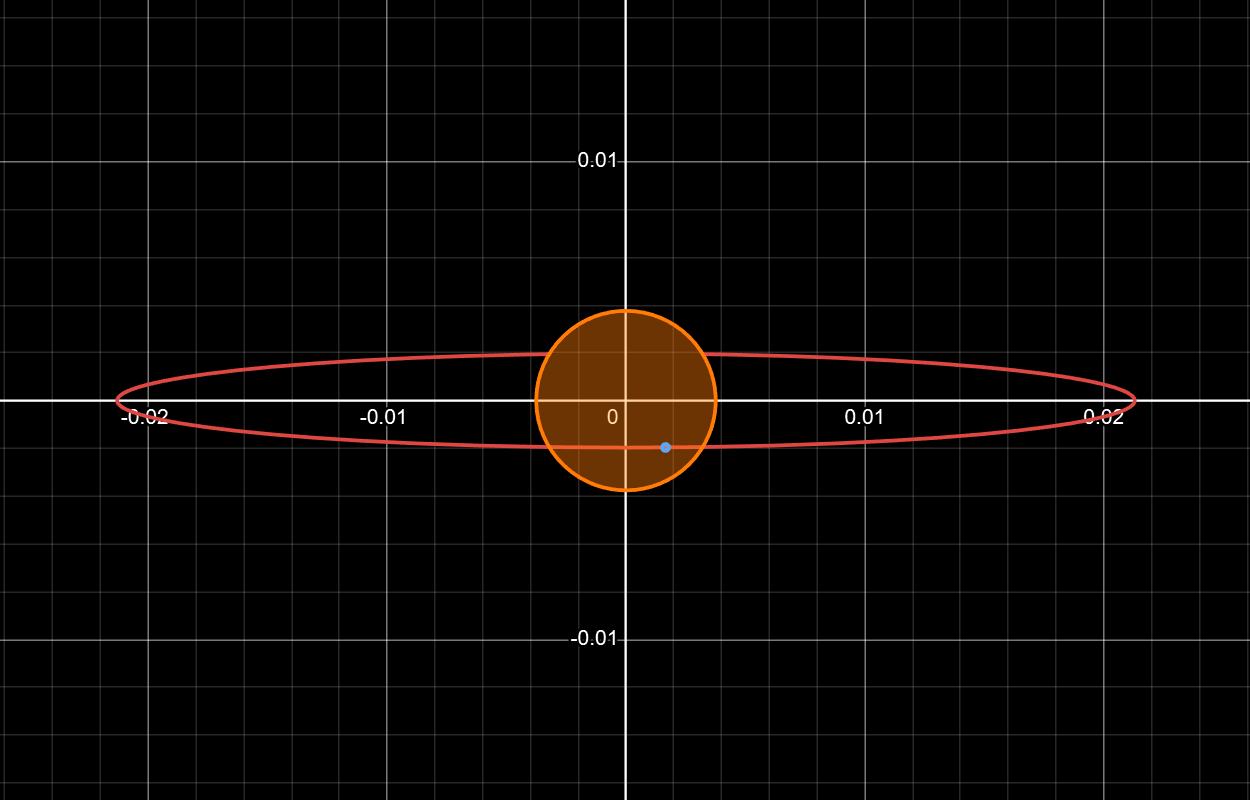
TOI-1853 b is a Neptune-sized exoplanet that orbits an orange dwarf star in the constellation Boötes, roughly 545 light-years from Earth. It was first detected by the Transiting Exoplanet Survey Satellite (TESS) in 2020 and confirmed as a planet in 2023. The planet completes one orbit around its star every 1.24 days, staying extremely close to the star at a distance of about 0.0213 AU. This proximity heats the planet to an equilibrium temperature of roughly 1480 K. Its orbit is likely nearly circular.
With a mass 73 times that of Earth—about 77% of Saturn’s mass—and a radius 90% of Neptune’s, TOI-1853 b is unusually dense. Its bulk density ranges between 9 and 10 grams per cubic centimeter, nearly twice Earth’s density and denser than steel. This high density implies the planet is composed almost entirely of solid rock and water, with only a thin atmosphere of hydrogen and helium, making it a mega-Earth rather than a gas giant. Its surface gravity is about 6.13 times Earth’s.
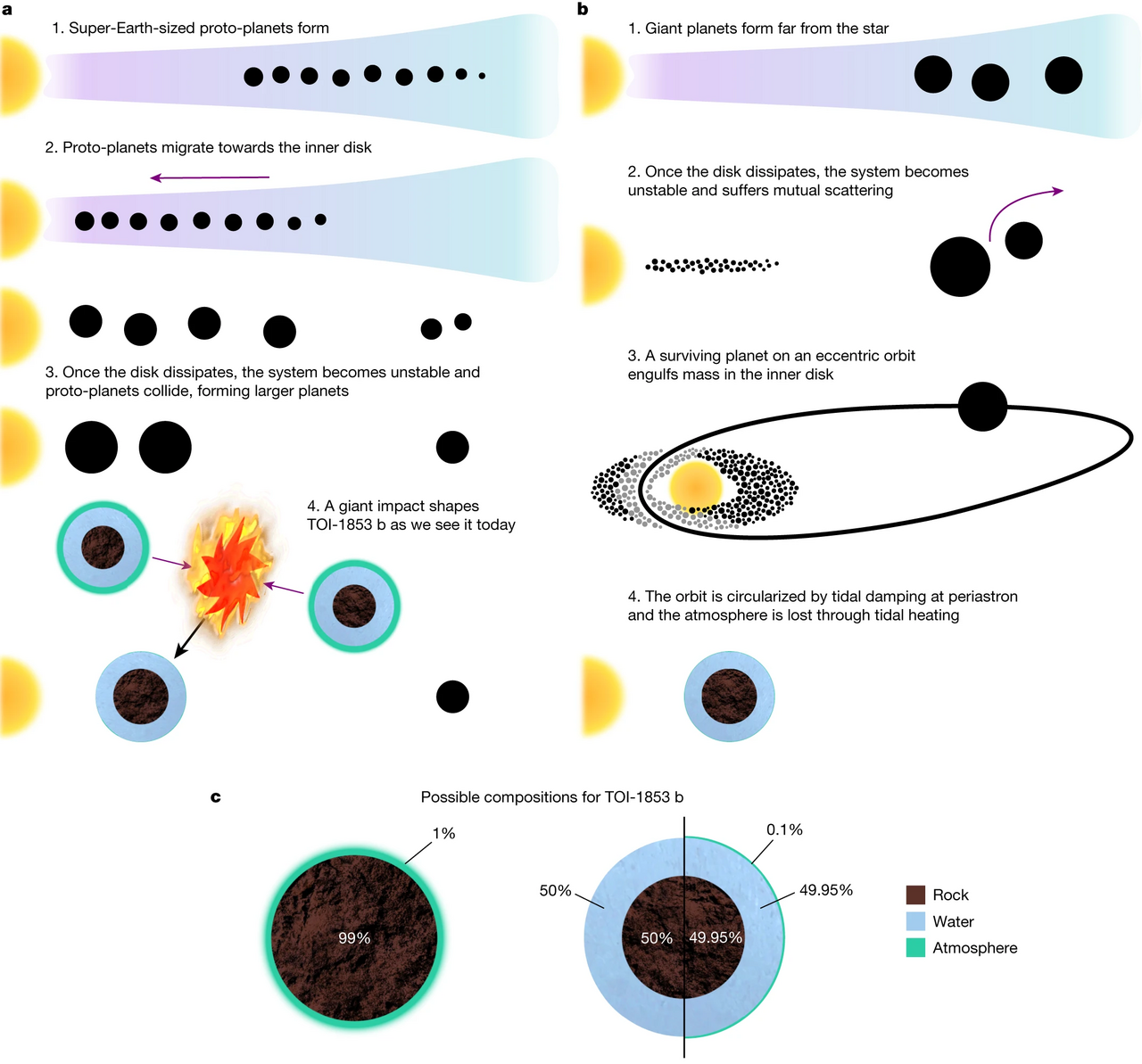
The planet’s extreme density challenges the standard idea that massive planets form through pebble accretion. Two main hypotheses have been proposed to explain its nature: it may have once been a gas giant whose atmosphere was stripped away by its host star, or it could be the remnant of multiple collisions between super-Earths.
TOI-1853 b sits in the Neptunian desert—a region of orbital periods shorter than 3.2 days where few Neptune-sized planets are found—likely because stellar radiation strips away their atmospheres. It is the most massive known mega-Earth, a class of dense, Neptune-mass exoplanets with radii between 2.1 and 5 Earth radii and densities above 8 grams per cubic centimeter. As of 2026, only 13 such planets have been confirmed.
The planet’s internal composition is not directly known, but its density suggests two possible structures. One model has it made of 99% rock and metal and 1% atmosphere by mass. The other has roughly equal parts rock and metal (49.95%) and high-pressure water ice or supercritical fluid (49.95%), with a 0.1% atmosphere. In both cases, the thin atmosphere is mostly hydrogen and helium, possibly containing steam if water is abundant. The rocky interior is likely differentiated into an iron core and silicate mantle.
Quick Facts
- Extrasolarplanet
- yes
- Discoverer
- TESS
- Discovered
- 2020 (first detection) / 2023 (confirmation)
- Discovery Method
- Transit
- Epoch
- BJD 2459690.7420 · 0.0006 / (mid-transit time)
- Eccentricity
- <0.03
- Star
- TOI-1853
Facts from the source article.
Lore & Background
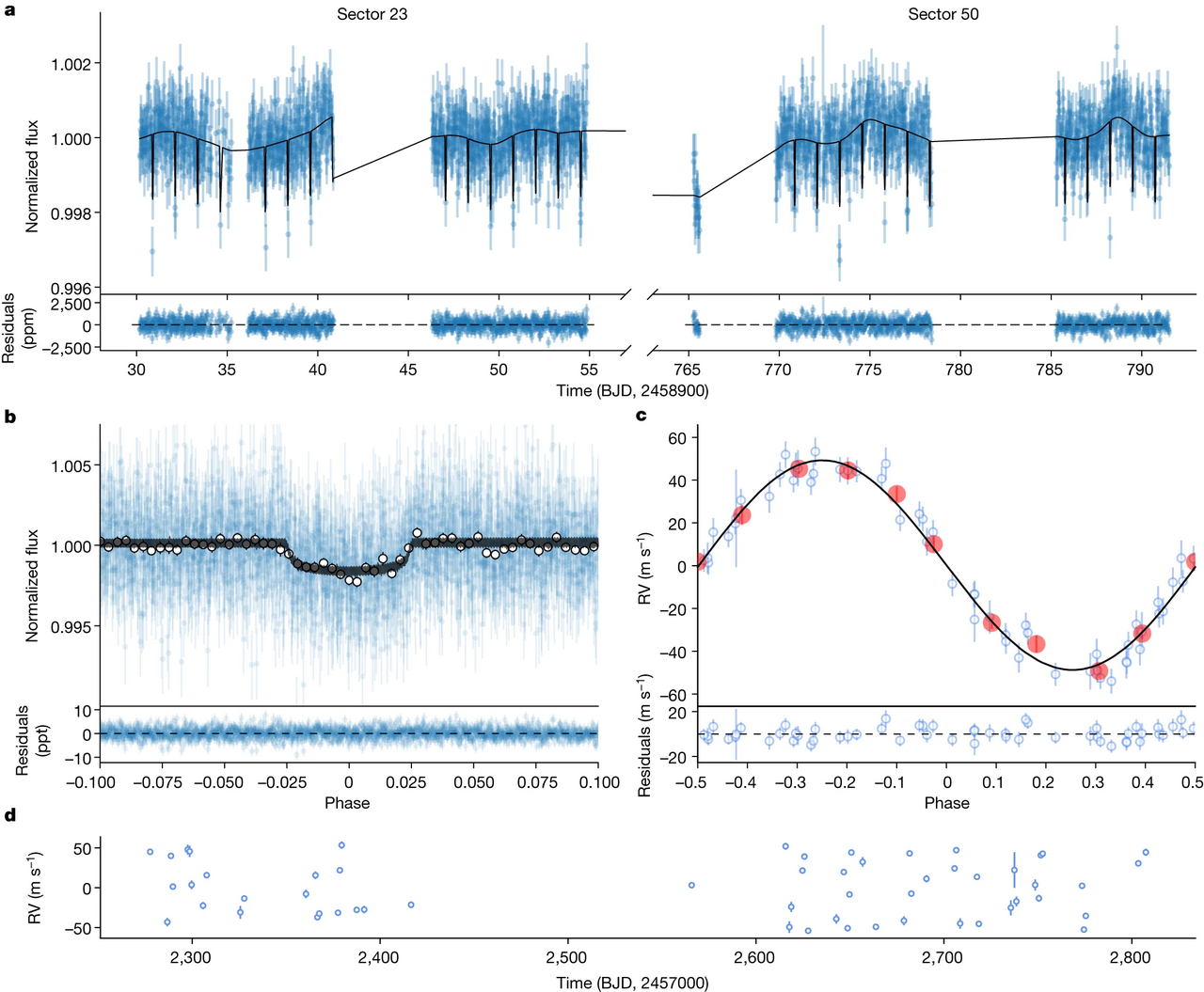
TOI-1853 b was first detected by TESS in early 2020 as TOI-1853.01. A team led by Luca Naponiello conducted follow-up observations using ground-based telescopes, observing additional transits in May and June 2020, searching for companions with high-resolution imaging in 2020–2021, and measuring radial velocity variations from February 2021 to August 2022. The planet's confirmation was published in the journal Nature in August 2023.
The planet orbits its host star at a distance of 0.0213 AU with a period of 1.24 days, placing it in the Neptunian desert—a region of short orbital periods where few Neptune-sized planets are found. Its equilibrium temperature is about 1480 K. The orbit is expected to be nearly circular, with an upper eccentricity limit of 0. The planet's high density implies it is composed almost entirely of solid rock and water, with only a thin hydrogen-helium atmosphere. Two possible internal structures have been proposed: one with 99% rock and metal and 1% atmosphere, and another with roughly equal parts rock/metal and high-pressure water ice, plus a trace atmosphere.
Reader's Guide
TOI-1853 b is significant because its high density challenges the standard pebble accretion model for planet formation, which predicts that massive planets should accrete substantial gas and become gas giants. Its density is so high that it is classified as a mega-Earth—one of only 13 such planets confirmed, and the most massive among them. Two competing hypotheses explain its nature: it could be a former gas giant whose atmosphere was stripped by its host star, or it could be the remnant of multiple collisions between super-Earths. The planet's existence in the Neptunian desert, where intense stellar radiation typically strips atmospheres, supports the stripped-gas-giant scenario. Future observations with the James Webb Space Telescope, including transmission spectroscopy and secondary eclipse spectroscopy, may distinguish between a hydrogen-dominated or water-dominated atmosphere and help constrain its interior composition. The planet's deep interior pressure is estimated at about 5,000 gigapascals, enough to make most elements behave as metals.
Did You Know?
- TOI-1853 b has a density higher than steel and nearly twice that of Earth.
- The planet is 73 times Earth's mass but only 90% of Neptune's radius.
- Two proposed origins are a stripped gas giant or a collision remnant of super-Earths.
From Candidate to Confirmed: The Road to TOI-1853 b
The story of TOI-1853 b began in early 2020, when the Transiting Exoplanet Survey Satellite flagged a periodic dimming of the orange dwarf star TOI-1853 in the constellation Boötes. At that stage the object carried only a provisional label—TOI-1853.01—and its planetary nature was still unverified. The credit for converting that candidate into a confirmed world belongs to a team led by Luca Naponiello, who spent nearly four years assembling the evidence required for a definitive answer. Their campaign included catching additional transits in May and June 2020, searching for any distant stellar companions with high-resolution imaging in 2020 and again in early 2021, and—most critically—measuring the tiny gravitational wobble the planet induces on its host star through Doppler spectroscopy over a stretch from February 2021 to August 2022. Once every line of evidence converged, Naponiello and collaborators published their confirmation in the journal Nature in August 2023, officially retiring the ".01" suffix and introducing a new, extraordinarily dense Neptune-sized planet to the scientific community.
A World Denser Than Steel: Physical Properties
TOI-1853 b packs 73.2 Earth masses into a sphere only 3.46 times Earth's radius—roughly 89.5 percent of Neptune's size and about 77 percent of Saturn's mass. The result is a bulk density of approximately 9.74 grams per cubic centimeter, a figure that exceeds the density of solid steel and sits nearly double that of our own planet. Surface gravity on this world would press down at about 60 metres per second squared, more than six times what we experience here. In a 2026 study, Maxwell Kroft and colleagues placed TOI-1853 b into a newly emphasized class of dense, Neptune-mass worlds they call mega-Earths, defined by radii between 2.1 and 5 Earth radii and densities above 5.5 g/cm³. As of March 2026, only thirteen such planets had been confirmed, and TOI-1853 b stands as the most massive member of the group. Its density tells us the interior must be overwhelmingly composed of heavy elements—rock, metal, and possibly high-pressure ice—rather than the light hydrogen and helium that dominate typical gas giants.
Two Possible Birth Stories: Composition and Formation
Because no direct probe can reach TOI-1853 b, scientists infer its makeup from density and orbital context. Naponiello and colleagues outlined two leading internal models. In the first, the planet is almost entirely rock and metal—99 percent by mass—with just a whisper of a hydrogen-helium atmosphere. In the second, roughly half the planet is rock and metal and the other half is water locked as high-pressure ice or supercritical fluid, again capped by a trace gaseous envelope. Both scenarios assume a differentiated interior with an iron core beneath a silicate mantle, and both predict interior pressures around 5,000 gigapascals, fifty times Earth's core-mantle boundary, where most elements would behave as metals. The water-rich picture gains extra plausibility if TOI-1853 b was forged in a series of violent collisions between super-Earths. Alternatively, it may have once been a fuller gas giant whose envelope was stripped away by its host star's radiation. Either way, the planet's extreme density poses a serious challenge to the standard pebble-accretion model of giant-planet formation.
Burning in the Neptunian Desert: Orbit and Fate
TOI-1853 b circles its orange dwarf host at a semi-major axis of just 0.0213 AU—about 3.19 million kilometres—completing one orbit in a mere 1.24 days. That proximity roasts the planet to an equilibrium temperature near 1,480 kelvin, or roughly 1,210 degrees Celsius. Its orbital period places it squarely inside the so-called Neptunian desert, a zone where periods shorter than about 3.2 days host very few Neptune-sized worlds, likely because intense stellar radiation erodes their atmospheres and shrinks their radii. The orbit is nearly circular, with eccentricity below 0.03, and tilted 84.7 degrees relative to the sky plane, which is what allows the planet to transit its star from our vantage point; each transit lasts about 1.19 hours. Tidal coupling between planet and star is expected to slowly drain orbital energy, but models suggest TOI-1853 b will endure for at least four billion more years before it finally spirals into its host star.
Gallery
Frequently Asked Questions
What is TOI-1853 b?
TOI-1853 b is a Neptune-sized exoplanet circling an orange dwarf star in the constellation Boötes, roughly 545 light-years from our solar system. It finishes a full lap around its host star in just over a day, making it an ultra-short-period world.
How was TOI-1853 b discovered?
NASA's TESS space telescope first flagged the planet as a transiting candidate in 2020. Follow-up observations were needed to rule out false positives, and the object was formally confirmed as a planet in 2023.
What are TOI-1853 b's key physical stats?
The world carries about 73 Earth masses—roughly 77 percent of Saturn's mass—within a radius about 90 percent that of Neptune, yielding a density between nine and nearly twice Earth's. Its equilibrium temperature sits near 1,480 kelvin because it hugs its star at only 0.0213 AU.
Why do scientists care about TOI-1853 b?
Its dense, compact interior paired with a Neptune-like radius makes it a so-called mega-Earth that resists easy classification in standard planet-formation models. Pinning down how such a body assembled helps researchers refine theories about core growth and envelope retention.
How close does TOI-1853 b orbit its star, and what does that mean for its climate?
The planet whips around its orange dwarf at a semi-major axis of about 0.0213 astronomical units, completing each orbit in roughly 1.24 days. That extreme proximity drives its equilibrium temperature up to approximately 1,480 K, far too hot for any liquid-water surface.
More in Transiting Exoplanets 1-24
Spotted an error? Know more?
Reader corrections go straight into our review queue. Suggest an edit · How this site is sourced