
Kepler-10c
A statistically confirmed exoplanet whose composition was revised from rocky to volatile-rich.

NASA/Ames/JPL-Caltech · Public domain
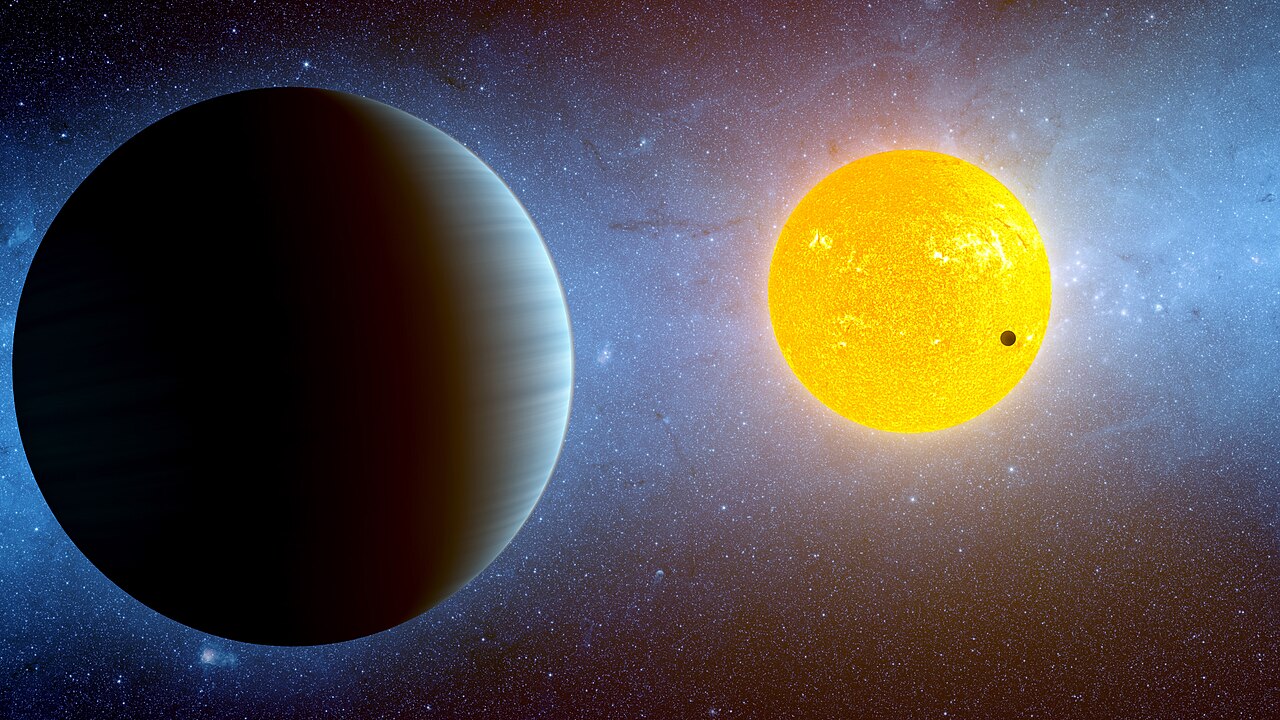
Kepler-10c is an exoplanet orbiting the G-type star Kepler-10, located about 608 light-years away in the constellation Draco. Its discovery was announced in May 2011 by the Kepler space telescope team, making it the third transiting planet to be confirmed statistically (based on probability rather than direct observation), after Kepler-9d and Kepler-11g. The planet was initially thought to be a massive rocky world, but later analysis revised its mass downward, suggesting a volatile-rich composition.
Quick Facts
- Discovered
- Announced May 23, 2011
- Discovery Method
- Transit (Kepler Mission)
- Apsis
- astron
- Semimajor
- 0.24070.0044 · 0.0053 AU
- Period
- 45.294850.00065 · 0.00076 d
- Inclination
- 89.650.09 · 0.12
- Star
- Kepler-10
- Density
- 3.14 0.63 · 0.55 g cm / −3
- Single Temperature
- T / eq / : 584 54 · 17 K
Facts from the source article.
Lore & Background
The discovery of Kepler-10c began with the detection of a longer-period dimming in Kepler-10's light curve, after the inner planet Kepler-10b was confirmed in January 2011. The signal, initially designated KOI 072.02, could not be confirmed by radial velocity measurements, so the Kepler team employed the BLENDER technique to rule out false positives. Observations with the Spitzer Space Telescope's IRAC instrument on August 30 and November 15, 2010, showed that the transiting object produced no color characteristic of stars, and the transit signal appeared identical in infrared and visible light. Speckle imaging from the WIYN Observatory's 3.5m telescope and adaptive optics from the PHARO camera on Palomar Observatory's 5m telescope, combined with Keck Observatory spectroscopy, ruled out contamination from nearby stars. BLENDER eliminated most alternatives, including hierarchical triple stars, leaving only the possibility of a background star or a transiting planet. Comparison with 1,235 other Kepler Objects of Interest led to statistical confirmation, and KOI 072.02 was renamed Kepler-10c, announced at the American Astronomical Society meeting in Boston on May 23, 2011. Kepler-10c was the first Kepler target observed by Spitzer to detect a shallow transit dip, and at the time Spitzer was the only facility capable of such analysis. The Kepler team noted that this statistical method would be necessary to confirm many planets in Kepler's field of view.
Reader's Guide
Kepler-10c holds significance as an early demonstration of statistical planet validation, a method the Kepler team considered essential for confirming many planets in the mission's field of view. It was the third transiting planet confirmed through statistical analysis rather than direct observation, following Kepler-9d and Kepler-11g. The planet's initial characterization suggested a high density and a mainly rocky composition with 5–20% ices by mass, leading to its classification as a potential 'mega-Earth.' However, more careful analysis in 2017 using HARPS-N and HIRES data revised its mass to about 7.37 Earth masses and a mean density of 3.14 g/cm³, indicating a volatile-rich world made almost entirely of water and other ices rather than rock. This revision highlights the challenges of exoplanet characterization and the importance of follow-up observations. Kepler-10c orbits its host star every 45.29485 days at 0.2407 AU, with an equilibrium temperature of 584 K. Its discovery and subsequent reclassification illustrate the evolving understanding of exoplanet demographics and the diversity of planetary compositions beyond the Solar System.
Did You Know?
- Kepler-10c was the third transiting planet confirmed statistically, after Kepler-9d and Kepler-11g.
- Its mass was revised from 15–19 Earth masses to about 7.37 Earth masses in 2017 using HARPS-N and HIRES data.
- The planet's equilibrium temperature of 584 K is nearly four times hotter than Jupiter's.
- Kepler-10c was the first Kepler target observed by the Spitzer Space Telescope to detect a shallow transit dip.
The Road to Confirmation
The identification of Kepler-10c as a genuine planet demanded a multi-instrument campaign spanning several observatories. After the inner world Kepler-10b was confirmed in January 2011, astronomers spotted a second, longer-period dimming in the star's light, hinting at an additional planet. Yet the signal could easily have been mimicked by a background star or a blended stellar system, and attempts to measure a radial-velocity wobble from the object—then catalogued as KOI 072.02—came up empty. To separate a true planet from these impostors, the team deployed a statistical tool called BLENDER, which systematically tested alternative explanations against the photometric data. The Spitzer Space Telescope's IRAC instrument observed the star on two occasions in late 2010, revealing that the transiting object produced no intrinsic color—a hallmark of a star—and that the transit depth looked identical in infrared and visible light. Ground-based speckle imaging at WIYN and adaptive-optics work at Palomar, together with spectroscopy from the Keck Observatory, eliminated a nearby contaminating star. After BLENDER ruled out hierarchical triple configurations and the signal was benchmarked against 1,235 other Kepler candidates, the team announced the confirmation at the American Astronomical Society meeting in Boston on May 23, 2011.
A World Reimagined
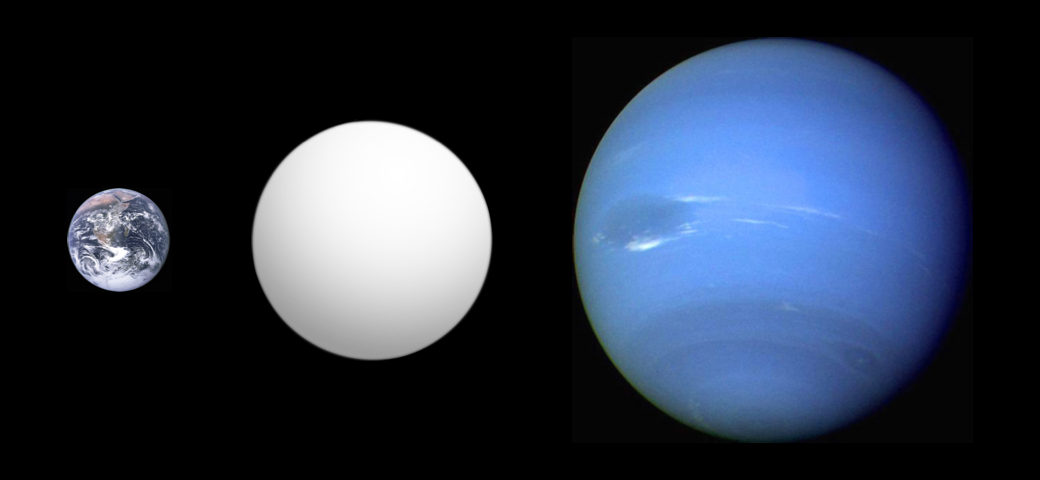
When Kepler-10c was first characterized, its radius appeared to be more than double that of Earth, and its inferred density pointed toward a predominantly rocky body carrying perhaps five to twenty percent ices by mass. For context, Earth's oceans account for only about 0.02 percent of the planet's total mass, with a modest additional water reservoir potentially locked in the mantle. Under that initial picture, Kepler-10c would have been a super-Earth with a modest icy veneer. The planet circles its host star every 45.3 days at a distance of roughly 0.24 astronomical units—about a quarter of the Sun-Earth separation—making it the outer of the two known worlds in the system, with the rocky Kepler-10b occupying the inner orbit. However, a 2017 reanalysis combining high-resolution data from the HARPS and HIRES spectrographs fundamentally changed the story. Rather than a large terrestrial world, Kepler-10c emerged as a typical volatile-rich planet with a mass of approximately seven Earths. This reclassification shifted the object from the super-Earth category into the realm of gas- or ice-dominated mini-Neptunes, reminding astronomers that early radius-and-density estimates can be misleading when the underlying mass measurement is uncertain.
An Ancient Solar Twin
Kepler-10, the G-type star that hosts both known planets, sits approximately 608 light-years from Earth in the constellation Draco. At 0.895 solar masses and 1.056 solar radii, it is slightly lighter than the Sun but almost the same size, with an effective temperature of 5,627 kelvin—noticeably cooler than our own star. More striking is its chemical makeup and age: the star is metal-poor, with an iron abundance measured at [Fe/H] = −0.15, meaning it contains roughly 29 percent less iron than the Sun. Its estimated age of about 10.6 billion years makes it an ancient object, having formed in the early epochs of the galaxy. Despite its solar-like appearance, Kepler-10 is far too faint to be seen without optical aid, carrying an apparent magnitude of 11.2. The combination of its advanced age, reduced metallicity, and the presence of two planets—one rocky and one volatile-rich—makes the system a valuable natural laboratory for studying how planetary architectures evolve over billions of years around stars that are only modestly different from our own Sun.
Pioneering Statistical Validation
Kepler-10c holds a distinctive place in the history of exoplanet detection because it was the third transiting planet to be validated through a purely statistical approach rather than direct radial-velocity measurement, following Kepler-9d and Kepler-11g. The Kepler team explicitly noted in the confirmation paper that this probabilistic method—anchored by the BLENDER analysis and cross-checked against 1,235 other candidates in the survey field—would become the primary route for confirming the large fraction of planets lurking in Kepler's field of view where individual radial-velocity signals are too weak to detect. The planet also marked a first for the Spitzer Space Telescope: it was the initial Kepler target for which Spitzer was tasked with detecting a shallow transit dip in the light curve, and at the time of the discovery Spitzer was the only facility capable of measuring such faint transits to a level where the data could be meaningfully analyzed. In this way, Kepler-10c became a proving ground for the very techniques that would later validate hundreds of additional worlds, establishing a methodological template for the statistical validation era of exoplanet science.
Gallery

Frequently Asked Questions
What is Kepler-10c?
Kepler-10c is a sub-Neptune-class exoplanet that circles the G-type star Kepler-10, roughly 608 light-years away in the constellation Draco. It completes one orbit every 45.3 days at a distance of about 0.24 AU from its host star.
How was Kepler-10c confirmed as a planet?
Rather than being verified through a second observed transit, the Kepler space telescope team validated it in May 2011 using a statistical probability framework. This made it the third exoplanet to earn confirmation purely through that method, after Kepler-9d and Kepler-11g.
What is Kepler-10c made of?
Early models painted it as a massive rocky super-Earth, but later analyses lowered its estimated mass and pointed toward a volatile-rich interior instead. Its radius of roughly 2.35 Earth radii places it firmly in the sub-Neptune category rather than the rocky-super-Earth one.
What does Kepler-10c's host star look like?
Kepler-10 is a G-type star slightly smaller and cooler than the Sun, with a surface temperature around 5,627 kelvin and an age estimated at about 10.6 billion years. It has a mass of 0.895 solar masses and a radius of 1.056 solar radii.
Why does Kepler-10c matter to exoplanet science?
It proved that a planet could be rigorously confirmed through probabilistic validation without a second direct transit detection, opening the door to confirming many more candidates. Its composition revision from rocky to volatile-rich also became a cautionary example of how initial super-Earth assumptions can shift as measurement precision improves.
More in Transiting Exoplanets 1-24
Spotted an error? Know more?
Reader corrections go straight into our review queue. Suggest an edit · How this site is sourced