Scott S. Sheppard
Discoverer of distant Solar System objects and many irregular moons.

George Eliot · Public domain
Scott S. Sheppard (born 1977) works as an astronomer at the Carnegie Institution for Science in Washington, DC, within its Department of Terrestrial Magnetism. He earned his undergraduate degree in physics with honors from Oberlin College in 1998 and began his graduate studies at the University of Hawaiʻi at Mānoa's Institute for Astronomy. Sheppard has been credited with finding many small moons around Jupiter, Saturn, Uranus, and Neptune. He also identified the first known trailing Neptune trojan, the first named leading Neptune trojan, and the first high-inclination Neptune trojan. These finds indicated that Neptune trojans mostly travel on highly tilted orbits, suggesting they are captured bodies from elsewhere in the Solar System. The main-belt asteroid 17898 Scottsheppard, discovered in 1999 by the LONEOS survey, was named in his honor.
Sheppard led the discovery of 2012 VP113, the object with the most distant known orbit in the Solar System. In 2014, the similarity of its orbit to other extreme Kuiper belt objects led Sheppard and Trujillo to propose that an unknown super-Earth—with a mass between two and fifteen times that of Earth—exists beyond 200 AU and up to 1500 AU, shepherding these smaller bodies into similar orbits. The extreme trans-Neptunian objects 2013 FT28 and 2014 SR349, announced in 2016 with Sheppard as a co-discoverer, further supported the idea of a massive planet beyond a few hundred AU. 2013 FT28 was the first known high semi-major axis, high-perihelion object anti-aligned with other known extreme objects. In 2018, Sheppard and colleagues announced 541132 Leleākūhonua, a high-perihelion inner Oort cloud object and only the third known after 2012 VP113 and Sedna, reinforcing the likelihood of a distant super-Earth.
Sheppard has been involved in discovering many small Solar System bodies, including trans-Neptunian objects, centaurs, comets, and near-Earth objects. Three comets bear his name: Sheppard-Trujillo, Sheppard-Tholen, and Trujillo-Sheppard. Possible dwarf planets he discovered include 471143 Dziewanna, 2010 KZ39, 2010 FX86, 532037 Chiminigagua, (523671) 2013 FZ27, and 2015 KH162. In 2018, he led the discovery of 2018 VG18, the most distant observed object in the Solar System and the first seen beyond 100 AU, at roughly 120 AU from the Sun.
- Born
- 1977
- Nationality
- American
- Undergraduate institution
- Oberlin College
- Bachelor degree year
- 1998
- Graduate institution
- Institute for Astronomy at the University of Hawaiʻi at Mānoa
- Employer
- Carnegie Institution for Science
- Asteroid named after him
- 17898 Scottsheppard
Lore & Background
Sheppard attended Oberlin College as an undergraduate, receiving his bachelor in physics with honors in 1998. He began as a graduate student at the Institute for Astronomy at the University of Hawaiʻi at Mānoa, where he was credited with the discovery of many small moons of Jupiter, Saturn, Uranus, and Neptune. He discovered the first known trailing Neptune trojan, 2008 LC18; the first named leading Neptune trojan, 385571 Otrera; and the first high inclination Neptune trojan, 2005 TN53. These discoveries showed that Neptune trojan objects are mostly on highly inclined orbits and thus likely captured small bodies from elsewhere in the Solar System.
Sheppard was the lead discoverer of 2012 VP113 (nicknamed Biden), the object with the most distant orbit known in the Solar System at the time. In 2014, the similarity of its orbit to other extreme Kuiper belt object orbits led Sheppard and Trujillo to propose that an unknown Super-Earth mass planet (2–15 Earth masses) beyond 200 AU and up to 1500 AU is shepherding these smaller bodies. The extreme trans-Neptunian objects 2013 FT28 and 2014 SR349, announced in 2016 and co-discovered by Sheppard, further supported this hypothesis. In 2018, the announcement of 541132 Leleākūhonua (nicknamed 'The Goblin') by Sheppard et al., being only the third known inner Oort cloud object after 2012 VP113 and Sedna, further demonstrated that a super-Earth planet in the distant Solar System likely exists.
Reader's Guide
Sheppard's discoveries have significantly shaped understanding of the outer Solar System. His identification of the first trailing, leading, and high-inclination Neptune trojans revealed that these objects are predominantly on highly inclined orbits, suggesting they are captured small bodies from elsewhere. The discovery of 2012 VP113, the most distant known object at the time, and its orbital similarity to other extreme Kuiper belt objects led Sheppard and Trujillo to propose the existence of a Super-Earth mass planet (2–15 Earth masses) beyond 200 AU, a hypothesis strengthened by subsequent discoveries of 2013 FT28, 2014 SR349, and 541132 Leleākūhonua. In 2018, Sheppard was the lead discoverer of 2018 VG18 (nicknamed Farout), the first object observed beyond 100 AU, at around 120 AU from the Sun. He also discovered a minor-planet moon around likely dwarf planet Chiminigagua and co-discovered a moon orbiting the binary trans-Neptunian object 341520 Mors–Somnus. His work on irregular moons of Jupiter, Saturn, Uranus, and Neptune, including moons like Margaret, Ferdinand, Psamathe, and S/2023 U 1, has expanded the known satellite systems of the giant planets. The main-belt asteroid 17898 Scottsheppard was named in his honor.
Institutional Home and Research Focus
Scott S. Sheppard is affiliated with the Carnegie Science Center, where his publicly accessible resource is dedicated to cataloging known extreme outer solar system objects. This focus places him squarely within the most remote and enigmatic corner of the Solar System's small-body population. While the broader trans-Neptunian field encompasses thousands of catalogued minor planets orbiting beyond Neptune's average distance of 30.1 astronomical units, Sheppard's particular interest lies in the subset whose orbits carry them to the very outermost reaches. His Carnegie Science Center page serves as a reference point within a larger ecosystem of data sources, including the Minor Planet Center's various lists and Johnston's Archive, which together track orbital parameters, diameters, albedos, and spectral classifications. By concentrating on the extreme end of the distribution, his work complements the broader census of cubewanos, resonant objects, and scattered-disc bodies that make up the rest of the trans-Neptunian population.
The Extreme Outer Solar System
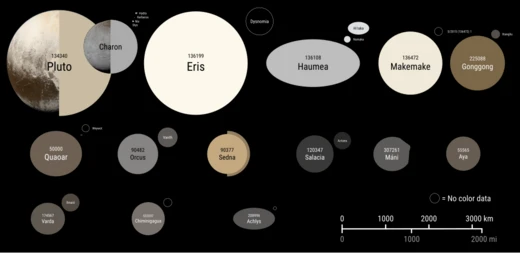
The category that defines Sheppard's research focus—extreme trans-Neptunian objects—includes three recognized subgroups: extreme scattered-disc objects, extreme detached objects, and sednoids. What unites them is a semi-major axis of at least 150 astronomical units combined with a perihelion that remains well beyond Neptune's orbit, meaning these bodies never venture close to the Sun even at their nearest approach. Among the largest known trans-Neptunian objects, Sedna stands out as a prominent example, sharing the dwarf-planet conversation with Pluto, Eris, Haumea, and Makemake, though it has not received official IAU dwarf-planet recognition. In the orbital parameter space that plots eccentricity and inclination against semi-major axis, sednoids account for eleven of the 1,418 objects mapped across all trans-Neptunian classes. Their extreme distances and unusual orbital geometries make them a natural subject for dedicated cataloging efforts at institutions like the Carnegie Science Center.
The Broader Trans-Neptunian Landscape
Sheppard's work on extreme objects exists within a vast and still-growing taxonomy of bodies beyond Neptune. As of May 2026, the minor-planet catalog holds 1,049 numbered trans-Neptunian objects, supplemented by 4,969 unnumbered bodies observed since 1993. These are conventionally divided among the Kuiper belt, the scattered disc, and the Oort cloud. The numbered population spans classical Kuiper belt objects (cubewanos), resonant subgroups such as plutinos and twotinos, scattered-disc objects, and the extreme detached and sednoid classes. Centaurs with sufficiently large semi-major axes are also included, their unstable orbits swinging from well inside Neptune's path to very distant aphelia. Most of these bodies share a low albedo near 0.09, with surface colors ranging from blue-grey to very red. A growing fraction are revealed to be binary or multiple systems, adding further complexity to the population Sheppard helps characterize at its outermost edge.
A Discovery Timeline Spanning Nine Decades
The field in which Sheppard operates has a history marked by long silences punctuated by rapid discovery. Pluto, the first trans-Neptunian object, was identified in 1930, yet it took more than sixty years before a second was found: Albion, provisionally designated 1992 QB1. Since that breakthrough, the pace has accelerated dramatically, with nearly five thousand additional unnumbered objects detected. The largest members of this population—Pluto, Eris, Haumea, Makemake, Gonggong, Quaoar, Sedna, and Orcus—have drawn formal IAU recognition as dwarf planets, with the exception of Gonggong, Sedna, and Orcus. A further tier of possible dwarf planets, including Salacia, Máni, Varda, Ixion, and Varuna, continues to be evaluated. For a researcher at the Carnegie Science Center tracking the most extreme of these distant worlds, this expanding roster represents both a rich dataset and an ongoing frontier of classification and understanding.
Gallery


Frequently Asked Questions
Who is Scott S. Sheppard?
Scott S. Sheppard is an American astronomer born in 1977 who specializes in discovering distant Solar System bodies and irregular moons. He is based at the Carnegie Institution for Science in Washington, DC, where he works within the Department of Terrestrial Magnetism.
What is Scott S. Sheppard most famous for discovering?
He is widely credited with identifying numerous small irregular moons orbiting Jupiter, Saturn, Uranus, and Neptune. He also made landmark finds among Neptune's trojan population, including the first known trailing Neptune trojan, the first named leading Neptune trojan, and the first high-inclination Neptune trojan.
Where does Scott S. Sheppard work?
He is employed by the Carnegie Institution for Science in Washington, DC, specifically within its Department of Terrestrial Magnetism.
Why is Scott S. Sheppard important to trans-neptunian object research?
His discoveries broadened the known inventory of irregular moons around the giant planets and revealed entirely new dynamical classes of Neptune trojans that had never been catalogued before. These findings gave astronomers fresh clues about the formation and long-term evolution of the outer Solar System.
More in Trans-Neptunian Objects, Part 2 1-24
Spotted an error? Know more?
Reader corrections go straight into our review queue. Suggest an edit · How this site is sourced