2013 FS28
A detached extreme trans-Neptunian object on a highly eccentric orbit.

2013 FS28 is a large, distant object in the Solar System, located in the extended scattered disc. It follows a highly elongated orbit and is about 470 kilometers (290 miles) across. This detached body is classified as an extreme trans-Neptunian object.
Discovered on March 16, 2013, by American astronomers Scott Sheppard and Chad Trujillo using the 4-meter Blanco Telescope at Cerro Tololo Observatory in Chile, the object has not yet been assigned a number or official name by the Minor Planet Center as of 2025. The official discoverers will be determined once it is numbered.
The object currently sits about 83 AU (12.4 billion km) from the Sun, based on a seven-year observation arc. Its orbit carries it from roughly 36 AU to 240 AU, taking about 1,600 years to complete one revolution. The orbit is highly eccentric (0.7) and tilted 13° relative to the ecliptic. Its closest possible approach to Neptune is 9 AU. With a perihelion distance of at least 30 AU and a semi-major axis of 150 AU or more, it belongs to a small group of detached objects. Such extreme trans-Neptunian objects cannot reach these orbits without the influence of another body, leading to speculation about the existence of Planet Nine. It will reach perihelion around December 2119.
Estimates from Johnston's Archive and astronomer Michael Brown put its diameter at 464 to 468 kilometers, assuming albedos of 0.09 and 0.07, respectively. As of 2018, no rotational lightcurve has been obtained, so its rotation period, pole orientation, and shape remain unknown.
- Diameter
- 464–468 km (based on assumed albedo of 0.09 and 0.07)
- Discovery date
- 16 March 2013
- Discoverers
- Scott Sheppard and Chad Trujillo
- Discovery site
- Cerro Tololo Observatory, Chile
- Distance from sun
- 83 AU (12.4 billion km)
- Orbital period
- ~1600 years
- Eccentricity
- 0.7
- Inclination
- 13°
- Perihelion date
- December 2119
Lore & Background
2013 FS28 was discovered on 16 March 2013 by American astronomers Scott Sheppard and Chad Trujillo at the Cerro Tololo Observatory in Chile, using the 4-meter Blanco Telescope. As of 2025, this minor planet has neither been numbered nor named by the Minor Planet Center; the official discoverer(s) will be defined when the object is numbered. Its observation arc began with its first official observation in March 2013.
The object orbits the Sun at a distance of roughly 36–240 AU once every 1600 years, with a high eccentricity of 0.7 and an inclination of 13° with respect to the ecliptic. It has a minimum orbital intersection distance with Neptune of 9 AU. It belongs to a small group of detached objects with perihelion distances of 30 AU or more and semi-major axes of 150 AU or more. Such extreme trans-Neptunian objects (ETNOs) cannot reach such orbits without some perturbing object, which has led to speculation of Planet Nine. It comes to perihelion around December 2119.
According to Johnston's Archive and American astronomer Michael Brown, 2013 FS28 measures 464 and 468 kilometers in diameter based on assumed albedos of 0.09 and 0.07, respectively. As of 2018, no rotational lightcurve has been obtained from photometric observations; the body's rotation period, pole, and shape remain unknown.
Reader's Guide
2013 FS28 is notable as an extreme trans-Neptunian object (ETNO) from the extended scattered disc, with a highly eccentric orbit that takes it from about 36 AU to 240 AU from the Sun. Its detached orbit—with a perihelion distance of 30 AU or more and a semi-major axis of 150 AU or more—places it among a small group of objects that cannot have reached such orbits without the gravitational influence of a perturbing body, a key piece of evidence in the speculation of a hypothetical Planet Nine. The object's diameter, estimated at roughly 470 kilometers, makes it a sizable but still poorly characterized body; no rotational lightcurve has been obtained, leaving its rotation period, pole, and shape unknown. Its discovery in March 2013 by Scott Sheppard and Chad Trujillo at Cerro Tololo Observatory, and its subsequent lack of numbering or naming as of 2025, underscore its status as a relatively recent and still-unresolved addition to the catalog of distant Solar System objects. The 7-year observation arc provides orbital parameters but leaves many physical details uncertain.
Did You Know?
- It has an orbital period of roughly 1600 years and comes to perihelion around December 2119.
- Its diameter is estimated at 464–468 kilometers based on assumed albedos of 0.09 and 0.07.
Frequently Asked Questions
What is 2013 FS28?
2013 FS28 is a large, detached extreme trans-Neptunian object residing in the extended scattered disc, roughly 465 kilometers across. It follows a highly eccentric orbital path that carries it far beyond the typical TNO population.
Who discovered 2013 FS28 and where?
American astronomers Scott Sheppard and Chad Trujillo spotted the object on March 16, 2013, using the 4-meter Blanco Telescope at Cerro Tololo Observatory in Chile. As of 2025, the Minor Planet Center has not yet assigned it a permanent number or official name.
How far is 2013 FS28 from the Sun and how long is its orbit?
The object currently sits about 83 astronomical units, roughly 12.4 billion kilometers, from the Sun, and it takes approximately 1,600 years to complete one full revolution. Its highly elongated path makes it one of the more extreme detached TNOs known.
How big is 2013 FS28 compared to other TNOs?
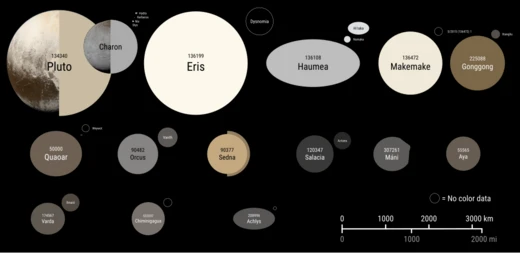
With an estimated diameter of 464 to 468 kilometers, 2013 FS28 is one of the larger known extreme trans-Neptunian objects. That places it well above many smaller scattered-disc bodies, though it remains smaller than giants like Pluto or Eris.
Why is 2013 FS28 important to TNO research?
As a detached extreme TNO on a highly eccentric orbit, it helps astronomers map the outermost gravitational architecture of the Solar System. Its size and orbital parameters provide useful data for understanding how material was distributed beyond Neptune during the system's formation.
More in Trans-Neptunian Objects, Part 2 1-24
Spotted an error? Know more?
Reader corrections go straight into our review queue. Suggest an edit · How this site is sourced