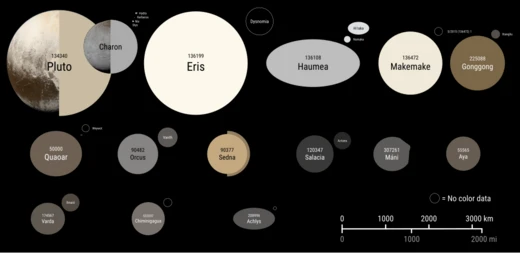
2013 UH15
A detached extreme trans-Neptunian object from the extended scattered disc.

2013 UH15 is a small, distant object located in the outermost reaches of the Solar System, roughly 130 kilometers across. It belongs to a category known as extreme trans-Neptunian objects, specifically from the extended scattered disc. First spotted on October 29, 2013, by astronomers using the Las Campanas Observatory in Chile’s Atacama Desert, this body follows a highly stretched orbit.
Its path around the Sun takes it from as close as 35.0 AU to as far as 305 AU, completing one full orbit every 2,221 years. The orbit has an eccentricity of 0.79 and is tilted about 26° relative to the plane of the planets. The closest it ever gets to Neptune is 12.9 AU. Objects like this, with perihelion distances of at least 30 AU and semi-major axes of 150 AU or more, are considered detached. Their unusual orbits suggest the influence of an unseen perturbing body, often linked to the Planet Nine hypothesis.
As of 2025, this minor planet has not yet received a number or a name from the Minor Planet Center. Its official discoverers will be determined once it is numbered.
Estimates of its size come from Johnston's Archive and astronomer Michael Brown, who calculate a diameter of 128 to 130 kilometers, assuming an albedo between 0.08 and 0.09. Because it is relatively small, Brown classifies it as "probably not" a dwarf planet. No rotational lightcurve has been measured, so its rotation period, shape, and pole orientation remain unknown.
- First observed
- 29 October 2013
- Observatory
- Las Campanas Observatory, Atacama Desert, Chile
- Diameter
- 128–130 km
- Semi major axis
- 170.2 AU
- Eccentricity
- 0.79
- Inclination
- 26°
- Perihelion distance
- 35.0 AU
- Aphelion distance
- 305 AU
- Orbital period
- 2221 years
Lore & Background
2013 UH15 orbits the Sun at a distance of 35.0–305 AU once every 2221 years, with a semi-major axis of 170.2 AU. Its orbit has an exceptionally high eccentricity of 0.79 and an inclination of 26° with respect to the ecliptic. The body's observation arc begins with its official first observation at Las Campanas in October 2013. It has a minimum orbital intersection distance with Neptune of 12.9 AU. It belongs to a small group of detached objects with perihelion distances of 30 AU or more and semi-major axes of 150 AU or more. These extreme trans-Neptunian objects (ETNOs) cannot reach such orbits without some perturbing object, which leads to the speculation of Planet Nine.
As of 2025, this minor planet has neither been numbered nor named by the Minor Planet Center. The official discoverers will be defined when the object is numbered. According to Johnston's Archive and to American astronomer Michael Brown, 2013 UH15 measures 128 and 130 kilometers in diameter based on an assumed albedo of 0.09 and 0.08, respectively. Due to its small size, it is listed as 'probably not' a dwarf planet on Michael Brown's website. As of 2018, no rotational lightcurve has been obtained from photometric observations; the body's rotation period, pole and shape remain unknown.
Reader's Guide
2013 UH15 is significant as an extreme trans-Neptunian object (ETNO) from the extended scattered disc, a class of detached objects whose orbits cannot be explained by Neptune's influence alone. Its highly eccentric orbit (eccentricity 0.79) and large semi-major axis (170.2 AU) place it among the small group of objects that fuel speculation about a hypothetical Planet Nine, as such orbits require a perturbing body. The object's diameter of approximately 130 kilometers places it below the threshold for likely dwarf planet status, according to Michael Brown's classification. Its discovery at Las Campanas Observatory in 2013 adds to the census of distant Solar System bodies, though it remains unnumbered and unnamed as of 2025. The lack of a rotational lightcurve means its physical properties beyond size are unknown, highlighting the observational challenges of studying such distant objects.
Did You Know?
- 2013 UH15 was first observed on 29 October 2013 at Las Campanas Observatory in Chile.
- It has an orbital period of 2221 years and a semi-major axis of 170.2 AU.
- Its diameter is estimated at 128–130 kilometers, based on assumed albedos of 0.09 and 0.08.
- As of 2025, it has not been numbered or named by the Minor Planet Center.
Frequently Asked Questions
What is 2013 UH15?
It is a small, icy body roughly 130 km in diameter that circles the Sun in the far outer Solar System. It is classified as a detached extreme trans-Neptunian object originating from the extended scattered disc.
When and where was 2013 UH15 first spotted?
Astronomers detected it on October 29, 2013, using the telescopes at Las Campanas Observatory in Chile's Atacama Desert.
How extreme is 2013 UH15's orbital path?
Its orbit swings from about 35 AU at closest approach out to 305 AU at its farthest point, with a semi-major axis of 170.2 AU and an eccentricity of 0.79. A single trip around the Sun takes roughly 2,221 years, and the path is tilted about 26° from the ecliptic plane.
What TNO classification does 2013 UH15 fall under?
It is a detached extreme trans-Neptunian object, meaning its perihelion sits far enough from Neptune that the giant planet no longer significantly scatters its trajectory. Its origin is traced to the extended scattered disc population.
Why do TNO fans consider 2013 UH15 noteworthy?
Its highly elongated orbit and great distance make it a useful natural probe of the outer Solar System's architecture and the dynamical processes that flung scattered-disc bodies outward. At only about 130 km across, it also sits near the smaller end of the extreme TNO population that remains detectable from Earth.
More in Trans-Neptunian Objects, Part 2 1-24
Spotted an error? Know more?
Reader corrections go straight into our review queue. Suggest an edit · How this site is sourced