David L. Rabinowitz
Astronomer who discovered possible dwarf planets and reduced asteroid estimates.

israel zeller ישראל זלר · CC BY 2.5
David Lincoln Rabinowitz (born 1960) is an American astronomer and researcher at Yale University, noted for building CCD cameras and software for detecting near-Earth and Kuiper belt objects. He helped reduce the estimated number of near-Earth asteroids larger than 1 km by half, from 1,000–2,000 to 500–1,000, and participated in the discovery of several possible dwarf planets.
- Born
- 1960
- Nationality
- American
- Institution
- Yale University
- Minor planets discovered
- 34
- Discovery period
- 1989–2010
- Notable discoveries
- 90377 Sedna, 90482 Orcus, Eris, Haumea, Makemake, 5145 Pholus, 1991 BA
Lore & Background
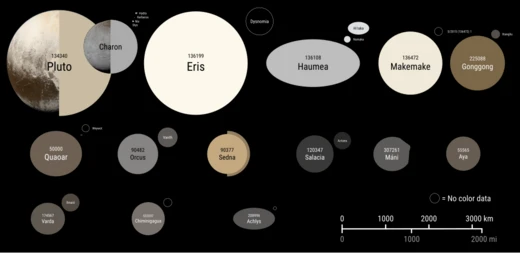
David Rabinowitz collaborated with Michael Brown and Chad Trujillo of the Quasar Equatorial Survey Team to discover several possible dwarf planets, including 90377 Sedna (possibly the first known inner Oort cloud object), 90482 Orcus, Eris (more massive than Pluto), Haumea, and Makemake, though no one would get credit for Haumea. He also discovered or co-discovered 5145 Pholus – a Centaur credited to Spacewatch – and the unnumbered Apollo near-Earth object 1991 BA, which remains uncredited. The minor planet 5040 Rabinowitz, a Phocaea asteroid discovered by Tom Gehrels in 1972, was named in his honor.
Reader's Guide
Rabinowitz's work with CCD cameras and software advanced the detection of near-Earth and Kuiper belt objects, directly halving the estimated number of near-Earth asteroids larger than 1 km. His discoveries of possible dwarf planets such as Eris, Sedna, Orcus, Haumea, and Makemake contributed to understanding the outer Solar System and the origin of the Oort cloud. He also assisted in detecting supernovae and quasars, helping to study dark energy and the accelerated expansion of the universe. The naming of asteroid 5040 Rabinowitz recognizes his contributions to the Spacewatch project. His credited discoveries of 34 minor planets from 1989 to 2010 include objects with unusual orbits, such as 1992 AD (Pholus) with a comet-like orbit of 92.26 years between Saturn and Neptune, and 1993 Nessus with an orbit of 123.2 years between Saturn and Pluto.
Did You Know?
- He co-discovered Eris, which is more massive than Pluto.
- The minor planet 5040 Rabinowitz was named in his honor.
- He discovered 1992 AD (Pholus), which has a comet-like orbit of 92.26 years without a tail.
Gallery






Frequently Asked Questions
Who is David L. Rabinowitz?
He is an American astronomer born in 1960 who is affiliated with Yale University. He is best known for designing CCD camera hardware and detection software that helped identify objects in the Kuiper belt and near Earth.
What are David L. Rabinowitz's most famous discoveries?
Among his 34 minor-planet finds made between 1989 and 2010, the standouts are Sedna, Orcus, Eris, Haumea, and Makemake—bodies now recognized as confirmed or candidate dwarf planets.
How did Rabinowitz's work change near-Earth asteroid estimates?
His systematic detection campaigns helped halve the projected count of large (over 1 km) near-Earth asteroids, narrowing the estimate from roughly 1,000–2,000 down to about 500–1,000.
Where is David L. Rabinowitz based?
He conducts his research at Yale University, where he built the imaging systems and software that form the backbone of his trans-Neptunian and near-Earth object surveys.
Why is David L. Rabinowitz important to TNO research?
He provided the technical infrastructure—custom CCD cameras and detection pipelines—that made it possible to catalog dozens of distant solar-system bodies, including several that reshaped our understanding of dwarf-planet candidates.
More in Trans-Neptunian Objects, Part 2 1-24
Spotted an error? Know more?
Reader corrections go straight into our review queue. Suggest an edit · How this site is sourced