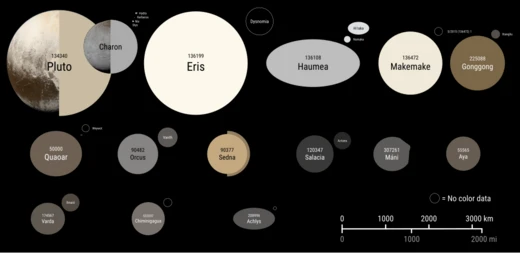
2010 GB174
Detached object with third-highest Jupiter Tisserand parameter among TNOs.

Atelier Jaeger · Public domain
2010 GB174 is a detached object first identified on April 12, 2010, from observations made with the Canada–France–Hawaii Telescope during the Next Generation Virgo Cluster Survey. Its orbit never brings it within 48.5 AU of the Sun, roughly the outer boundary of the Kuiper belt. The object’s high eccentricity points to a past gravitational scattering event that placed it on its current path. Like other detached objects, it lies beyond Neptune’s present gravitational influence, leaving the origin of its orbit uncertain. Among all trans-Neptunian objects, 2010 GB174 has the third highest Tisserand parameter with respect to Jupiter, trailing only Sedna and 2012 VP113. It has not been observed since 2015. Each year, it reaches opposition in late March within the constellation Virgo. Precovery images extend its observation record back to June 26, 2009. The object reached perihelion around mid-1951 and had moved beyond 70 AU by September 2014. Computer simulations based on Solar System formation models suggest that 2010 GB174, along with Sedna, may belong to the inner edge of the Oort cloud.
- Discovery date
- 12 April 2010
- Discovery telescope
- Canada–France–Hawaii Telescope
- Survey
- Next Generation Virgo Cluster Survey
- Minimum distance from sun
- 48.5 AU
- Perihelion date
- mid-1951
- Distance in september 2014
- beyond 70 AU
- Precovery earliest date
- 26 June 2009
- Opposition constellation
- Virgo
- Last observed year
- 2015
Lore & Background
2010 GB174 is classified as a detached object, meaning it is outside the current gravitational influence of Neptune. Its large orbital eccentricity strongly suggests it was gravitationally scattered onto its current orbit, though how it arrived there remains unknown. It has not been observed since 2015. The object comes to opposition in late March each year in the constellation of Virgo. Precovery images have been found back to 26 June 2009. It reached perihelion in mid-1951 and had moved beyond 70 AU by September 2014. Numerical simulations based on models of Solar System formation suggest that 2010 GB174, along with Sedna, may be part of the inner edge of the Oort cloud.
Reader's Guide
2010 GB174 holds significance as a detached object whose orbit places it beyond Neptune's influence, raising questions about its origin. Its large eccentricity indicates a past gravitational scattering event, but the mechanism remains unknown. The object's high Tisserand parameter relative to Jupiter—third among all trans-Neptunian objects, after Sedna and 2012 VP113—highlights its unusual orbital dynamics. Numerical simulations suggest it may belong to the inner edge of the Oort cloud, linking it to the broader structure of the Solar System's outer reaches. Its discovery as part of the Next Generation Virgo Cluster Survey underscores the serendipitous nature of such finds. The lack of observations since 2015 limits further study, but precovery images extending back to 2009 provide a longer observational arc. The object's perihelion in mid-1951 and its current distance beyond 70 AU illustrate its slow, distant journey. Its opposition in Virgo each late March aids targeted observations.
Did You Know?
- 2010 GB174 never gets closer than 48.5 AU from the Sun.
- It has the third highest Tisserand parameter relative to Jupiter of any trans-Neptunian object.
- Precovery images of 2010 GB174 have been found back to 26 June 2009.
Discovery and the Survey That Found It
2010 GB174 came to light on 12 April 2010, though it had been quietly drifting through the telescope's field of view for nearly a year before that. The identification was made using data captured at the Canada–France–Hawaii Telescope, collected as part of the Next Generation Virgo Cluster Survey—a program not originally designed to hunt for distant solar-system bodies, but whose wide-field imaging proved serendipitous. Precovery analysis later pushed the object's known history back to 26 June 2009, confirming that it had been present in earlier frames all along. Since its formal discovery, follow-up observations have been sparse; the object has not been detected since 2015. For observers hoping to catch it, the best window arrives in late March of each year, when it reaches opposition against the backdrop of the constellation Virgo. The combination of a survey not aimed at trans-Neptunian objects and the sheer distance of the body made 2010 GB174 a classic case of a distant wanderer stumbling into the wrong dataset.
Orbital Architecture and the Detached Classification
2010 GB174 is classified as a detached object, a category defined by orbits that remain well beyond the gravitational reach of Neptune. Its perihelion never dips below 48.5 astronomical units, placing the closest approach to the Sun right around the outer boundary of the Kuiper belt. The orbit is notably eccentric, and the object's Tisserand parameter relative to Jupiter ranks third among all known trans-Neptunian objects, trailing only Sedna and 2012 VP113. That high value signals a dynamically distinct population. The body reached its perihelion in mid-1951, and by September 2014 it had already swung out beyond 70 AU, illustrating the vast scale of its orbital path. Because it operates entirely outside Neptune's sphere of influence, the usual resonant or scattering mechanisms that shape most Kuiper belt dynamics simply do not apply. This places 2010 GB174 in a small and peculiar group of objects whose orbital parameters set them apart from the rest of the trans-Neptunian census.
The Scattering Puzzle
The most striking feature of 2010 GB174's orbit is its large eccentricity, a trait that astronomers interpret as strong evidence the body was once gravitationally scattered onto its present path. Yet a fundamental question remains unanswered: because the object sits entirely outside Neptune's current gravitational domain, the planet cannot be the agent that delivered it to this orbit. No other known mechanism in the present-day Solar System readily accounts for the kind of energetic kick required. This leaves the origin of 2010 GB174's trajectory as an open problem in celestial mechanics. The fact that it shares its detached classification and high Tisserand parameter with only a handful of other bodies—Sedna and 2012 VP113 being the most prominent—suggests that whatever process placed it here may have been rare, ancient, or both. Until a plausible dynamical pathway is identified, the object's orbital history remains one of the small but important unsolved puzzles at the outer frontier of the Solar System.
A Possible Window into the Inner Oort Cloud
Numerical simulations that model the formation and early evolution of the Solar System have pointed to an intriguing possibility: 2010 GB174, together with Sedna, may represent the innermost fringe of the Oort cloud. If that interpretation holds, the object would not be a simple trans-Neptunian body but rather a member of the vast, diffuse reservoir of icy bodies that surrounds the Sun at extreme distances. The simulations suggest that during the early, more chaotic epochs of planetary formation, objects like 2010 GB174 could have been nudged onto their current highly eccentric orbits by interactions with the young giant planets or by the gravitational influence of passing stellar companions. The object's position—detached from Neptune, with a perihelion near 48.5 AU and an aphelion extending well beyond 70 AU—fits the profile of a body caught between the structured Kuiper belt and the more distant Oort cloud. Confirming or refuting this link would sharpen our understanding of how the outer Solar System assembled itself.
Gallery

Frequently Asked Questions
What is 2010 GB174?
2010 GB174 is a detached trans-Neptunian object whose orbit keeps it at least 48.5 AU from the Sun at every point. It was first detected on April 12, 2010, and sits well beyond Neptune's current gravitational reach.
How was 2010 GB174 discovered?
The object was identified on April 12, 2010, using the Canada–France–Hawaii Telescope. The detection came as part of the Next Generation Virgo Cluster Survey, which was not originally designed to hunt for solar-system bodies.
Why is 2010 GB174's orbit considered unusual?
Its high eccentricity suggests it was once flung onto this path by a gravitational encounter with a larger body. Because its perihelion of 48.5 AU places it outside the main Kuiper belt, its exact orbital origin remains unclear.
What makes 2010 GB174 stand out among all TNOs?
It holds the third-highest Jupiter Tisserand parameter of any known trans-Neptunian object, a measure that helps astronomers sort bodies by their dynamical history. This makes it a useful data point for understanding how detached objects were scattered outward.
Where is 2010 GB174 in its orbit right now?
The object reached perihelion around mid-1951 and has been drifting outward since then. By September 2014 it was already past 70 AU from the Sun and continues on a long, slow arc back toward the inner system.
More in Trans-Neptunian Objects, Part 2 1-24
Spotted an error? Know more?
Reader corrections go straight into our review queue. Suggest an edit · How this site is sourced