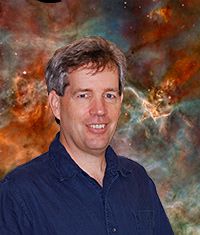
Keith S. Noll
American planetary scientist and discoverer of many Kuiper belt binaries.

Keith S. Noll (born 1958) is an American planetary scientist known for his work at NASA's Goddard Space Flight Center and the Space Telescope Science Institute. He is notable for his extensive research on trans-Neptunian objects and for discovering more than 75% of all then-known binary asteroids in the Kuiper belt by about 2020.
- Born
- 1958
- Nationality
- American
- Field
- planetary scientist
- Employer
- NASA's Goddard Space Flight Center
- Position held
- chief of GSFC's Planetary Systems Laboratory (2011–2017)
- Project scientist
- Lucy mission (since 2015)
- Binary discovery share
- more than 75% of all then-known binary asteroids in the Kuiper belt by about 2020
Lore & Background
Keith S. Noll works at NASA's Goddard Space Flight Center as a planetary astronomer. Before coming to GSFC, he worked at the Space Telescope Science Institute for 20 years, where he founded the Hubble Heritage Project in 1998. He became chief of GSFC's Planetary Systems Laboratory in 2011, a position he held for six years. Since 2015, he has served as the Lucy mission’s project scientist.
His research interests include the study of small bodies in the Solar System, the atmospheres of giant planets, brown dwarfs, Saturn's moon Titan, and icy satellites. He has focused on the study of trans-Neptunian objects, particularly with the Hubble Space Telescope. By about 2020, he was responsible for discovering more than 75% of all then-known binary asteroids in the Kuiper belt. Noll is interested in identifying opportunities for studying material from the early Solar System that is accessible to Earth-based missions like Lucy.
In 1993, Noll became a member of the International Astronomical Union. Since 2007, he has been a member of the Working Group Small Body Nomenclature, the section of the IAU responsible for naming minor planets, and became its vice-chair in 2023. In 2006, the Mars-crossing asteroid 6386 Keithnoll was named in his honor.
Reader's Guide
Keith S. Noll's significance lies in his transformative contributions to the study of trans-Neptunian objects, particularly through his use of the Hubble Space Telescope. By about 2020, he had discovered more than 75% of all then-known binary asteroids in the Kuiper belt, a remarkable achievement that greatly expanded knowledge of these distant, primitive bodies. His co-discoveries include the binary nature of the trans-Neptunian object 58534 Logos and of 16974 Iphthime, the third known binary Jupiter trojan, as well as several minor-planet moons such as Hiisi, Ilmarë, Thorondor, Echidna, Actaea, G!o'e !Hu, and the moon of 38628 Huya. His role as project scientist for the Lucy mission since 2015 aligns with his interest in studying material from the early Solar System accessible to Earth-based missions. Additionally, his long service on the IAU's Working Group Small Body Nomenclature, including becoming vice-chair in 2023, underscores his influence in the formal naming of minor planets. The naming of asteroid 6386 Keithnoll in his honor in 2006 reflects the recognition of his work by the astronomical community.
Gallery
Frequently Asked Questions
Who is Keith S. Noll?
He is an American planetary scientist born in 1958 who has dedicated his career to studying small bodies beyond Neptune. He has been affiliated with NASA's Goddard Space Flight Center and the Space Telescope Science Institute.
What is Keith S. Noll most famous for in the TNO community?
By roughly 2020 he had identified more than three-quarters of all then-known binary asteroids in the Kuiper belt, making him the single most prolific discoverer in that niche. His cataloging work fundamentally shaped how the field tracks paired objects past Neptune.
What leadership position did Keith S. Noll hold at NASA?
Between 2011 and 2017 he served as head of the Planetary Systems Laboratory at Goddard Space Flight Center. In that role he oversaw a team focused on understanding small bodies in the outer solar system.
What is the Lucy mission and how is Keith S. Noll involved?
Lucy is a NASA spacecraft designed to fly past Jupiter's Trojan asteroids, and Noll has served as its project scientist since 2015. His job involves turning the mission's scientific goals into concrete operational requirements for the flight team.
Why do TNO fans consider Keith S. Noll a central figure in the field?
His decades of cataloging Kuiper belt binaries gave the community a far richer picture of how small bodies pair up beyond Neptune. Combined with his GSFC leadership and his ongoing work on Lucy, he has become one of the most visible names in outer-solar-system science.
More in Trans-Neptunian Objects, Part 2 1-24
Spotted an error? Know more?
Reader corrections go straight into our review queue. Suggest an edit · How this site is sourced