Chad Trujillo
Co-discoverer of Eris, the most massive known dwarf planet.

Orion415 · CC BY-SA 4.0
Chadwick A. Trujillo (born November 22, 1973) is an American astronomer who specializes in the outer Solar System, particularly trans-Neptunian objects (TNOs). He is notable as the co-discoverer of several major TNOs, including Eris, the most massive dwarf planet known in the Solar System, and Makemake, one of the first five official dwarf planets.
- Notable discoveries
- Co-discoverer of Eris, Makemake, Quaoar, Sedna, Orcus; also claimed co-discoverer of Haumea
Lore & Background
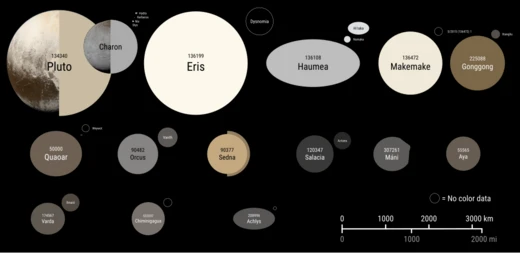
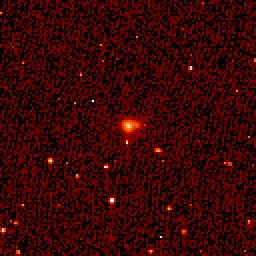
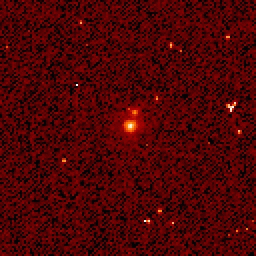
Trujillo attended Oak Park and River Forest High School in Oak Park, Illinois, then earned a B.Sc. in physics from MIT in 1995 and a Ph.D. in astronomy from the University of Hawaiʻi in 2000. He was a postdoctoral scholar at Caltech from 2000 to 2003, then worked as an astronomer at the Gemini Observatory in Hawaii. In 2013 he became head of the Adaptive Optics/Telescope Department at Gemini, serving until 2016, after which he joined Northern Arizona University as assistant professor. Trujillo, along with Michael Brown and David Rabinowitz, discovered Eris in 2003. Because of its satellite Dysnomia, Eris became the first TNO known to be more massive than Pluto. The discovery led to Eris being initially considered the tenth planet by Trujillo, his team, NASA, and many others, but the International Astronomical Union later classified it as a dwarf planet. Trujillo also co-discovered Quaoar, Sedna (possibly the first known inner Oort cloud object), Orcus, and Makemake. The discovery of Haumea was also claimed by Trujillo's team, but that claim is disputed by the Sierra Nevada Observatory in Spain.
Reader's Guide
Trujillo's work with computer software and his examination of TNO orbits advanced the understanding of the Kuiper belt and outer Solar System. His co-discovery of Eris, the first TNO found to be more massive than Pluto, directly challenged Pluto's status as the ninth planet and contributed to the International Astronomical Union's creation of the dwarf planet category. The discovery of Sedna as a possible inner Oort cloud object expanded knowledge of the Solar System's outermost regions. Trujillo's credited discoveries of 88 minor planets, including several possible dwarf planets, have provided key data for studying the composition, dynamics, and history of the trans-Neptunian region. The main-belt asteroid 12101 Trujillo was named in his honor, and in 2006 he was named a Science Spectrum Magazine Trailblazer as a top minority in science.
Did You Know?
- Trujillo co-discovered Eris, the only known TNO more massive than Pluto.
- The main-belt asteroid 12101 Trujillo is named for him.
Pioneering Discoveries in the Outer Dark
Chad Trujillo, working alongside Scott S. Sheppard, made a series of remarkable discoveries of extreme trans-Neptunian objects that expanded humanity's understanding of the Solar System's outermost reaches. Among their finds was 2013 FT28, whose longitude of perihelion aligns with the proposed orbit of Planet Nine, though it sits well within that hypothetical body's path where computer modeling indicates it would remain safe from gravitational kicks. Their discovery of 2014 SR349 proved equally significant, as this object appears anti-aligned with Planet Nine, reinforcing the statistical pattern that suggests an unseen massive body is sculpting these distant orbits. Perhaps most striking was 2014 FE72, an object whose orbit stretches to roughly 4,000 AU from the Sun in a massively elongated ellipse. At such extreme distances, the object's trajectory is no longer governed solely by the Sun's gravity but is influenced by the galactic tide and the gravitational pull of other stars. These discoveries collectively demonstrated that the outer Solar System harbors objects with orbital architectures far more exotic than previously catalogued.
The Statistical Signature of a Hidden World
The known population of extreme trans-Neptunian objects exhibits a highly statistically significant asymmetry in the distribution of object pairs with small ascending and descending nodal distances. This pattern, which Trujillo and Sheppard highlighted in their 2014 study, may be indicative of a response to external perturbations from a hypothetical Planet Nine. The gravitational influence of such a distant body could shepherd these objects into similar types of orbits, explaining why some cluster in alignment with the proposed ninth planet while others, like 2014 SR349, appear anti-aligned. Objects such as 2015 KG163, discovered through the Outer Solar System Origins Survey, share an orientation similar to 2013 FT28 but possess a larger semi-major axis that may cause its orbit to cross Planet Nine's path. Meanwhile, 2015 RX245 fits neatly into the anti-aligned group. Even 2015 GT50 defies simple categorization, with its orbital orientation at a right angle to the proposed Planet Nine and its argument of perihelion falling outside the expected cluster. These collective patterns strengthen the case for an unseen gravitational architect in the deep outer Solar System.
Defining the Architecture of the Outer Frontier
Trujillo's work helped crystallize the taxonomy of extreme trans-Neptunian objects into three distinct subgroups, each defined by its perihelion distance and degree of interaction with the giant planets. The scattered ETNOs, or extreme scattered disc objects, have perihelia around 38 to 45 AU and eccentricities exceeding 0.85, likely formed through gravitational scattering by Neptune. The detached ETNOs, or extreme detached disc objects, occupy perihelia between roughly 40-45 and 50-60 AU, placing them less vulnerable to Neptune's perturbations yet still relatively close to the ice giant. At the far extreme sit the sednoids or inner Oort cloud objects, whose perihelia extend beyond 50-60 AU, far enough that Neptune's gravitational influence becomes negligible. Sedna and 2012 VP113 exemplify this group with perihelia greater than 70 AU. Earlier explanations for Sedna's extreme perihelion included a close encounter with an unknown distant planet or a flyby by a random star from the Sun's birth cluster. Trujillo's contributions helped formalize how these categories relate to one another and to the broader question of what forces shape the outermost Solar System.
Growing the Catalog and Extending the Search
Since the early 2010s, the catalog of known extreme trans-Neptunian objects has steadily grown. The Outer Solar System Origins Survey, associated with Trujillo and Sheppard's research program, contributed additional members including 2013 SY99, which notably has a lower inclination than many of its peers and was discussed by Michele Bannister at a March 2016 SETI Institute lecture and later at an October 2016 AAS conference. By early 2016, ten more ETNOs with perihelia beyond 30 AU and semi-major axes exceeding 250 AU had been identified, bringing the total to sixteen. Most of these objects are relatively small but appear comparatively bright when near perihelion in their long elliptical orbits. The search continues to evolve: Malena Rice and Gregory Laughlin applied a shift-stacking algorithm to TESS sector data, recovering known ETNOs like Sedna and generating seventeen new candidates at geocentric distances of 80 to 200 AU. Early follow-up with the William Herschel Telescope failed to confirm two of these candidates, underscoring how challenging detection at such distances remains. Meanwhile, 2015 BP519, nicknamed Caju, stands as a probable outlier with the highest inclination and farthest nodal distance in the known population.
Gallery

Frequently Asked Questions
Who is Chad Trujillo?
Chadwick A. Trujillo is an American astronomer born in 1973 who focuses his research on the far reaches of our Solar System. He is best known in the TNO community for his work identifying and characterizing objects that orbit well beyond Neptune.
What TNOs did Chad Trujillo discover?
Trujillo is credited as a co-discoverer of several major bodies, including Eris, Makemake, Quaoar, Sedna, and Orcus. He has also been listed as a co-discoverer of Haumea, though that particular credit is sometimes debated among the research teams involved.
Why is Chad Trujillo important to TNO fans?
He helped bring some of the most iconic dwarf planets in our Solar System to public attention during the early-2000s discovery boom. His role in identifying Eris, in particular, was a key factor that ultimately reshaped the IAU's classification of planets and dwarf planets.
What is Chad Trujillo's role in the TNO field?
He serves as a co-discoverer and researcher specializing in the outer Solar System, working to catalog and study objects that orbit well beyond Neptune. His contributions span both the initial identification of new bodies and the follow-up observations needed to confirm their orbital and physical properties.
How is Chad Trujillo connected to Eris?
Trujillo was part of the team that first identified Eris in 2005, making him a co-discoverer of what is now recognized as the most massive known dwarf planet. The discovery of that object was the catalyst that led the IAU to formally define the term 'dwarf planet' in 2006.
More in Trans-Neptunian Objects, Part 2 1-24
Spotted an error? Know more?
Reader corrections go straight into our review queue. Suggest an edit · How this site is sourced