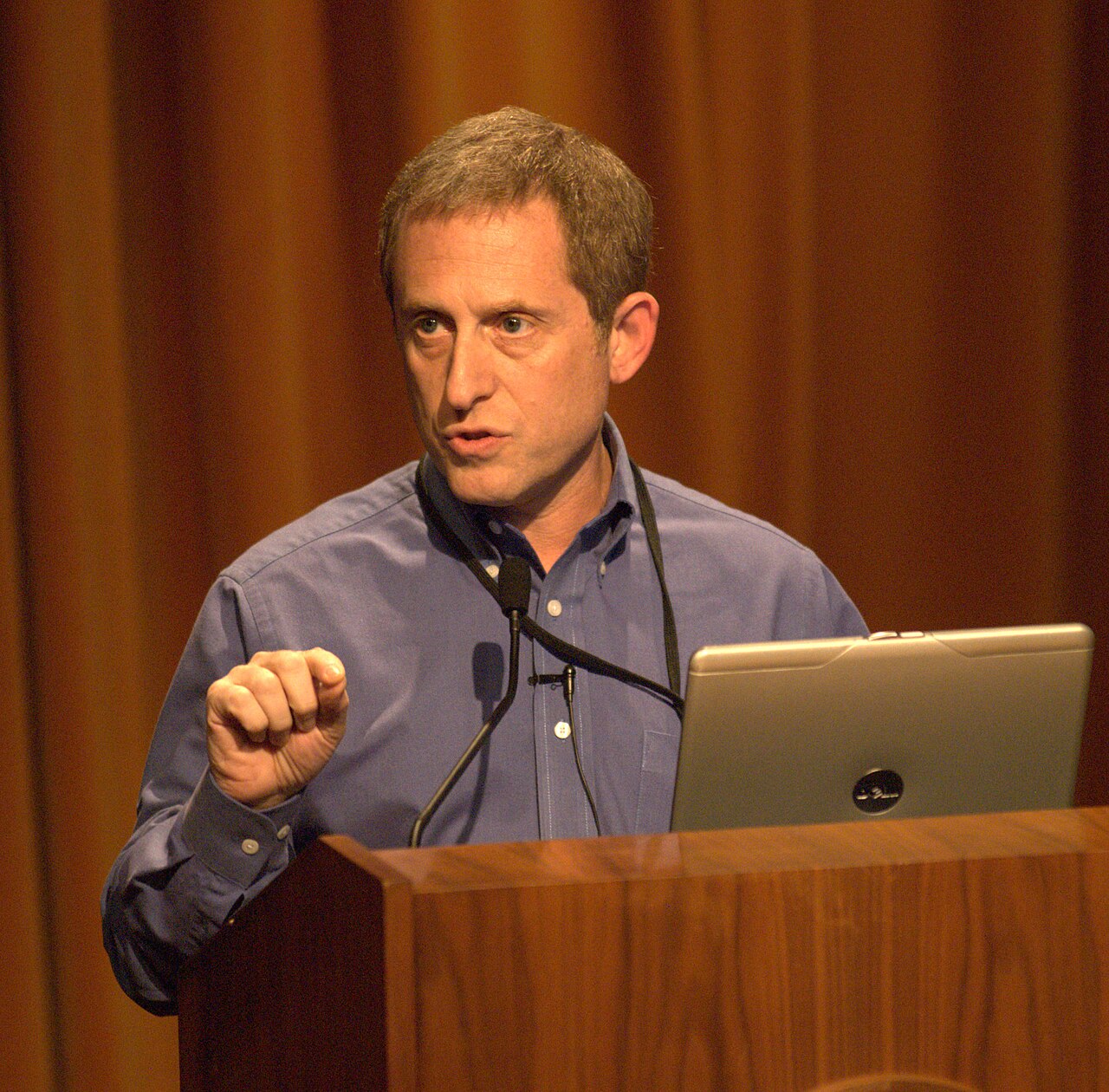
Alan Stern
Principal investigator of the New Horizons Pluto mission and former NASA science chief.

NASA / Eric James · Public domain
Alan Stern is an American engineer, planetary scientist, and private astronaut, best known as the principal investigator of the New Horizons mission to Pluto. He has been involved in 24 suborbital, orbital, and planetary space missions, including eight for which he served as mission principal investigator, and has developed eight scientific instruments for planetary and near-space research.
- Born
- November 22, 1957
- Birth place
- New Orleans, Louisiana
- Education
- University of Texas, Austin (bachelor's degrees in physics & astronomy; master's degrees in aerospace engineering and planetary atmospheres); University of Colorado, Boulder (doctorate in astrophysics
- Notable role
- Principal investigator of the New Horizons mission to Pluto
- Nasa role
- Associate Administrator of NASA's Science Mission Directorate (2007)
- Awards
- Time magazine's 100 Most Influential People in The World (2007); Smithsonian Magazine's American Ingenuity Award in the Physical Sciences (2015); Colorado Space Hall of Fame (2016)
Lore & Background
Alan Stern was born in New Orleans, Louisiana to Jewish parents Joel and Leonard Stern. He graduated from St. Mark's School of Texas in 1975, then attended the University of Texas, Austin, earning bachelor's degrees in physics & astronomy and master's degrees in aerospace engineering and planetary atmospheres. He earned a doctorate in astrophysics and planetary science from the University of Colorado, Boulder in 1989. From 1983 to 1991, he held positions at the University of Colorado, and from 1991 to 1994 he led Southwest Research Institute's Astrophysical and Planetary Sciences group and chaired NASA's Outer Planets Science Working Group. He later directed the Department of Space Studies at Southwest Research Institute from 1998 to 2005.
Stern was selected as a Space Shuttle mission specialist finalist in 1995 and a candidate payload specialist in 1996, but did not fly on the Space Shuttle. He has flown numerous WB-57 and F-18 airborne research astronomy missions, including with a sophisticated camera system called the Southwest Ultraviolet Imaging System (SWUIS) to search for hypothetical Vulcanoid asteroids. In 2007, he was appointed NASA's Associate Administrator for the Science Mission Directorate, directing a $4.4 billion organization with 93 flight missions and over 3,000 research grants. He resigned in March 2008, effective April 11, on the same day NASA Chief Michael D. Griffin overruled a funding decrease for Mars missions; NASA officials would neither confirm nor deny a connection.
Reader's Guide
Alan Stern's significance lies in his leadership of the New Horizons mission, which provided the first close-up exploration of Pluto and the Kuiper belt. As principal investigator, he drove the mission from concept to execution, inspired partly by the Voyager flyby of Neptune and Triton in 1989, which he witnessed as a graduate student. His career spans instrument development, including the Southwest Ultraviolet Imaging System that flew on two space shuttle missions, and the ALICE UV Spectrometer for the Rosetta comet orbiter. As NASA's Associate Administrator for Science, he oversaw a record 10 major new flight projects and implemented deep reforms in research and education programs, though his 'hard-charging' style led to internal battles over funding. His resignation followed a dispute over Mars mission funding, highlighting tensions between science priorities and budget constraints. Stern has also been active in private sector space efforts, joining Blue Origin in 2008 and co-founding Uwingu in 2012, advocating for public-private partnerships to reduce costs and expand space exploration.
Did You Know?
- He developed the Southwest Ultraviolet Imaging System, which flew on space shuttle missions STS-85 (1997) and STS-93 (1999).
- Stern was appointed NASA's Associate Administrator for the Science Mission Directorate in 2007, directing a $4.4 billion organization.
- He was inducted into the Colorado Space Hall of Fame on October 7, 2016.
Gallery





Frequently Asked Questions
Who is Alan Stern?
Alan Stern is an American planetary scientist, engineer, and private astronaut born in New Orleans in 1957 who became globally known for leading the first spacecraft flyby of Pluto. Over his career he has been involved in roughly 24 suborbital, orbital, and planetary missions, serving as principal investigator on eight of them.
What is Alan Stern's most famous mission?
He is the principal investigator of the New Horizons spacecraft, which performed the first close-range exploration of Pluto and its moon Charon in 2015. In addition to that flagship role, Stern has designed eight scientific instruments for planetary and near-space research.
Where did Alan Stern get his education?
He completed bachelor's degrees in physics and astronomy along with master's degrees in aerospace engineering and planetary atmospheres at the University of Texas at Austin. He then earned his doctorate in astrophysics at the University of Colorado, Boulder.
What major awards has Alan Stern received?
Time magazine named him to its 2007 list of the 100 Most Influential People in the World, and Smithsonian Magazine honored him with its 2015 American Ingenuity Award in the Physical Sciences. He was also inducted into the Colorado Space Hall of Fame in 2016.
Did Alan Stern hold a leadership role at NASA?
Yes, beginning in 2007 he served as Associate Administrator of NASA's Science Mission Directorate, a senior position overseeing the agency's science portfolio. He later returned to his hands-on work as PI of the New Horizons mission through its Pluto encounter.
More in Trans-Neptunian Objects, Part 2 1-24
Spotted an error? Know more?
Reader corrections go straight into our review queue. Suggest an edit · How this site is sourced