(508338) 2015 SO20
An extreme trans-Neptunian object linked to Planet Nine speculation.

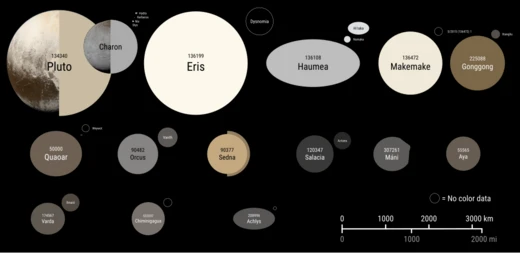
(508338) 2015 SO20 is a large object in the outer Solar System, classified as an extreme trans-Neptunian object and an extended scattered disc object. It has an estimated diameter of around 220 kilometers (140 miles). This body is one of only a few known detached objects, meaning its orbit has a perihelion (closest approach to the Sun) of at least 30 AU and a semi-major axis of at least 150 AU. Such an orbit is difficult to explain without the gravitational influence of an unseen perturbing body, which has contributed to the hypothesis of a ninth planet, often called Planet Nine.
- First observed as
- 2010 TF182
- First observation date
- 8 October 2010
- First observer
- Megan Schwamb
- First observatory
- La Silla Observatory, Chile
- Alternate observation designation
- 2015 SO20
- Alternate observation date
- 20 September 2015
- Alternate observatory
- Calar Alto Observatory, Spain
- Diameter estimate 1
- 222 km (based on absolute magnitude 6.5 and albedo 0.09)
- Diameter estimate 2
- 221 km (based on absolute magnitude 6.7 and albedo 0.08)
- Orbital distance range
- 33.2–290.1 AU
Lore & Background
2015 SO20 was first observed as 2010 TF182 on 8 October 2010, by American astronomer Megan Schwamb at ESO's La Silla Observatory in northern Chile. It was also observed as 2015 SO20 during the Calar Alto TNO Survey at the Calar Alto Observatory, Spain, on 20 September 2015.
It orbits the Sun at a distance of 33.2–290.1 AU once every 2054 years and 9 months, with a semi-major axis of 161 AU. Its orbit has an eccentricity of 0.79 and an inclination of 23° with respect to the ecliptic.
Based on an absolute magnitude of 6.5 and an assumed albedo of 0.09, Johnston's Archive calculated a mean-diameter of 222 kilometers. Michael Brown estimates an albedo of 0.08 with a diameter of 221 kilometers using an absolute magnitude of 6.7.
Reader's Guide
The significance of (508338) 2015 SO20 lies in its classification as an extreme trans-Neptunian object and extended scattered disc object. It is one of a small number of detached objects with a perihelion distance of 30 AU or more and a semi-major axis of 150 AU or more. The article notes that such objects cannot reach these orbits without some perturbing object, which leads to the speculation of Planet Nine. This makes 2015 SO20 a key piece of evidence in the ongoing search for a hypothetical ninth planet. Its diameter estimates, ranging from 221 to 222 kilometers depending on assumed albedo, place it among the larger known objects in the outer Solar System. The object's discovery history, involving observations at two different observatories and spanning five years, highlights the collaborative effort in cataloging distant Solar System bodies. Its legacy is tied to the broader investigation of the outer Solar System's structure and the potential existence of an undiscovered massive planet.
Did You Know?
- It was first observed as 2010 TF182 on 8 October 2010 by Megan Schwamb at La Silla Observatory.
- It takes 2054 years and 9 months to orbit the Sun.
- Its diameter is estimated at either 222 km or 221 km depending on the assumed albedo.
More in Trans-Neptunian Objects, Part 2 1-24
Spotted an error? Know more?
Reader corrections go straight into our review queue. Suggest an edit · How this site is sourced