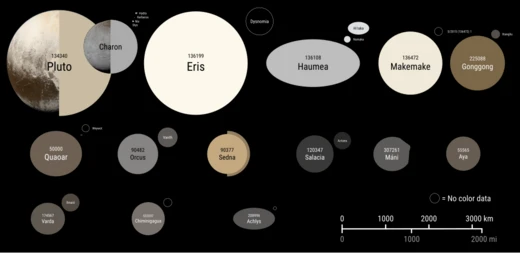
(445473) 2010 VZ98
Scattered-disc object discovered in 2010 with a highly eccentric orbit.

(445473) 2010 VZ98 is a scattered-disc object located in the far outer Solar System, with a diameter estimated between 400 and 500 kilometers. It was first spotted on November 11, 2010, by American astronomers David Rabinowitz, Megan Schwamb, and Suzanne Tourtellotte using the La Silla Observatory in northern Chile, at which point it was 38 astronomical units from the Sun.
Its orbit takes it from 34.3 AU to 266.6 AU from the Sun, completing one lap every 1,846 years along a path with a semi-major axis of 150.5 AU. The orbit is highly elliptical (eccentricity 0.77) and tilted about 5° relative to the ecliptic. Limited data hint that it might be locked in a 3:2 orbital resonance with a hypothetical planet beyond Neptune whose semi-major axis would be between 195 and 215 AU. The earliest known images of the object were taken in 1998 by the Sloan Digital Sky Survey at Apache Point Observatory, extending the observation arc by 12 years before its official discovery; these precovery images were identified in May 2015.
Photometric observations at Las Campanas Observatory in Chile, carried out by researchers from the Carnegie Institution for Science, produced a lightcurve showing a rotation period of 9.72 ± 0.05 hours and a brightness variation of 0.18 magnitude.
Estimates of its size and reflectivity vary. Michael E. Brown calculates a diameter of 471 kilometers with an albedo of 0.07; Johnston's Archive gives 443 kilometers and an albedo of 0.09; and the Collaborative Asteroid Lightcurve Link assumes an albedo of 0.10, yielding a diameter of 401 kilometers. These figures are based on an absolute magnitude between 5.0 and 5.3.
As of 2025, this minor planet has not been given a name.
- Discovery date
- 11 November 2010
- Discoverers
- David Rabinowitz, Megan Schwamb, Suzanne Tourtellotte
- Discovery site
- ESO's La Silla Observatory, Chile
- Distance at discovery
- 38 AU from the Sun
- Diameter range
- 400 to 500 kilometers
- Orbital period
- 1846 years
- Semi-major axis
- 150.5 AU
Lore & Background
2010 VZ98 orbits the Sun at a distance of 34.3–266.6 AU once every 1846 years, with a semi-major axis of 150.5 AU. Its orbit has a high eccentricity of 0.77 and an inclination of 5° with respect to the ecliptic. Small number statistics suggest that this body may be trapped in a 3:2 orbital resonance with an unseen planet beyond Neptune with a semi-major axis of 195–215 AU. The first precovery was taken by the Sloan Digital Sky Survey at the Apache Point Observatory in 1998, extending the body's observation arc by 12 years prior to its discovery; these precoveries were found in May 2015.
A rotational lightcurve of 2010 VZ98 was obtained from photometric observation by members of the Carnegie Institution for Science at Las Campanas Observatory, Chile. The lightcurve gave a rotation period of 9.72±0.05 hours with a brightness variation of 0.18 magnitude. While American astronomer Michael E. Brown assumes a diameter of 471 kilometers and an albedo of 0.07, Johnston's Archive estimates a diameter of 443 kilometers with a generic albedo of 0.09. The Collaborative Asteroid Lightcurve Link assumes an albedo of 0.10 and calculates a diameter of 401 kilometers. These estimates are based on an absolute magnitude between 5.0 and 5.3. As of 2025, this minor planet remains unnamed.
Reader's Guide
The significance of (445473) 2010 VZ98 lies in its membership in the scattered disc and its extreme orbit, which reaches a distance of 266.6 AU from the Sun. Its high eccentricity and long orbital period of 1846 years place it among the most distant known objects in the Solar System. The possibility of a 3:2 orbital resonance with an unseen planet beyond Neptune adds to its interest for dynamical studies. The object's diameter estimates, ranging from 401 to 471 kilometers depending on assumed albedo, place it near the threshold for potential dwarf planet status, though no official classification has been made. Its discovery by a team of American astronomers at La Silla Observatory in Chile, and the later recovery of precovery images from 1998, highlight the collaborative and long-term nature of outer Solar System surveys. As of 2025, the object remains unnamed, reflecting the ongoing process of cataloging such distant bodies.
More in Trans-Neptunian Objects, Part 2 1-24
Spotted an error? Know more?
Reader corrections go straight into our review queue. Suggest an edit · How this site is sourced