2017 OF201
Extreme TNO and dwarf planet candidate discovered in archived images.

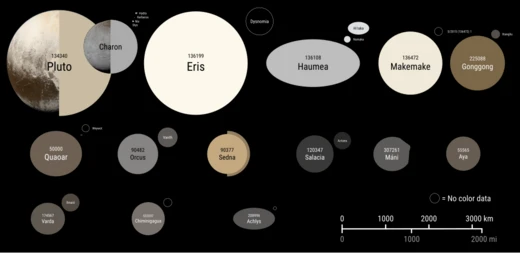
2017 OF201 is an extreme trans-Neptunian object and dwarf planet candidate, estimated to be around 500 to 900 kilometers in diameter. It is notable for being one of the brightest known objects in the Solar System without a directly measured size, and its discovery in archived telescope images was announced in 2025 by a team led by Sihao Cheng, with Jiaxuan Li and Eritas Yang. Its highly elongated orbit, ranging from 45 to 1,610 astronomical units from the Sun, places it near the boundary of the scattered disc and inner Oort cloud, and its orbit is influenced by Neptune, distinguishing it from sednoids.
- Estimated diameter
- 500 to 900 km (300 to 600 mi)
- Absolute magnitude
- between 3 and 4
- Semi-major axis
- 840 AU
- Orbital period
- about 24,000 years
- Eccentricity
- 0.95
- Inclination
- 16.2°
- Perihelion distance
- 44.9 AU
- Aphelion distance
- 1,610 AU (0.0255 ly)
- Discovery announcement date
- 21 May 2025
- Discovery team
- Sihao Cheng, Jiaxuan Li, Eritas Yang
Lore & Background
2017 OF201 was discovered by a team at the Institute for Advanced Study led by Sihao Cheng, along with Princeton University students Jiaxuan Li and Eritas Yang, during a search for trans-Neptunian objects in archived Dark Energy Camera Legacy Survey images, motivated by the hope of finding Planet Nine. Cheng became inspired after attending a 2005 lecture by Michael E. Brown. The team found ten detections from 2014–2018 in DECaLS data, and following advice from Mike Alexandersen, they found nine additional detections in archived Canada–France–Hawaii Telescope images from 2011–2012. Searches in Subaru and Gemini North archives yielded no further detections. The Minor Planet Center announced the object on 21 May 2025, and later precovery observations were found in Sloan Digital Sky Survey images from 2004 and 2009.
The orbit of 2017 OF201 is extremely large and elongated, with an average distance of 840 AU and an eccentricity of 0.95. It recently passed its closest approach to the Sun in mid-November 1930, and as of 2025 it is 90.5 AU from the Sun, making it one of the most distant observed Solar System objects. Its perihelion of 44.9 AU is below 60 AU, meaning Neptune's gravity affects its orbit, so it is not considered a sednoid. Over billions of years, its orbit is shaped by both Neptune and the galactic tide. Co-discoverer Yang stated that the team believes the object was scattered into the Oort cloud by some large planet and then ejected again into its current orbit.
Physically, 2017 OF201 has not been imaged by high-resolution telescopes and has no known moons. Its diameter is estimated from brightness, with Cheng's team giving a most likely value of 700 km and an albedo of 0.13, while Johnston's archive estimates 757 km with an albedo of 0.124. It is likely large enough to be a dwarf planet. Observations show a red color similar to Sedna, slightly redder than average TNOs, and its brightness does not vary by more than 0.1 magnitudes, suggesting a nearly spherical shape.
Reader's Guide
2017 OF201 is significant as an extreme trans-Neptunian object that challenges the Planet Nine hypothesis. Its orbit does not align with the clustering of other extreme TNOs like Sedna, which has been used as evidence for a distant massive planet. Simulations by Cheng's team suggest that Planet Nine would eject 2017 OF201 from its current orbit within 100 million years, though the current orbit could be temporary. Cheng stated that the object's existence as an outlier could potentially challenge the Planet Nine hypothesis. However, Konstantin Batygin, co-author of the hypothesis, argued the discovery means nothing because Neptune significantly influences the object's orbit. Cheng noted the object is at the boundary between stability and instability, and his team agreed their simulations do not disprove Planet Nine. In interviews, Cheng still thought Planet Nine possible, Yang was neutral, and Li initially thought it 'kills Planet Nine' but later conceded the results were not definitive, jokingly saying 'it's 49 percent killed'. Astronomer Samantha Lawler stated that the original argument for Planet Nine is getting weaker. The Hubble Space Telescope is planned to image 2017 OF201 in 2026, which should determine if it has significantly sized moons, allowing reliable mass and possibly size determination. Co-discoverer Yang also noted that the discovery implies there are likely thousands of similar objects too distant and faint to be observed.
Did You Know?
- 2017 OF201 was discovered in archived telescope images from 2011 to 2018, not through new observations.
- Its orbit takes about 24,000 years to complete, with an aphelion of 1,610 AU.
- The object is not considered a sednoid because its perihelion is below 60 AU, allowing Neptune's gravity to affect its orbit.
- The Hubble Space Telescope is scheduled to image 2017 OF201 in 2026 to search for moons.
More in Trans-Neptunian Objects, Part 2 1-24
Spotted an error? Know more?
Reader corrections go straight into our review queue. Suggest an edit · How this site is sourced