2015 RX245
A detached extreme trans-Neptunian object possibly influenced by Planet Nine.

2015 RX245 is a large, distant object in the outer Solar System, classified as a detached trans-Neptunian object. Its orbit is highly eccentric, taking it from 45.6 AU to 788 AU from the Sun, with a semi-major axis of 417 AU and an orbital period of roughly 8,512 years. The object’s inclination relative to the ecliptic is 12°. It belongs to a rare category of extreme trans-Neptunian objects (ETNOs) that have perihelion distances of at least 30 AU and semi-major axes of 150 AU or more. Such orbits are difficult to explain without the gravitational influence of an unseen perturbing body, which has fueled speculation about the existence of Planet Nine. 2015 RX245 is also referred to as an extended detached disc object or extreme distant detached object (EDDO). Its minimum orbital intersection distance with Neptune is 17.5 AU.
First observed on 8 September 2015 by the Outer Solar Systems Origins Survey, the discovery was made using the 3.6-meter Canada–France–Hawaii Telescope at Mauna Kea Observatories in Hawaii. A precovery image from 23 June 2015 extends the observation arc back by 11 weeks. The object’s size and orbit are similar to those of 2013 SY99, and both were located about 60 AU from the Sun at the time of observation.
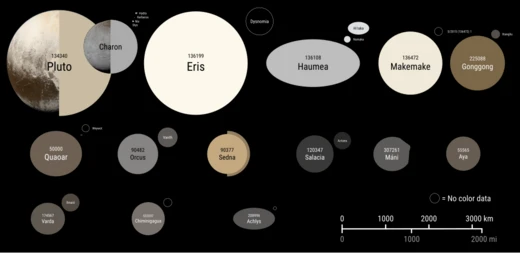
Estimates of its diameter vary: Michael Brown calculates 128 kilometers, while Johnston’s Archive gives 130 kilometers, both based on assumed albedos of 0.09 and 0.08, respectively. As of 2018, no rotational lightcurve has been obtained, so its rotation period, pole, and shape remain unknown. As of 2025, the minor planet has neither been numbered nor named by the Minor Planet Center; its official discoverers will be designated upon numbering.
- Diameter
- approximately 250 kilometers (160 miles)
- First observed
- 8 September 2015
- Discovery survey
- Outer Solar System Origins Survey
- Discovery telescope
- 3.6-meter Canada–France–Hawaii Telescope at Mauna Kea Observatories, Hawaii, United States
- Perihelion distance
- 45.6 AU
- Aphelion distance
- 788 AU
- Semi-major axis
- 417 AU
- Orbital period
- 8512 years (3,109,107 days)
- Eccentricity
- 0.89
- Inclination
- 12°
Lore & Background
2015 RX245 was first observed on 8 September 2015 by astronomers with the Outer Solar System Origins Survey using the 3.6-meter Canada–France–Hawaii Telescope at Mauna Kea Observatories, Hawaii. Its observation arc begins with a precovery taken at Mauna Kea on 23 June 2015, 11 weeks prior to its official first observation. The object orbits the Sun at a distance of 45.6–788 AU once every 8512 years, with an exceptionally high eccentricity of 0.89 and an inclination of 12° relative to the ecliptic. It has a minimum orbital intersection distance with Neptune of 17.5 AU. 2015 RX245 has a similar size and orbit as 2013 SY99, and both were about 60 AU from the Sun at the time of observation.
Reader's Guide
2015 RX245 is notable as a member of the extreme trans-Neptunian objects (ETNOs), a small group of detached objects with perihelion distances of 30 AU or more and semi-major axes of 150 AU or more. Its highly eccentric orbit, reaching from 45.6 AU to 788 AU, cannot be achieved without some perturbing object, which has led to speculation about the existence of Planet Nine. The object is also classified as an extended detached disc object or extreme distant detached object (EDDO). As of 2025, it has neither been numbered nor named by the Minor Planet Center; the official discoverers will be defined when the object is numbered. Its diameter is disputed: the source article states approximately 250 kilometers, while Michael Brown and Johnston's Archive give 128 and 130 kilometers based on assumed albedos of 0.09 and 0.08, respectively. No rotational lightcurve has been obtained, so its rotation period, pole, and shape remain unknown.
Did You Know?
- Its orbit has an exceptionally high eccentricity of 0.89 and a semi-major axis of 417 AU.
- A precovery image from 23 June 2015 extends its observation arc by 11 weeks.
More in Trans-Neptunian Objects, Part 2 1-24
Spotted an error? Know more?
Reader corrections go straight into our review queue. Suggest an edit · How this site is sourced