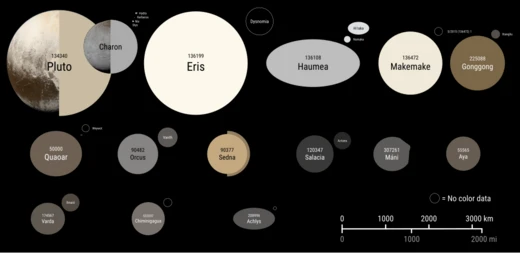
2014 FE72
Extreme scattered disc object with orbit reaching outer Oort cloud.

2014 FE72 is a trans-Neptunian object first observed on 26 March 2014 at Cerro Tololo Inter-American Observatory in La Serena, Chile. It is an extreme scattered disc object whose orbit extends into the outer Oort cloud, making it one of the most distant objects in the Solar System by its aphelion and average distance. Its discovery was announced on 29 August 2016.
- Discovery date
- 26 March 2014
- Discovery location
- Cerro Tololo Inter-American Observatory, La Serena, Chile
- Discoverers
- Scott Sheppard and Chad Trujillo
- Announcement date
- 29 August 2016
- Apparent magnitude
- 24.6
- Absolute magnitude
- 6.19
- Estimated diameter
- 265 km (assuming TNO albedo 0.08) or 218 km (assuming SDO albedo 0.124)
- Perihelion
- ~36.3 AU
- Aphelion
- ~5548 AU (barycentric)
- Orbital period
- ~147,500 years
Lore & Background
2014 FE72 was discovered by astronomers Scott Sheppard and Chad Trujillo using the Dark Energy Camera on the 4-meter Víctor M. Blanco Telescope at Cerro Tololo. The discovery was part of a survey for objects beyond Neptune and the Kuiper belt, searching for evidence of the predicted Planet Nine. The Minor Planet Center formally announced the discovery on 29 August 2016, and the Carnegie Institution for Science identified it as the first distant Oort cloud object found with an orbit entirely beyond Neptune.
Its orbit is extremely elongated, with an eccentricity of 0.99, a perihelion of about 36.3 AU, and a barycentric aphelion of about 5548 AU. The orbital period is roughly 147,500 years, and its inclination is about 20.6°. These orbit values are the largest known for any Solar System body that is not a long-period comet. 2014 FE72 last passed through perihelion in late 1965, and as of 2026 it is about 68 AU from the Sun.
Little is known about its physical characteristics. Its diameter is estimated at 265 km assuming a typical TNO albedo of 0.08, or 218 km assuming a typical SDO albedo of 0.124. It has an absolute magnitude of about 6.19 and appears extremely faint at apparent magnitude 24.6. It is not known to have any natural satellites. American astronomer Michael Brown considers it possibly a dwarf planet, but a study by William M. Grundy suggests objects in the 400–1000 km size range form a transition zone, and 2014 FE72 falls below that.
Reader's Guide
2014 FE72 is significant as one of the most distant known objects in the Solar System by both aphelion and average orbital distance, with an orbit that extends into the outer Oort cloud. It was the first discovered object in this population to have a perihelion beyond the orbit of Neptune. Its orbit was likely shaped by past gravitational interactions with Neptune, but also affected by forces such as the galactic tide. The longitude of perihelion of 2014 FE72 aligns with the orbital positioning seen in other extreme trans-Neptunian objects, and its orbital clustering is discussed in models studying the influence of a distant massive mini Neptune known as Planet Nine. Simulations using Modified Newtonian Dynamics study its origin without Planet Nine, showing that around 75 million years ago it was inside the outer planet region, and after close encounters it was scattered outward to its current extreme orbit around 25 million years ago. Its legacy lies in helping to explain the structure of the outer Solar System and the possible existence of Planet Nine.
Did You Know?
- 2014 FE72 has an orbital period of about 147,500 years, roughly 5 times longer than Sedna.
- It was the first distant Oort cloud object discovered with an orbit entirely beyond Neptune.
- As of 2026, 2014 FE72 is about 68 AU from the Sun, having passed perihelion in late 1965.
Frequently Asked Questions
Who discovered 2014 FE72 and when?
Scott Sheppard and Chad Trujillo spotted it on 26 March 2014 using the Cerro Tololo Inter-American Observatory in La Serena, Chile. The discovery was made public on 29 August 2016.
What type of trans-Neptunian object is 2014 FE72?
It is classified as an extreme scattered disc object, meaning its orbit is highly elongated and pushed far beyond the typical scattered-disc population. Its path stretches all the way into the outer Oort cloud region.
How distant is 2014 FE72 from the Sun?
By both its aphelion and its average orbital distance, 2014 FE72 ranks among the most remote known bodies in the Solar System. Its orbit carries it deep into the outer Oort cloud, far beyond the usual trans-Neptunian zone.
What are the brightness measurements for 2014 FE72?
Its apparent magnitude is 24.6, meaning it is extremely faint from Earth. Its absolute magnitude of 6.19 gives astronomers a sense of its intrinsic brightness independent of distance.
Why do TNO fans consider 2014 FE72 significant?
It pushes the known boundary of the Solar System even farther out, with an orbit that reaches into the outer Oort cloud. As one of the most distant catalogued objects, it helps researchers probe the outermost gravitational architecture of our planetary system.
More in Trans-Neptunian Objects, Part 2 1-24
Spotted an error? Know more?
Reader corrections go straight into our review queue. Suggest an edit · How this site is sourced