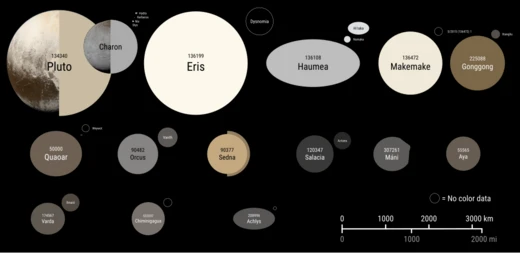
(148209) 2000 CR105
Detached object with a highly eccentric orbit beyond Neptune.

(148209) 2000 CR105 is a trans-Neptunian object classified as a detached object. It is notable for being the first discovered Solar System object with a semi-major axis exceeding 150 AU, a perihelion beyond Neptune, and an argument of perihelion of . Its highly eccentric orbit takes it around the Sun every 3,305 years at an average distance of 222 astronomical units (AU).
Lore & Background
2000 CR105 is considered a detached object because, like Sedna, it is not within the gravitational influence of Neptune even at its perihelion (closest approach to the Sun). The object's blue (neutral) color suggests a low albedo, leading Mike Brown's website to list a diameter of 327 km based on an assumed albedo of 0.04; however, if the albedo is higher, the object could be half that size. The origin of its far-flung orbit is a mystery, with several hypotheses proposed: it may have been pulled from its original position by a passing star, by a very distant and as-yet-undiscovered giant planet (though considered unlikely), or by an undiscovered companion star such as Nemesis. Another hypothesis is that it was captured from another planetary system during a close encounter early in the Sun's history; Kenyon and Bromley estimate a 15% probability that a star like the Sun had an early close encounter and a 1% probability that outer planetary exchanges would have happened. 2000 CR105 is estimated to be 2–3 times more likely to be a captured planetary object than Sedna. It may also be influenced by Planet Nine.
Reader's Guide
2000 CR105 holds significance as the first object discovered in the Solar System with a semi-major axis exceeding 150 AU, a perihelion beyond Neptune, and an argument of perihelion of 340°±55°. Its detached orbit, beyond Neptune's gravitational influence, challenges models of Solar System formation and evolution. The mystery of how it arrived in its current orbit has spurred multiple hypotheses, including stellar flybys, an undiscovered giant planet, a companion star, or capture from another star system. The work of Kenyon and Bromley suggests a 15% probability of a close encounter early in the Sun's history and a 1% chance of planetary exchanges, with 2000 CR105 being 2–3 times more likely than Sedna to be a captured object. Its potential influence by Planet Nine adds further interest. The object's size remains uncertain, depending on its actual albedo, which is expected to be low due to its blue color. As a detached object, it represents a class of trans-Neptunian bodies that help define the outer boundaries of the Solar System and inform searches for hypothetical planets beyond Neptune.
More in Trans-Neptunian Objects, Part 2 1-24
Spotted an error? Know more?
Reader corrections go straight into our review queue. Suggest an edit · How this site is sourced