Nedelin catastrophe
Deadliest rocket launch accident, suppressed by Soviet authorities for decades.

The Nedelin catastrophe, also known as the Nedelin disaster, was a launch-pad accident that occurred on 24 October 1960 at the Baikonur Cosmodrome in the Kazakh SSR during preparations for the first test flight of a prototype R-16 intercontinental ballistic missile. The disaster resulted in the deaths of Chief Marshal of Artillery Mitrofan Ivanovich Nedelin, head of the R-16 development programme, and dozens of other military and technical personnel. The Soviet authorities suppressed information about the event for decades, falsely reporting that Nedelin had died in an air crash.
Quick Facts
- English Name
- The Catastrophe at Baikonur Cosmodrome
- Time
- 18:45
- Date
- 24 October 1960
- Venue
- Baikonur Cosmodrome
- Location
- Kazakh SSR, Soviet Union
- Also Known As
- Nedelin disaster
- Cause
- Premature ignition of the second-stage engine
- Organisers
- Soviet Strategic Missile Troops
- Deaths
- 78 (1994 state commission)
Facts from the source article.
Lore & Background
On 23 October 1960, the prototype R-16 intercontinental ballistic missile was installed on launching pad 41 at Baikonur Cosmodrome, awaiting final tests before launch. The missile was over 30 meters long, 3.0 meters in diameter, and had a launch weight of 141 tons. It was fuelled with hypergolic propellants—UDMH as fuel and a saturated solution of N2O4 in nitric acid as oxidiser, nicknamed 'Devil's venom'—chosen for storability despite extreme corrosiveness and toxicity. Schedule pressure to achieve a test launch before the 7 November 1960 anniversary of the Bolshevik Revolution led to overlapping pre-launch tests and launch preparations, eroding normal safety margins.
Reader's Guide
The Nedelin catastrophe stands as the deadliest launch accident in rocket or spaceflight history, though the R-16 was being tested as a military missile. The immediate technical cause was a fault in the replaced main sequencer that caused the second-stage engine to fire while the missile was still on the pad, rupturing the first stage and causing a fire and explosion. Contributing factors included extreme schedule pressure, the presence of more personnel on the launch pad than should have been, and the failure to keep personnel in protected positions. The disaster led to a complete news blackout, with the Soviet government falsely reporting that Nedelin had died in a plane crash. The R-16 programme resumed in January 1961, with its first successful flight on 2 February 1961. A memorial to the victims was erected in the Park of Baikonur in the first half of the 1960s and is still visited by RKA officials before any manned launch. The accident caused 24 October to be referred to as Baikonur's 'Black Day,' and no launches have been attempted on that date at Baikonur ever since.
Did You Know?
- Missile designer Mikhail Yangel survived the explosion because he had left to smoke a cigarette behind a bunker a few hundred metres away, but suffered burn injuries.
- The Soviet authorities falsely reported that Chief Marshal of Artillery Mitrofan Ivanovich Nedelin had died in an air crash.
- A 1994 state commission report gave the death toll as 78, including 74 killed at the site and four who later died in hospital.
The Strategic Imperative Behind the R-16
The R-16 intercontinental ballistic missile represented the Soviet Union's answer to a critical limitation of its predecessor, the R-7. That earlier weapon relied on liquid oxygen as an oxidiser, a substance whose rapid boil-off made sustained launch readiness nearly impossible. The R-16 solved this by adopting a hypergolic propellant pair: UDMH as fuel and a saturated solution of N2O4 in nitric acid as oxidiser. This combination, derisively nicknamed "Devil's venom," was chosen specifically because both components remained stable at high boiling temperatures, allowing the missile to sit fuelled for extended periods. The trade-off was severe: the chemicals were extremely corrosive and toxic. The vehicle itself was enormous—over thirty metres long, three metres in diameter, and weighing 141 tonnes at launch. Chief Marshal of Artillery Mitrofan Nedelin, who headed the R-16 development programme, drove an aggressive timeline to complete the maiden test before the 7 November 1960 anniversary of the Bolshevik Revolution. That deadline, combined with mounting engineering problems, compressed the schedule to the point where pre-launch testing and final launch preparations began to overlap, eroding the safety margins that the hazardous propellants demanded.
The Moment of Catastrophe
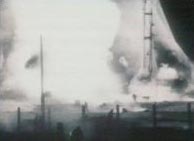
On 24 October 1960, the prototype R-16 sat on launching pad 41 at Baikonur Cosmodrome, fully fuelled and surrounded by military and technical personnel. During pre-launch testing, a fault in the recently replaced main sequencer sent an erroneous electrical signal that ignited the second-stage engine while the missile was still bolted to the pad. The unexpected thrust ruptured the first stage directly beneath it, triggering a violent explosion that obliterated the vehicle. Those standing close to the rocket were incinerated almost instantly. Personnel farther out were consumed by the fireball or poisoned by vapours of the toxic hypergolic propellants. Physicist Andrei Sakharov later recounted that most of the men on the pad sprinted toward the perimeter but found themselves trapped behind the barbed-wire security fence, unable to escape the spreading blaze. The blast killed Nedelin himself, a senior aide, the USSR's leading missile-guidance designer, and more than seventy other officers and engineers in a single moment. A camera operator, before seeking shelter, remotely triggered the automatic cameras positioned around the pad, capturing the destruction in detail.
Survival, Grief, and the Question of Numbers
The official 1994 state-commission figure placed the death toll at 78—74 killed at the site and 4 who later succumbed to their injuries in hospital. Yet estimates have ranged widely over the decades. An Italian news agency reported 100 dead in December 1960; spy Oleg Penkovsky passed a figure of 300 to The Guardian in 1965; the Soviet government initially acknowledged only a "significant number" in 1989 before settling on 54; and Roscosmos, citing engineer Boris Chertok, later suggested 126, while qualifying that the true count might fall anywhere between 60 and 150. Among the few who lived, missile designer Mikhail Yangel's escape was pure chance: he had stepped away to smoke a cigarette behind a bunker several hundred metres from the pad. He still suffered burn injuries. When Khrushchev confronted him with the question of why he had survived, Yangel answered in a trembling voice that he had walked away for a smoke and that it was all his fault. He subsequently suffered a heart attack and was sidelined for months.
Secrecy, Accountability, and the Road Back
Within hours of the explosion, Nikita Khrushchev ordered total silence. An official news release announced that Nedelin had perished in an air crash, and the families of the other victims were instructed to repeat the same story. The disaster was effectively buried for decades. Khrushchev dispatched Leonid Brezhnev to lead an investigation commission at the site. Upon arriving on 25 October, Brezhnev publicly declared that no one would be put on trial and that the priority was understanding the causes and resuming operations. The commission nonetheless found that far more personnel had been gathered on the pad than safety protocols allowed; most should have been sheltering in off-site bunkers. Despite the public reassurance, I. A. Doroshenko was ultimately held accountable for the event. The R-16 programme was not abandoned: it resumed in January 1961, and the missile achieved its first successful flight on 2 February 1961. The catastrophe delayed Yangel's work but did not end it, and the R-16 remained a cornerstone of Soviet strategic deterrence.
Gallery
Frequently Asked Questions
What was the Nedelin catastrophe?
On 24 October 1960, a rocket exploded on its pad at Baikonur Cosmodrome while crews were getting ready for the maiden flight of a new ICBM prototype. It stands as the deadliest accident ever linked to rocket or spaceflight activity.
How many people died in the Nedelin catastrophe?
A 1994 Soviet state commission officially recorded 78 fatalities, but alternative tallies span anywhere from 54 to 300. Among the dead was Chief Marshal of Artillery Mitrofan Nedelin, the officer who oversaw the R-16 programme.
Why did the Soviet government hide the Nedelin catastrophe?
The Soviet government buried the incident for decades, telling the public that Marshal Nedelin had been killed in a plane crash rather than a rocket explosion. The event was not openly acknowledged until 1989.
What missile was involved in the Nedelin catastrophe?
It was the R-16 intercontinental ballistic missile, still in prototype stage, that blew up on the pad. The vehicle never actually launched; the disaster struck during pre-flight preparation work.
Where and when did the Nedelin catastrophe take place?
The explosion happened on 24 October 1960 at Baikonur Cosmodrome, which at the time was part of the Kazakh Soviet Socialist Republic. Military and technical personnel were on the ground conducting launch-readiness checks when the accident occurred.
More in Space program fatalities 1-24
Spotted an error? Know more?
Reader corrections go straight into our review queue. Suggest an edit · How this site is sourced