Gordo (monkey)
Early U.S. monkey in space; data contributed to space research.

Threeohsix · CC BY-SA 4.0
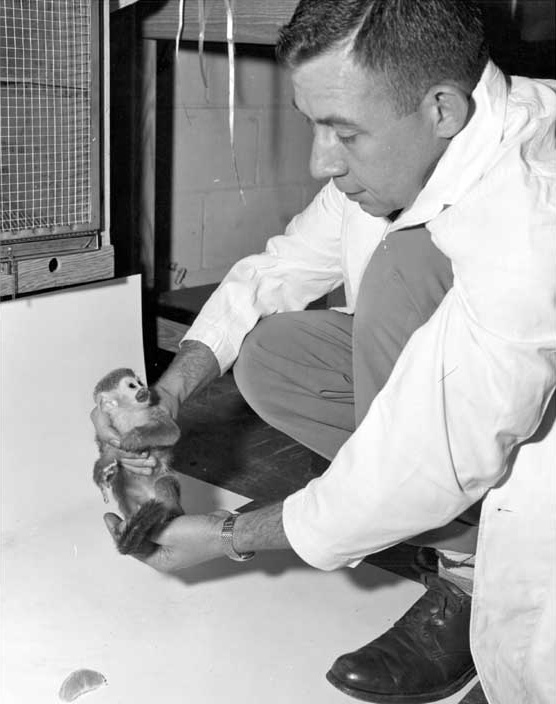
Gordo, also known as Old Reliable, was a South American squirrel monkey launched into space by the U.S. Air Force on December 13, 1958, aboard a Jupiter missile from Cape Canaveral. He was one of the first monkeys sent into space, and his flight provided physiological data that contributed to the broader knowledge base used in early human spaceflight efforts.
Quick Facts
- Species
- Common squirrel monkey
- Sex
- Male
- Known For
- Demonstrated viability of human spaceflight
- Weight Kg
- 1-1.5
- Height Cm
- 30
Facts from the source article.
Lore & Background
Gordo was a South American squirrel monkey, about one foot tall and weighing between 1 and 1.5 kg. The species was selected for space travel because of its similar anatomical and physiological makeup to humans, sensitivity to temperature changes, small size, ease of handling, and ability to tolerate high gravitational forces. He was trained by the U.S. Navy through a structured acclimation process that included mock capsules simulating g-forces, vibration, and confinement, allowing physiological data collection without sedatives. His calm demeanor during conditioning earned him the nickname 'Old Reliable.'
The flight took place at 0353 hours EST on December 13, 1958, from Cape Canaveral. Gordo wore a leather-lined plastic helmet and specially customized space suit, strapped to a contoured rubber bed in a tapered capsule behind the nose-cone. He was fitted with instruments including a thermometer, microphone, and cardiogram. The rocket reached a height of 310 miles and traveled 1,500 lateral miles. During the 15-minute flight, Gordo was weightless for 8.3 minutes, experiencing 10g during takeoff and 40g upon reentry. Scientists noted his breathing slowed after takeoff and his pulse became slightly irregular, but both returned to normal during weightlessness. Aside from a slight slowing of the pulse, he suffered no ill effects from entry into space or weightlessness.
A technical malfunction prevented the capsule's parachute from opening. After six hours of recovery efforts by the U.S. Army, neither Gordo's body nor the vessel were ever recovered. The Pentagon stated there were no significant adverse physical effects during weightlessness or fall to Earth, and it is believed he was alive at the time of impact.
Reader's Guide
Gordo's mission, despite the loss of the monkey and capsule, was considered a success by NASA. The critical physiological telemetry data—including signals on respiration, steady heartbeat, and lack of severe distress—alleviated concerns about how the human body would cope with weightlessness and the difficulties of space travel. This data directly informed NASA's Project Mercury and proved to U.S. Navy doctors that humans could survive a similar trip. Less than a year later, monkeys Able and Baker followed a similar launch profile and were recovered unharmed, becoming the first primates to survive a spaceflight. Gordo's flight also garnered significant media attention within the Space Race and the Sputnik crisis, portraying him as a symbol of American ingenuity. However, the mission sparked angry protests from animal rights groups, including the ASPCA and the British RSPCA, who expressed grave concern. The high mortality rates among early test subjects raised ethical questions that later influenced stricter guidelines for animal welfare in subsequent NASA and U.S. Air Force missions.
Did You Know?
- Gordo was not the first U.S. monkey in space; that distinction belongs to Albert II.
- The rocket used was a Jupiter missile, not a PGM-19 Jupiter rocket.
- The flight was an Air Force project; data from animal flights contributed generally to space research, but did not directly inform NASA's Project Mercury.
The Jupiter AM-13 Mission
On December 13, 1958, a small squirrel monkey known as Gordo was placed aboard the Jupiter AM-13 rocket, a vehicle operated by the United States Army. This mission represented one of the more ambitious primate flights of the era, sending its passenger on a trajectory that carried it more than 2,400 kilometers (approximately 1,500 miles) through the upper atmosphere. The rocket reached an altitude of roughly 500 kilometers (310 miles), placing Gordo well beyond the 100-kilometer Kármán line that internationally marks the boundary of space. The flight was part of a broader American effort to understand how living organisms could endure the physical stresses of rocketry and re-entry, knowledge that would eventually support crewed spaceflight in the 1960s. Gordo's journey thus placed him among the small group of non-human primates who experienced the full arc of a long-duration rocket trajectory before any human astronaut ever did, and his survival of the launch and flight phase marked a genuine milestone in the program's progression.
A Fatal Recovery
Despite surviving the launch and the extreme conditions of his flight, Gordo's mission ended in tragedy during the recovery phase. After completing his trajectory and descending back toward Earth, the monkey came down in the South Atlantic Ocean. The cause of his death was a mechanical failure of the parachute recovery system housed within the rocket's nose cone. Rather than a controlled descent, the malfunctioning mechanism meant Gordo could not be safely extracted from the capsule. This outcome echoed a pattern seen throughout the primate space program, where parachute failures had claimed the lives of Albert II, Albert IV, and Albert V in earlier V-2 and Aerobee flights. In Gordo's case, the failure occurred not during the dramatic moments of launch or re-entry but in the final, seemingly routine step of bringing the animal back to the surface. The South Atlantic landing site also meant that any recovery effort was complicated by the open ocean, though the primary cause of death was the mechanical malfunction of the nose-cone system itself.
Among the Primate Pioneers
Gordo's flight in December 1958 placed him in a long and often tragic lineage of non-human primates who served as test passengers in the American space program. In total, more than thirty-two primates from multiple species—including rhesus macaques, crab-eating macaques, squirrel monkeys, pig-tailed macaques, and chimpanzees—were launched into space or the upper atmosphere by the United States, France, and the Soviet Union between 1948 and 1996. No individual primate ever flew more than once, and many backup animals endured training and preparation only to never leave the ground. Gordo, a squirrel monkey, was part of a cohort that included Miss Baker (also a squirrel monkey) and Goliath, while the majority of earlier flights carried rhesus macaques. His mission came after the Albert series of V-2 flights in 1948 and 1949, after Yorick's 1951 Aerobee flight, and before the landmark Able and Baker mission of May 1959. Like most primate passengers in the program, he was anesthetized before lift-off.
Old Reliable: A Name and a Legacy
Gordo carried an alternate name—Old Reliable—that reflected the trust placed in him by the scientists and military personnel who selected him for the Jupiter AM-13 mission. The nickname suggests a sense of confidence in the animal's suitability for the demanding physical conditions of a rocket flight, a confidence that the broader program had been building since the earliest, often fatal, V-2 experiments of the late 1940s. By 1958, the American effort had progressed from simple sub-orbital hops to missions reaching hundreds of kilometers in altitude, and Gordo's flight to 500 kilometers represented a significant step in that progression. His experience, along with that of Miss Baker (who survived her 1959 flight and lived until 1984) and the chimpanzees Ham and Enos in the Mercury program, contributed to the physiological understanding that made crewed spaceflight possible in the 1960s. Gordo's story, like those of the Alberts before him, is one of a small animal whose brief life was spent in service of a larger human ambition, ending not in the sky but in the sea.
Gallery



Frequently Asked Questions
Who is Gordo (monkey)?
Gordo, nicknamed Old Reliable, was a South American squirrel monkey that the U.S. Air Force sent into orbit as part of its early animal spaceflight program. He is remembered as one of the first primates to travel beyond Earth's atmosphere.
When and where was Gordo launched into space?
On December 13, 1958, Gordo was launched aboard a Jupiter missile from Cape Canaveral, Florida. The mission was conducted by the U.S. Air Force as part of its pre-human spaceflight research effort.
What did Gordo's flight accomplish?
During his brief journey, Gordo's body generated physiological data that researchers later incorporated into the growing body of knowledge guiding early human spaceflight. His contribution helped scientists better understand how living organisms respond to the stresses of launch and space travel.
Why is Gordo important in space history?
As one of the earliest primates to be sent into space, Gordo's mission helped lay the groundwork for the safety protocols that would eventually protect human astronauts. His data fed directly into the broader research base that made crewed flights possible.
How is Gordo remembered today?
Fans and historians of early space exploration regard Gordo as a quiet pioneer whose sacrifice expanded humanity's understanding of spaceflight physiology. He is often cited alongside other animal astronauts as a critical stepping stone between rocketry experiments and the first human orbital missions.
More in Space program fatalities 1-24
Spotted an error? Know more?
Reader corrections go straight into our review queue. Suggest an edit · How this site is sourced