Elliot See
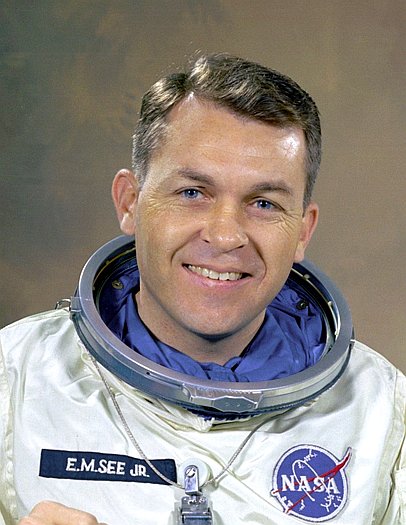
NASA astronaut killed before his first space flight.

Wikimedia Commons · Public domain
Elliot McKay See Jr. was an American engineer, naval aviator, test pilot, and NASA astronaut. He was selected in NASA's second group of astronauts in 1962 and was the prime command pilot for what would have been his first space flight, Gemini 9. He was killed along with his crewmate in a NASA jet crash before the mission.
Quick Facts
- Birth Name
- Elliot McKay See Jr.
- Birth Date
- 1927-07-23
- Birth Place
- Dallas, Texas, U.S.
- Death Date
- 1966-02-28
- Death Place
- St. Louis, Missouri, U.S.
- Resting Place
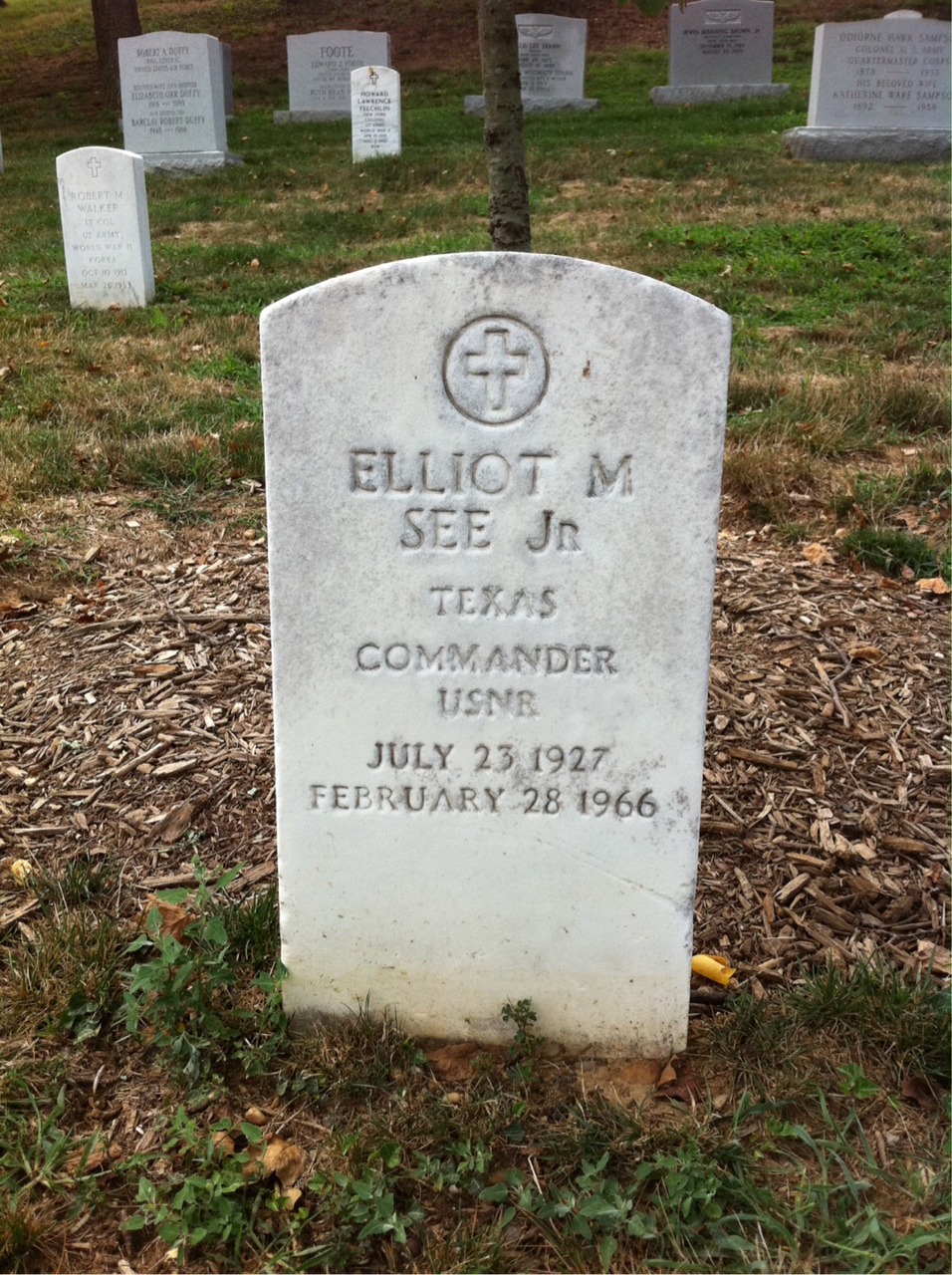
- Arlington National Cemetery
- Education
- University of Texas, Austin (attended) / United States Merchant Marine Academy (BS) / University of California, Los Angeles (MS)
- Selection
- 1962 NASA Group 2
- Rank
- Commander, USNR
Facts from the source article.
Lore & Background
Elliot See was born on July 23, 1927, in Dallas, Texas, to Elliot McKay See Sr. and Mamie Norton See. He attended Highland Park High School, was an Eagle Scout, and graduated in 1945. He received an appointment to the United States Merchant Marine Academy in 1945, graduating in 1949 with a Bachelor of Science degree in marine engineering and a Naval Reserve commission. He joined General Electric as an engineer and was called to active duty as a naval aviator during the Korean War, flying Grumman F9F Panther fighters from the USS Randolph and USS Boxer. He married Marilyn Denahy in 1954, and they had three children.
After his tour of duty, See rejoined General Electric in 1956 as a flight test engineer and became a group leader and experimental test pilot at Edwards Air Force Base, flying the latest jet aircraft with GE engines. He obtained a Master of Science degree in aeronautical engineering from UCLA in 1962. Selected in NASA's second group of astronauts in 1962, See was the prime command pilot for Gemini 9. He was killed along with Charles Bassett, his Gemini 9 crewmate, in a NASA jet crash at the St. Louis McDonnell Aircraft plant, where they were to undergo two weeks of space rendezvous simulator training.
Reader's Guide
Elliot See's significance lies in his role as a NASA astronaut selected for the Gemini program, specifically as the prime command pilot for Gemini 9. His death in a training accident, along with his crewmate, underscored the inherent risks of early spaceflight and the rigorous preparation required. See's background as an engineer, naval aviator, and test pilot exemplified the diverse expertise NASA sought in its astronauts. His work on spacecraft electrical and sequential systems, as well as his contributions to mission planning, including simulating lunar landing lighting conditions, contributed to the foundation of later Apollo missions. Though he never flew in space, his legacy is tied to the Gemini program's development and the broader narrative of human space exploration.
Did You Know?
- Elliot See earned the rank of Eagle Scout in the Boy Scouts of America.
- He was the oldest of NASA's second group of astronauts, at age 35 at selection.
- See survived a plane crash in 1952 when his Luscombe Silvaire Sprayer's engine failed, requiring plastic surgery for deep facial cuts.
- He was a co-captain of the rifle team at the United States Merchant Marine Academy and won the Captain Tomb Trophy for marksmanship.
Early Life and Formative Years
Elliot McKay See Jr. was born on July 23, 1927, in Dallas, Texas, to an electrical engineer father at General Electric and a mother whose career spanned advertising and real estate. Elliot earned his Eagle Scout rank after five years in the Boy Scouts, and at Highland Park High School he competed on varsity teams in several sports, including boxing. He graduated in 1945.
With World War II still ongoing, the eighteen-year-old faced a choice between enlisting and pursuing education. He applied for aviation cadet training but failed the physical, and in his own words, "going to college became the most important thing." He enrolled at the University of Texas, pledged to Phi Kappa Psi, and earned a private pilot's license. That same year he received an appointment to the United States Merchant Marine Academy. He spent his plebe year in Pass Christian, Mississippi, before transferring to Kings Point, New York, where he commanded the Third Company, captained the rifle team to the Captain Tomb Trophy for individual marksmanship in December 1948, and served as head cheerleader. When Congress authorized the academy to confer degrees in 1949, See graduated with his B.S. in marine engineering, his marine engineer's licenses, and a commission in the United States Naval Reserve.
Navy Service and the Korean War
After graduation, See joined the Aircraft Gas Turbine Division of General Electric in Boston, and when the division relocated to Cincinnati, Ohio, he met Marilyn Jane Denahy, a GE secretary. He and a friend pooled funds to buy a Luscombe Silvaire Sprayer. In November 1952, while giving Marilyn a joyride, the engine began to fail. See attempted an emergency landing on a short, unimproved field, but the tail wheel caught a power line and forced the plane into the ground. He suffered deep facial cuts requiring plastic surgery; Marilyn escaped with minor injuries.
By 1953 he was working as a flight test engineer at GE's Evendale, Ohio, plant. The Korean War called him to active duty, and after initial stationing at Miramar Naval Air Station near San Diego, he married Marilyn on September 30, 1954, before shipping out for a sixteen-month operational tour. Flying the Grumman F9F Panther with Fighter Squadron 144, he deployed to the Mediterranean aboard USS Randolph, which returned to the United States in June 1955. In October he embarked with VF-144 on USS Boxer, traveling to Hawaii, Japan, the Philippines, and Hong Kong, where he focused on line maintenance and carrier landings. By the end of his tour he had reached the rank of lieutenant commander. He returned home in February 1956, in time for the birth of his first child, Sally.
Test Pilot Career at General Electric
See rejoined General Electric in 1956 as a flight test engineer after completing his naval tour. He rose to become a group leader and experimental test pilot at Edwards Air Force Base in California, where the United States Air Force conducted its most demanding flight tests. There he served as project pilot for the development of the General Electric J79-8 engine used in the F4H aircraft. His work also encompassed powerplant flight tests on the J-47, J-73, J-79, CJ805, and CJ805 aft-fan engines, which required him to fly in a wide array of platforms including the F-86, XF4D, F-104, F11F-1F, RB-66, F4H, and T-38.
Beyond his flying duties, See pursued academic growth. Starting in 1960, he worked toward a master's degree one night per week, eventually earning a Master of Science in aeronautical engineering from UCLA in 1962. This combination of hands-on experimental flying and advanced engineering study positioned him at the intersection of practical aviation and theoretical aerodynamics, a skill set that would prove critical when NASA later selected him for the astronaut corps.
NASA Selection and Tragic End
In 1962, See was selected as a member of NASA's second group of astronauts, a recognition that validated years of test-pilot experience and advanced engineering education. He was assigned as the prime command pilot for Gemini 9, which would have been his first spaceflight. The mission was to demonstrate a space rendezvous, a critical capability for future crewed operations.
On February 28, 1966, See and his Gemini 9 crewmate Charles Bassett were killed in a NASA jet crash at the St. Louis McDonnell Aircraft plant. They had been scheduled to undergo two weeks of space rendezvous simulator training at the facility when the accident occurred. The loss of both pilots on the same day, just weeks before what would have been their orbital debut, represented a devastating blow to the Gemini program and to the broader American space effort. See was thirty-eight years old. His wife Marilyn and their three children—Sally, born in 1956, Carolyn in 1957, and David in 1962—lost their husband and father.
Gallery

Frequently Asked Questions
Who is Elliot See?
Elliot McKay See Jr. was an American engineer, naval aviator, and test pilot who earned his place in NASA's second astronaut class in 1962. He is best known as the prime command pilot designated for the Gemini 9 mission, a flight he never actually made.
What was Elliot See's role in the space program?
See was assigned as the prime command pilot for Gemini 9, meaning he would have been the overall leader of the spacecraft during that mission. His role was cut short when he perished in a jet crash before the vehicle ever reached orbit.
How did Elliot See die?
On February 28, 1966, See and his crewmate lost their lives when their NASA jet crashed near St. Louis, Missouri. The fatal accident occurred during a flight that was part of his pre-mission training, ending his career before his first orbital trip.
Why is Elliot See's story significant to space history fans?
His death is often cited as one of the most heartbreaking 'what ifs' of the early American space era, since he was moments away from commanding a landmark Gemini mission. Fans frequently point to his loss as a reminder that astronauts faced lethal danger even on the ground, long before launch.
What was Elliot See's background before joining NASA?
Born in Dallas, Texas on July 23, 1927, See built a career spanning engineering, naval aviation, and test-pilot work before his 1962 selection. That combination of technical depth and hands-on flight experience is what made him a natural fit for a Gemini command seat.
More in Space program fatalities 1-24
Spotted an error? Know more?
Reader corrections go straight into our review queue. Suggest an edit · How this site is sourced