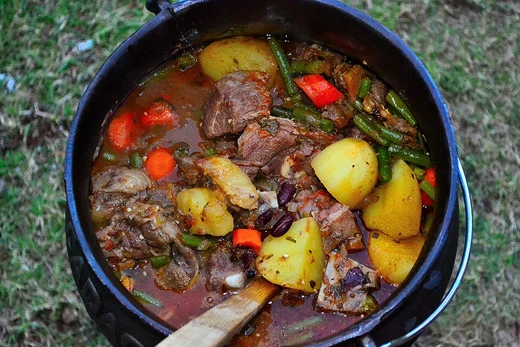
Cook and Enjoy It
English version of the definitive South African cookbook.

Eva Rinaldi · CC BY-SA 2.0
Ina de Villiers first published *Kook en Geniet* in 1951 at her own expense, after South African publishers showed no interest. The book went on to become the definitive cookbook of authentic South African food culture. Its English translation, *Cook and Enjoy It*, was released by the Central News Agency in 1961. When the agency stopped publishing in 1972, Human & Rousseau took over.
In 1990, Human & Rousseau acquired the rights to produce and market the Afrikaans edition. This led to a fully revised edition in 1992, with a new look for both language versions. The revision kept the character of the original’s more than 700 recipes and basic cooking principles, while updating many recipes to include modern appliances like microwaves and food processors. Some recipes were retested and rewritten in an easier-to-follow style; a few were edited or replaced, but the spirit of the original was preserved.
In 2009, Human & Rousseau published another updated edition. The author’s daughter, Eunice van der Berg, oversaw the revitalization. This edition returned to a format closer to the original, while adding a modern feel. The English title was shortened to *Cook and Enjoy*.
Ina de Villiers died on 20 September 2010 at age 91. By 2005, over half a million Afrikaans copies had been sold. By the time of her death, sales in both languages had far exceeded one million copies.
- Born
- Not specified in source
- Died
- 20 September 2010 at age 91
- Field
- Cookbook author
- Nationality
- South African
- Known for
- Authoring Kook en Geniet / Cook and Enjoy It, a definitive South African cookbook
Lore & Background
Ina de Villiers self-published Kook en Geniet in 1951 after South African publishers showed indifference. The book became a cornerstone of South African food culture. The English edition, Cook and Enjoy It, was published by the Central News Agency in 1961, and from 1972 by Human & Rousseau after the Central News Agency withdrew from publishing. In 1990 Human & Rousseau obtained rights to the Afrikaans edition, leading to a completely revised edition in 1992 with a new appearance for both languages, incorporating modern appliances like microwaves and food processors while retaining the original's more than 700 recipes and basic cooking principles. Some recipes were newly tested and rewritten in an easy-to-follow style, with a few edited or replaced to preserve the spirit and essence of the original.
Reader's Guide
Cook and Enjoy It and its Afrikaans counterpart, Kook en Geniet, hold a unique place in South African culinary history as the definitive representation of authentic South African food culture and heritage. The book's journey from a privately published volume in 1951 to a bestseller exceeding a million copies in both languages by the time of the author's death in 2010 underscores its enduring cultural significance. The 1992 revised edition modernized recipes for contemporary kitchens while maintaining the character of the original 700-plus recipes. The 2009 edition, overseen by the author's daughter Eunice van der Berg, returned to a format more in line with the original while incorporating a modern approach, and truncated the English title to Cook and Enjoy. The book's legacy is reflected in its massive sales—over half a million Afrikaans copies by 2005—and its role in preserving and transmitting South African culinary traditions across generations.
Did You Know?
- Kook en Geniet was originally published by Ina de Villiers in her private capacity in 1951 after South African publishers expressed indifference.
- In 2009, a new edition was published with a truncated English title: Cook and Enjoy.
- By 2005, over half a million Afrikaans copies had been sold, and sales in both languages far exceeded a million copies by the time of the author's death.
Roots in the Land: Indigenous Culinary Heritage
South African cuisine's deepest roots stretch back to the Khoisan peoples, who sustained themselves by foraging more than three hundred species of edible wild plants across the landscape. The San, in particular, relied on a varied diet of tortoises, crayfish, coconuts, and squash, while also developing sophisticated techniques for preserving meat. The arrival of Bantu-speaking pastoralists from north-east Africa, beginning around 200 AD, transformed the food landscape by introducing domestic cattle and cultivated grain crops. This convergence allowed Bantu communities to supplement Khoisan preservation methods with fresh meat available on demand, while also building an extensive repertoire of dishes from sorghum, millet, fermented milk, and roasted or stewed meats. Over time, maize—a Central American crop—gradually displaced sorghum as the staple grain, though red sorghum (mabele) and cocoyam (madumbe) remain widely cultivated in both traditional settlements and urban markets. The rooibos shrub legume, long foraged by the Khoisan, continues to shape the nation's culinary identity to this day.
Fire and Flesh: The Braai Tradition
Meat sits at the very heart of South African culinary identity, a legacy that traces back to the moment Bantu pastoralists introduced domestic cattle to the region and the Khoisan peoples refined their ancient methods of meat preservation. From that intersection emerged two of the nation's most beloved food traditions: the braai and biltong. The braai is far more than a cooking method—it is a social ritual in which South Africans of all backgrounds gather around an open flame to grill meat, transforming a simple meal into a communal celebration. Biltong, a dried and spiced meat snack, carries forward the practical wisdom of preserving protein for long stretches between fresh kills. Together, these traditions reflect a cuisine that is fundamentally meat-based, where the act of cooking over fire and the craft of curing and seasoning have become inseparable from national identity. Whether in a rural homestead or a city backyard, the sizzle of meat over coals remains the defining sound of South African table culture.
A Tapestry of Arrivals: Colonial and Diasporic Layers
The 17th century marked a turning point as Dutch and British settlers carried their own foodways into South Africa, setting in motion centuries of culinary cross-pollination. The Cape Malay community forged a distinctive diasporic cuisine rooted largely in Southeast Asian traditions, while Afrikaner voortrekkers pushing further inland blended Dutch, Khoisan, Cape Malay, and Bantu cooking practices to suit their nomadic existence. French Huguenot refugees who settled in Franschhoek played a pivotal role in establishing the country's viticultural industry. Under British colonial rule, waves of Asian immigrants—many arriving as indentured laborers in the 19th century—brought a rich vocabulary of spices, seasonings, and dishes that became historically associated with KwaZulu-Natal. Indian South African cooking, once regionally concentrated, has since spread across the entire country and is now embraced by all ethnic groups. Each wave of arrival added a new thread to an already complex culinary fabric, ensuring that South African food remains a living record of migration, adaptation, and cultural exchange.
Fermented, Shared, Sustained: Beer, Milk, and the Shebeen
Long before European contact, beer brewed from local grains—especially sorghum—was woven into the fabric of indigenous South African life. It was unfiltered, cloudy, and low in alcohol, yet it served as a nutritional lifeline, providing vitamins that grain-heavy diets often lacked. Beer featured so prominently in social life that it became central to ceremonies like betrothals and weddings, where one family would ceremoniously pour for the other. As mining drew black South Africans into cities under the migrant labour system, women followed and began brewing beer for the predominantly single male workforce. That tradition endures today in shebeens—informal township bars typically owned by women known as shebeen queens. Similarly, milk and its fermented forms have been dietary pillars for centuries; cows were highly prized, and a calabash of cool sour milk was the traditional greeting in any village. The Sotho-Tswana proverb 'cattle beget children' captures the deep link between dairy, fertility, and community. During apartheid, shebeens became vital non-formal community centers, and after the end of apartheid, South African cuisine entered a renaissance with growing global visibility.
Gallery





Frequently Asked Questions
Who is the author of Cook and Enjoy It?
Cook and Enjoy It was written by Ina de Villiers, a South African cookbook author who passed away on 20 September 2010 at the age of 91. She is best known for creating this landmark volume of South African recipes.
When was Cook and Enjoy It first published?
The original Afrikaans edition, Kook en Geniet, came out in 1951 after de Villiers self-funded the printing because South African publishers declined to take it on. The English-language version, Cook and Enjoy It, followed in 1961 through the Central News Agency.
Why is Cook and Enjoy It considered important in South African food culture?
It is widely regarded as the definitive cookbook capturing authentic South African food traditions in a single volume. Its long-running publication history—spanning from 1951 to the 1990s and beyond—cemented its status as a cultural reference point for the country's cuisine.
Which publishers have released Cook and Enjoy It over the years?
The Central News Agency first issued the English edition in 1961 before ceasing operations in 1972, after which Human & Rousseau assumed the title. In 1990, Human & Rousseau also secured the rights to the Afrikaans edition and produced a fully revised edition in 1992 with a refreshed design for both language versions.
Did Cook and Enjoy It go through any major revisions?
Yes. In 1992, Human & Rousseau released a fully revised edition that updated the presentation and content while preserving the book's original character. This revision applied to both the English and Afrikaans editions simultaneously.
More in South African cuisine 1-24
Spotted an error? Know more?
Reader corrections go straight into our review queue. Suggest an edit · How this site is sourced