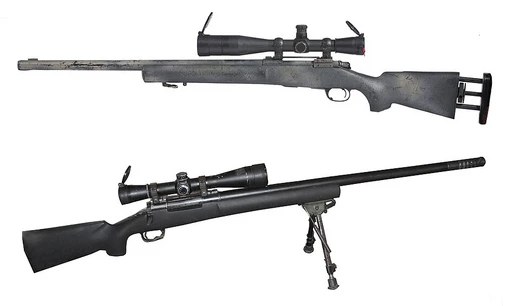
Zastava M93 Black Arrow
Serbian bolt-action anti-materiel rifle scaled from the Mauser 98.

The Zastava M93 Black Arrow is a Serbian bolt-action anti-materiel rifle chambered in 12.7×108mm, produced by Zastava Arms. Its design began in 1993, with production starting in 1998. The rifle is primarily a scaled-up version of the Mauser 98 system, with additional influence from the French FR-F1. The front of the bolt resembles the Mauser design, while the rear and firing pin are similar to the FR-F1, scaled to 12.7mm caliber. This approach simplifies manufacturing and disassembly while maintaining the Mauser’s reliability. The trigger block safety is modeled after the Russian SVT-40, also used by the FR-F1.
The M93 is a bolt-action, air-cooled, magazine-fed firearm with a fixed stock. It feeds from a detachable 5- or 10-round box magazine. The shoulder stock is telescoping, connected to the pistol grip by two stiff springs. The bolt handle sits over the right side of the receiver. A carrying handle is attached to the forend, and the barrel ends in a multi-baffled brake to manage recoil. A folding bipod is also included. In Serbian military service, it was issued with a ZRAK 8x56 optical sight, a scaled-up version of the scope used on the Zastava M76.
The rifle is available in both 12.7×108mm and .50 BMG (12.7×99mm). The .50 BMG chambering was developed later for export markets, as 12.7×108mm is uncommon outside former Soviet states. Civilian versions sold in the United States replace the included scope with a Picatinny rail on the receiver, allowing the buyer to mount their own optic.
Current users include the Bulgarian military (via re-export), the Philippine Army (37 rifles), Philippine Navy and Marine Corps (11), and one each for the Philippine Air Force and the Intelligence Service of the AFP. The Syrian Army also uses the M93, as do both the internationally recognized government and Houthi forces in the Yemeni civil war. Among non-state actors, the YPG has employed the rifle.
Quick Facts
- Origin
- Federal Republic of Yugoslavia · 1992 / Serbia and Montenegro · 2003 / Serbia
- Is Ranged
- yes
- Service
- 1998–present
- Manufacturer
- Zastava Arms
- Weight
- 16 kg
- Length
- 1670 mm
- Part Length
- 1000 mm
- Caliber
- 12.7×108mm / .50 BMG (12.7x99mm)
- Action
- Bolt action (rotating bolt; long action)
- Velocity
- 12.7x108mm: 800 m/s / .50 BMG: 888 m/s
- Range
- 1800 m
- Feed
- 5- or 10-round box magazine
Facts from the source article.
Lore & Background
The M93 Black Arrow was designed in 1993 and entered production in 1998. In Serbian military service, it was issued with a ZRAK 8x56 optical sight, a scaled-up version of the scope used on the smaller Zastava M76. The rifle is available in both 12.7×108mm and .50 BMG, with the latter developed for export markets where the Soviet cartridge is rare.
The weapon is a bolt-action, air-cooled, magazine-fed firearm with a fixed stock. It feeds from a 5- or 10-round detachable box magazine. The shoulder stock has a telescoping design with two stiff springs connecting it to the pistol grip. The bolt handle rests over the right side of the receiver. A carrying handle is affixed to the forend, and the barrel is capped by a multi-baffled brake to manage recoil. A folding bipod is attached.
Its overall design is a scale-up of the Mauser 98 system, similar to the Mauser 1918 T-Gewehr, with influence from the French FR-F1. The front end of the bolt closely resembles the Mauser design, while the back end and firing pin are essentially the same as the FR-F1's bolt, scaled up to 12.7mm. The trigger block safety is similar to the Russian SVT-40 and is also used by the FR-F1. Civilian market versions, particularly in the United States, have a Picatinny rail over the receiver instead of an included scope.
Reader's Guide
The Zastava M93 Black Arrow represents a modern adaptation of the classic Mauser 98 bolt-action system, scaled up to handle the powerful 12.7×108mm cartridge. Its design borrows from both the Mauser 1918 T-Gewehr and the French FR-F1, combining the front bolt features of the Mauser with the rear bolt and firing pin of the FR-F1. This hybrid approach simplifies manufacturing and disassembly while retaining the reliability of the original Mauser design.
The rifle has seen service with multiple users, including the Serbian military, the Philippine Army, Navy, Marine Corps, Air Force, and Intelligence Service, as well as the Syrian Army and forces in the Yemeni civil war. It has also been used by non-state actors such as the YPG. Bulgarian re-exports have been noted. The availability of a .50 BMG chambering expanded its export potential, while civilian versions with Picatinny rails allow for custom optics. Its legacy is that of a robust, scaled-up anti-materiel rifle that bridges Eastern and Western design traditions.
Did You Know?
- The rifle's trigger block safety is similar to that of the Russian SVT-40.
- Civilian market versions in the United States have a Picatinny rail instead of an included scope.
Frequently Asked Questions
What is the Zastava M93 Black Arrow?
It is a Serbian bolt-action anti-materiel rifle manufactured by Zastava Arms, purpose-built to destroy armored vehicles, light aircraft, and other hardened targets at long range.
What caliber does the Zastava M93 Black Arrow fire?
The standard chambering is 12.7×108mm, and a .50 BMG variant is also offered for buyers who prefer the NATO cartridge.
What existing rifles influenced the Zastava M93 Black Arrow's design?
The action is fundamentally a scaled-up Mauser 98, with the rear bolt and firing pin drawing on the French FR-F1 and the trigger-block safety echoing the Soviet SVT-40.
How is the Zastava M93 Black Arrow fed?
Instead of a single-chamber or en-bloc clip, it uses a detachable box magazine that holds either five or ten rounds.
When was the Zastava M93 Black Arrow developed and when did it enter production?
Zastava Arms began the design process in 1993, and the rifle started rolling off the production line in 1998.
More in Sniper Rifles 1-22
Spotted an error? Know more?
Reader corrections go straight into our review queue. Suggest an edit · How this site is sourced