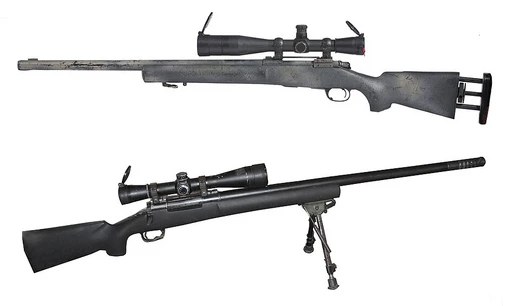
C14 Timberwolf
Canadian military's standard bolt-action sniper rifle chambered in .338 Lapua Magnum.

The C14 Timberwolf MRSWS (Medium Range Sniper Weapon System) is a bolt-action sniper rifle manufactured by PGW Defence Technologies Inc., a Canadian arms company. In 2005, the company secured a $4.5 million contract to supply the Canadian Forces Land Command with this rifle. It serves as the primary sniper rifle for the Canadian Armed Forces, chambered for the .338 Lapua Magnum cartridge and intended for anti-personnel engagements out to 1,200 meters.
The Timberwolf began as a civilian precision sport rifle, offered in chamberings up to the .408 Cheyenne Tactical and the .416 PGW wildcat cartridge. The military version incorporates several modifications and accessories to suit service use. Its official military designation is the C14 Timberwolf Medium Range Sniper Weapon System (MRSWS).
During the 1990s, the Canadian Armed Forces sought a sniper rifle to replace the aging C3A1, which fired the smaller 7.62×51mm NATO cartridge and had been in service since the 1950s. Trials at CFB Gagetown in 2001 selected the C14 Timberwolf MRSWS as the new designated anti-personnel sniper rifle. Production for the Canadian Forces Land Command began in 2005. Since its introduction, the C3A1 has been gradually phased out, and the C14 is now the main sniper rifle in the arsenal. Snipers rate it highly, citing the rifle itself and the increased effective range and penetration of the .338 Lapua Magnum over the earlier 7.62×51mm NATO round.
The manufacturer states the C14 Timberwolf’s accuracy potential as sub-0.75 MOA with proper ammunition. The Canadian Forces accuracy standard required hitting a chest-sized target at 1,200 meters 90% of the time. PGW Defence Technologies averaged over 95% on this standard, and every rifle delivered under the contract was evaluated for accuracy and witnessed by Department of National Defence officials.
The C14 Timberwolf MRSWS is chambered for the .338 Lapua Magnum cartridge, achieving a maximum muzzle velocity of 838 m/s with 19.44-gram Sierra MatchKing very-low-drag bullet loads. This is significantly more powerful than the 7.62×51mm NATO cartridge used in the C3A1, which typically fires 11.3-gram bullets at 790 m/s.
The action is a manually operated stainless steel bolt-action with a right-hand side bolt and ejection port.
Quick Facts
- Is Ranged
- yes
- Origin
- Canada
- Design Date
- 2001
- Designer
- PGW Defence Technologies Ltd
- Production Date
- 2005–present
- Wars
- War in Afghanistan (2001–2021) / Yemeni Civil War (2015–present) / Saudi-led intervention in Yemen / Saudi–Yemeni border conflict (2015–present)
- Spec Label
- PGW Timberwolf
- Part Length
- 660 mm (26 in)
- Cartridge
- .338 Lapua Magnum
- Feed
- 5 round detachable box
- Action
- manually operated bolt action
- Velocity
- 823 m/s (2,700 ft/s) for 19.44 g (300 gr) SMK
Facts from the source article.
Lore & Background
The Timberwolf rifle was originally developed as a civilian long-range hunting and sport shooting rifle for super magnum cartridges by the Canadian company Prairie Gun Works, now PGW Defence Technologies Inc. During the 1990s, the Canadian Armed Forces formulated a requirement for a sniper rifle that could fulfill an anti-personnel role up to 1,200 m, replacing the aging C3A1 bolt-action rifle firing the 7.62×51mm NATO cartridge. In 2001, during trials at CFB Gagetown, the C14 Timberwolf MRSWS was selected as the new designated anti-personnel sniper rifle. Production for the Canadian Forces Land Command began in 2005 under a $4.5 million contract.
The military version features several modifications from the civilian sport rifle, including a heavy free-floating Krieger barrel, a McMillan A5 composite stock with adjustable cheekpiece and length-of-pull spacers, and a three-position safety. The bolt is partly helically fluted, and the barrel is cryogenic stress relieved. The rifle uses a 25 MOA forward-sloped Picatinny rail for optics, with the Canadian Forces originally using Leupold Mark 4 16x40mm LR/T M1 riflescopes and later Schmidt & Bender PMII telescopic sights. The .338 Lapua Magnum cartridge provides significantly more power and range than the C3A1's 7.62×51mm NATO round.
Reader's Guide
The C14 Timberwolf MRSWS represents a significant upgrade in capability for the Canadian Armed Forces, replacing the C3A1 sniper rifle that had been in service since the 1950s. Its adoption marked a shift to the .338 Lapua Magnum cartridge, which offers greater effective range and penetration than the 7.62×51mm NATO round. The rifle is highly rated by snipers, who appreciate both the weapon itself and the additional range and penetration it provides. The manufacturer's accuracy standard of sub 0.75 MOA and the Canadian Forces' requirement of 90% hit probability on a chest-sized target at 1,200 m were exceeded by PGW Defence Technologies, which averaged over 95% in testing witnessed by DND officials. Since its introduction, the C14 has become the main sniper rifle in the Canadian arsenal, with the C3A1 slowly removed from active service. The rifle has also been used by the SAS, the Royal Saudi Land Force, and the Ukrainian Ground Forces and Marine Corps, the latter delivered by the Canadian government in early 2022 during the Russian invasion of Ukraine.
Did You Know?
- The C14 Timberwolf MRSWS was originally developed as a civilian precision sport rifle before being modified for military use.
- The rifle's barrel is cryogenic stress relieved and partly helically fluted to reduce weight while maintaining structural strength.
- The C14 Timberwolf MRSWS replaced the C3A1 sniper rifle, which fired the smaller 7.62×51mm NATO cartridge.
From Civilian Range to Military Contract
The C14 Timberwolf did not begin life as a military weapon. Prairie Gun Works, the Canadian firm that would later rebrand as PGW Defence Technologies Inc., first developed the Timberwolf as a civilian precision rifle intended for long-range hunting and sport shooting in super magnum calibres. The civilian line was chambered in cartridges as large as the .408 Cheyenne Tactical and the .416 PGW, a wildcat derived from the .408, both of which are dimensionally larger and more powerful than the .338 Lapua Magnum that would eventually define the military variant. The path to military service began in the 1990s when the Canadian Armed Forces identified a need for an anti-personnel sniper rifle capable of effective engagement out to 1,200 metres, a role the ageing C3A1, a 7.62×51mm NATO bolt-action in service since the 1950s, could no longer fill. In 2001, during competitive trials held at CFB Gagetown, the Timberwolf was selected as the new designated anti-personnel sniper rifle. Production for the Canadian Forces Land Command commenced in 2005 under a $4.5 million supply contract.
Mechanical Architecture & Engineering Choices
At the core of the C14 Timberwolf is a manually operated stainless steel bolt action with the bolt throw and ejection port on the right side. The rotary bolt uses dual front locking lugs plus a single rear lug, requiring only a 90-degree rotation. The bolt is partly helically fluted to trim weight and prevent debris jams, while a double plunger ejector and hook-type extractor ensure smooth, reliable case ejection. The barrel is a modified heavy free-floating Krieger piece, standard at 660 mm (26 inches) for the military variant, with a 737 mm (29-inch) option also available. It carries a 254 mm (one-in-ten) twist rate tuned to stabilize long, heavy very-low-drag projectiles like 300-grain Sierra MatchKing and Lapua Scenar bullets. The barrel is cryogenic stress relieved and partly helically fluted to shed weight while retaining rigidity, terminating in a detachable proprietary stainless steel muzzle brake. The action sits in a McMillan A5 composite stock of high-strength fibre glass, with an adjustable saddle cheekpiece and spacer plates for individual fit, all supported by a PGWDTI titanium cantilever monoblock bedding block. A three-position safety with a field-strip middle position and a five-round detachable box magazine round out the core mechanical package.
Ballistics & Accuracy Benchmarks
The C14 Timberwolf MRSWS is chambered for the .338 Lapua Magnum, a cartridge that delivers a maximum muzzle velocity of 838 m/s (2,750 ft/s) when loaded with 19.44-gram (300-grain) Sierra MatchKing very-low-drag bullets. This represents a substantial step up from the C3A1's 7.62×51mm NATO round, which typically propels 11.3-gram (175-grain) projectiles at around 790 m/s (2,580 ft/s). The practical consequence is greater effective range and deeper penetration at long distance. PGW Defence Technologies states the rifle's accuracy potential at sub 0.75 MOA with proper ammunition. The Canadian Forces set a demanding hit-probability standard: a chest-sized target at 1,200 metres (1,312 yards) had to be struck 90 per cent of the time. In evaluation, PGW averaged over 95 per cent on that benchmark, and every single weapon delivered under the contract was individually tested for accuracy in the presence of Department of National Defence officials. This level of verified consistency, combined with the cartridge's ballistics, is what made the Timberwolf a credible replacement for a rifle that had served since the 1950s.
Service Life & the Sniper's Verdict
Since entering production in 2005, the C14 Timberwolf MRSWS has steadily displaced the C3A1 from active Canadian Forces service and now stands as the primary sniper rifle in the armed forces' arsenal. Snipers who have adopted the system rate it highly, citing both the rifle's inherent handling qualities and the tangible gains in effective range and penetration that the .338 Lapua Magnum provides over the older 7.62×51mm NATO cartridge. The rifle's optical setup has evolved over time: the Canadian Forces initially standardised on a Leupold Mark 4 16×40 mm LR/T M1 riflescope before transitioning to Schmidt & Bender PMII telescopic sights. Night-vision capability is available through Simrad night sights mounted on custom scope rings, or UNS and MUNS night sights fitted via a PGWDTI proprietary mount. The integral Picatinny rail with a 25 MOA forward slope, along with two shorter MIL-STD-1913 rail sections at the stock's forefront, provide mounting points for tactical lights, lasers, and a wide array of accessories including bipods, muzzle brakes, sound suppressors, and slings. This modularity ensures the Timberwolf can be tailored to the operational needs of the individual marksman.
Frequently Asked Questions
What is the C14 Timberwolf?
The C14 Timberwolf is a bolt-action sniper rifle that serves as the standard precision weapon for the Canadian Armed Forces. Officially designated the Medium Range Sniper Weapon System, it was designed by Canadian manufacturer PGW Defence Technologies Inc. for anti-personnel engagements at extended range.
What cartridge does the C14 Timberwolf use and what is its effective range?
The Timberwolf is chambered for the .338 Lapua Magnum and is rated for reliable anti-personnel shots out to 1,200 meters. Under Canadian Forces standards, the rifle must achieve over 95% hit probability on a chest-sized target at that distance.
Who makes the C14 Timberwolf and how did it get adopted?
PGW Defence Technologies Inc., a Canadian arms company, builds the rifle. In 2005 the company won a $4.5 million contract from Canadian Forces Land Command, which led to the Timberwolf becoming the military's standard bolt-action sniper system.
What are the C14 Timberwolf's key specs?
The rifle features a 660 mm (26-inch) standard barrel with a 737 mm (29-inch) long-barrel option, a five-round detachable box magazine, and a rotary bolt with three locking lugs (two front, one rear). Manufacturer-stated accuracy is under 0.75 MOA, and muzzle velocity hits 838 m/s with a 300-grain Sierra Matchking projectile.
How did the C14 Timberwolf evolve from a civilian rifle to a military weapon?
The Timberwolf platform originally appeared as a civilian precision sport rifle available in large-caliber chamberings up to the .408 Cheyenne Tactical and a .416 PGW wildcat. PGW then adapted the design for military service, and the 2005 Land Command contract formalized its role as the Canadian Forces' primary sniper platform.
More in Sniper Rifles 1-22
Spotted an error? Know more?
Reader corrections go straight into our review queue. Suggest an edit · How this site is sourced