Meunier rifle
A pioneering French semi-automatic rifle adopted but never mass-produced.

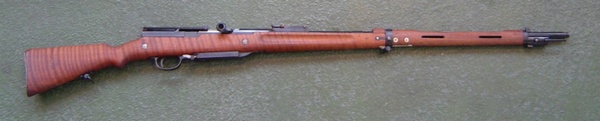
The Meunier rifle, also known as the Meunier A6 or STA No. 8, was a long-recoil-operated semi-automatic infantry rifle developed as part of a French military program initiated in 1890 to replace the Mle 1886–93 Lebel rifle. It was adopted in 1910 but saw only limited production and use before World War I halted its deployment.
Quick Facts
- Origin
- France
- Is Ranged
- YES
- Service
- 1910–1918
- Wars
- World War I
- Number
- 1,013 rifles manufactured
- Variants
- Meunier A6 Rifle, Carbine.
- Weight
- 4 kg empty, 4.6 kg with bayonet, 4.1 kg loaded, 4.8 kg loaded with bayonet.
- Length
- 1295 mm
- Part Length
- 715 mm
- Cartridge
- 7mm Meunier
- Caliber
- 7×59mm "7mm Meunier"
- Action
- Semi-automatic
Facts from the source article.
Lore & Background
The Meunier rifle emerged from a secret program directed by General Naquet-Laroque at the Puteaux (APX) arsenal. Four government establishments—STA, ENT, Puteaux, and CTV—proposed over 20 prototypes, roughly half recoil-operated and half gas-operated. The Meunier A6 was one of only three prototypes deemed industrially viable, alongside the ENT B5 (direct gas impingement) and the APX C7 (Browning long-recoil system). The Meunier rifle itself was partly derived from the Browning long-recoil system of 1900.
The rifle fired a rimless 7×59mm cartridge substantially more powerful than the 8mm Lebel. The original loading delivered a muzzle velocity exceeding 1000 m/s, but a lighter load was chosen in 1913. The final cartridge specifications were debated between the arsenals at Puteaux and Tulle until 1912, when a case length of 56.95 mm was settled. During spring 1914, MAS tooled up to produce 5,000 rifles per month, but mass production was cancelled due to the imminent conflict with Germany. Only 1,013 rifles were manufactured at Tulle arsenal before World War I; these were tested in the trenches and most were lost during the war.
Reader's Guide
The Meunier rifle represents an early attempt to field a semi-automatic infantry rifle, adopted in 1910 but overtaken by the outbreak of World War I. Its long-recoil mechanism, shared with the Remington Model 8, was mechanically more complex than later gas-operated designs. The rifle fired a specialized 7mm rimless cartridge that was not interchangeable with the standard 8mm Lebel ammunition, complicating logistics. Only 1,013 were ever built, and the majority were lost in World War I. Surviving examples were further depleted during the Second World War. The Meunier was eventually replaced by the gas-operated Mle 1917 RSC semi-automatic rifle, which was cheaper to produce and used standard Lebel components and ammunition. The Meunier's legacy is that of a technically advanced but ultimately impractical design, a footnote in the evolution of military self-loading rifles. A single carbine version, made by cutting down a full-length rifle, exists in the collection of the Springfield Armory in Massachusetts.
Did You Know?
- The Meunier rifle fired a 7×59mm rimless cartridge with a muzzle velocity of 3412 ft/s in its original loading.
- Only 1,013 Meunier rifles were ever manufactured, all at the Tulle arsenal (MAT) before World War I.
- The Meunier A6 was one of three semi-automatic prototypes deemed industrially viable, alongside the ENT B5 and APX C7.
- A single Meunier A6 carbine, a trials version, is held in the archives of the Springfield Armory in Massachusetts.
Shoulder-Fired Design Identity
The Meunier rifle is classified as a firearm specifically engineered for shoulder-fired operation, a design philosophy that sets it apart from hand-held pistols and other compact weapons. Its defining structural characteristic is a barrel whose internal walls are cut with a helical groove pattern, a feature that is the very reason it carries the rifle designation. This rifling is not ornamental; it is the functional heart of the weapon's accuracy system. The shoulder-mounted configuration, paired with the rifled barrel, places the Meunier within a long tradition of precision-oriented firearms. The combination of a stable firing platform provided by the shoulder and the controlled rotation imparted by the barrel's internal geometry gives the weapon its characteristic ballistic profile. In essence, the Meunier's identity as a rifle rests on two inseparable elements: the way the shooter supports it and the way its barrel shapes the projectile's trajectory.
The Rifling and Lands System
At the core of the Meunier rifle's mechanical function lies its rifling system, a series of helical grooves machined into the barrel's interior walls. The raised portions between these grooves, termed lands, play a crucial role in the weapon's operation. When a round is discharged, these raised surfaces press against the bullet's exterior, compelling it to rotate. The resulting spin follows an axis that mirrors the weapon's own orientation, ensuring the projectile's rotational direction is locked to the barrel's alignment. This spin is not incidental; it is the mechanism by which the rifle stabilizes the projectile in flight, ensuring a predictable and accurate trajectory. The helical nature of the grooves means the rotational force is applied progressively along the barrel's length rather than instantaneously, helping to manage the mechanical stresses placed on the bullet during its transit through the bore.
Place Within the Rifle Taxonomy
The Meunier rifle exists within a broader family of shoulder-fired, rifled firearms that encompasses several distinct mechanical categories. The principal types recognized in this family include the automatic rifle, the bolt-action rifle, the lever-action rifle, and the semi-automatic rifle. Each of these classifications reflects a different approach to the cycling of the action, the mechanism by which a round is loaded, fired, and the spent casing is ejected. The Meunier, as a member of this rifle family, shares the fundamental shoulder-fired, rifled-barrel architecture common to all these types, while its specific action mechanism determines where it falls within this taxonomy. Understanding the Meunier in context requires recognizing that the rifle category is not monolithic but rather a spectrum of designs united by their shared reliance on rifling and shoulder support.
Projectile Engagement and Spin
The interaction between the Meunier rifle's barrel and its projectile is a precisely engineered process. For small-arms usage, the projectile is specifically termed a bullet, and its engagement with the barrel's internal geometry is what transforms a simple discharge into a controlled, accurate shot. As the bullet travels down the bore, the lands, the raised areas between the helical grooves, press against its surface, gripping it and forcing rotation. The axis of this spin aligns with the weapon's orientation, meaning the bullet rotates in a manner directly determined by how the barrel is aimed. This spin stabilizes the bullet aerodynamically, preventing it from tumbling or drifting unpredictably through the air. The result is a projectile that maintains its intended course over distance, which is the ultimate purpose of the rifling system embedded in the Meunier's barrel.
Gallery
Frequently Asked Questions
What exactly is the Meunier rifle?
The Meunier rifle, also referred to as the Meunier A6 or STA No. 8, is a French semi-automatic infantry rifle created in the 1890s as a planned successor to the Lebel. It was formally adopted by the French military in 1910.
How does the Meunier rifle's action work?
It uses a long-recoil mechanism to cycle its bolt and fires in semi-automatic mode, so one trigger pull sends a single round downrange. This made it a pioneering design among early service rifles.
Why did the Meunier rifle never see wide service?
World War I erupted before France could scale manufacturing, capping total output at just 1,013 units. The conflict effectively froze further deployment and ended any realistic chance of it replacing the Lebel in the field.
What cartridge does the Meunier rifle chamber?
It was built around the rimless 7×59 mm Meunier round, which initially generated roughly 3,412 ft/s at the muzzle before a lighter loading brought that figure down to about 2,690 ft/s.
Who manufactured the Meunier rifle?
Production was carried out by France's Atelier de Construction de Puteaux (APX) and the Tulle arsenal (MAT), both state-run facilities responsible for French small arms at the time.
More in Sniper Rifles 1-22
Spotted an error? Know more?
Reader corrections go straight into our review queue. Suggest an edit · How this site is sourced