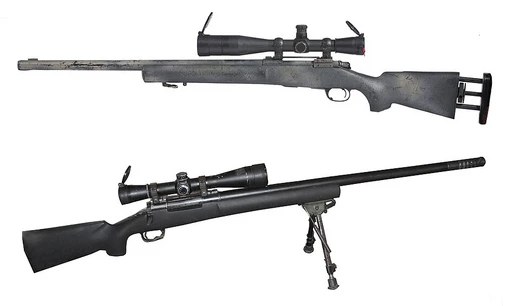
MACS M3
Bullpup anti-material rifle derived from the MACS M2A.

The MACS M3 is a Croatian heavy sniper rifle chambered in .50 BMG, manufactured since 1991. It is a bullpup reconfigured version of the MACS M2A, designed for engaging live power, unshielded and lightly armed vehicles, ground planes, radar and communication antennas, as well as eliminating enemy snipers and destroying unexploded ordnance.
- Type
- Anti-material rifle
- Place of origin
- Croatia
- In service
- 1991–present
- Used by
- Croatia, Slovenia, Bosnia and Herzegovina, Romania
- Produced
- 1991–present
- Weight
- 12 kg
- Cartridge
- .50 Browning Machine Gun
- Action
- Single shot, bolt action
Lore & Background
The MACS M3 is an enhanced version of the earlier MACS M2A, reconfigured into a bullpup layout by moving the butt stock assembly forward so that the bolt action protrudes well to the rear. This redesign reduces the overall length to 1.11 meters and the weight, with bipod and optical sight, to 8.8 kilograms. Many components, including the manual bolt action and optical sights, remain the same as those on the MACS M2A, though the barrel length has been reduced slightly. The ballistic performance of the MACS M3 remains similar to that of the MACS M2A. The rifle can only be fired from the right shoulder. It is intended for action against live power, unshielded and lightly armed vehicles, ground planes, radar and other communication antennas and systems, and is also used for the elimination of enemy snipers and the destruction of unexploded ordnance. The most effective results are achieved at distances up to 1,500 meters.
Reader's Guide
The MACS M3 represents a notable adaptation of the MACS M2A into a more compact bullpup configuration, reducing overall length to 1.11 meters and weight to 8.8 kilograms with bipod and optical sight. This design choice allows for easier transport and maneuverability while retaining the ballistic performance of its predecessor. The rifle's role as an anti-material weapon is clearly defined: it is employed against live power, unshielded and lightly armed vehicles, ground planes, radar and communication antennas, as well as for counter-sniper operations and ordnance disposal. Its effective range of up to 1,500 meters underscores its capability for long-range precision engagement. The MACS M3 has been in service since 1991 and is used by Croatia, Slovenia, Bosnia and Herzegovina, and Romania. The rifle's single-shot bolt action and .50 BMG cartridge align it with other heavy sniper systems of its era. Its bullpup layout, while limiting firing to the right shoulder, offers a practical compromise between portability and firepower in a niche anti-material role.
Did You Know?
- The MACS M3 is a bullpup reconfiguration of the MACS M2A.
- The rifle is manufactured in Croatia since 1991.
Design & Engineering
The MACS M3 represents a deliberate reconfiguration of its predecessor, the MACS M2A, into a bullpup configuration. By relocating the butt stock assembly forward, designers allowed the bolt action mechanism to extend well past the rear of the weapon. This architectural shift brought the overall length down to 1.11 meters while keeping the weight—with bipod and optical sight attached—at 8.8 kilograms. The barrel was trimmed slightly compared to the M2A, yet the core ballistic performance remained essentially unchanged. The manual bolt action and optical sights carry over directly from the earlier model, meaning operators familiar with the M2A would find the M3's handling and cycling largely identical. One notable constraint baked into this layout is that the rifle can only be shouldered and fired from the right side, a limitation inherent to the bullpup geometry. The single-shot, bolt-action design chambers the .50 Browning Machine Gun cartridge, making it a dedicated anti-material platform rather than a general-purpose rifle.
Tactical Role & Capabilities
The MACS M3 is purpose-built as an anti-material weapon, tasked with neutralizing targets that standard infantry small arms simply cannot penetrate or destroy. Its primary mission set includes taking out live power sources, unshielded or lightly armored vehicles, ground-based aircraft, radar installations, and communication antenna systems. Beyond hard targets, the rifle also serves in the elimination of opposing snipers and the controlled destruction of unexploded ordnance on the battlefield. The weapon reaches its most effective performance envelope at ranges extending to approximately 1,500 meters, a distance at which a single .50 BMG round can still deliver decisive kinetic energy to the intended target. As a single-shot, bolt-action platform, each engagement demands precision and patience from the marksman, with the operator cycling the manual bolt between rounds. The rifle's role is fundamentally destructive rather than suppressive in the volume-of-fire sense, making it a force multiplier for units that need to deny an adversary critical infrastructure and key personnel.
Heritage & Lineage
The MACS M3 traces its origins to Croatia, where it has been in continuous production since 1991—a period that coincides with the country's emergence as an independent state following the breakup of Yugoslavia. The rifle is not a ground-up design but rather an enhanced iteration of the earlier MACS M2-A, refined to meet evolving tactical requirements. Within the broader MACS family, the M3 sits alongside the MACS M2, MACS M2A, and the MACS M4, forming a lineage of .50-caliber anti-material rifles developed under Croatian engineering. The M3's bullpup reconfiguration represents the most significant structural departure from the M2A, yet the shared components—bolt mechanism, optical sights, and overall ballistic characteristics—underscore how much of the original design philosophy was preserved. The fact that production has continued uninterrupted from 1991 to the present speaks to the rifle's enduring relevance and the sustained demand for a domestically produced heavy sniper platform in the region.
Service & International Adoption
Although developed and manufactured in Croatia, the MACS M3 has found operational service well beyond its country of origin. The rifle is in active use by Croatia, Slovenia, Bosnia and Herzegovina, and Romania, reflecting a degree of regional trust in Croatian small-arms engineering. Its continuous in-service status from 1991 to the present indicates that the weapon has remained relevant across multiple conflict and peacekeeping environments in the Balkans and broader Eastern European theater. The adoption by neighboring and allied nations suggests that the M3 meets specific doctrinal needs—likely the requirement for a compact, high-caliber anti-material rifle that can be fielded by specialized infantry or reconnaissance elements. The shared .50 BMG cartridge standard across these nations also simplifies logistics and ammunition supply. As a single-shot, bolt-action weapon weighing 12 kilograms in its base configuration, the M3 occupies a niche that demands both individual marksmanship skill and the logistical support to keep operators supplied with heavy-caliber ammunition in the field.
Gallery

Frequently Asked Questions
What is the MACS M3?
The MACS M3 is a Croatian bullpup anti-material rifle chambered in .50 BMG. It has been in continuous production and active service since 1991.
What role is the MACS M3 built for?
It is designed to destroy lightly armored vehicles, ground planes, radar and communications antennas, unexploded ordnance, and enemy snipers. In practice it functions as a heavy anti-material platform rather than a conventional long-range man-killing rifle.
Which countries operate the MACS M3?
Croatia, Slovenia, Bosnia and Herzegovina, and Romania all field the MACS M3 in their respective armed forces.
How is the MACS M3 related to the MACS M2A?
The M3 is a bullpup reconfiguration of the MACS M2A, with the action and magazine relocated behind the trigger group to shorten the overall profile while retaining the same .50 BMG chambering.
How heavy is the MACS M3?
At roughly 12 kg, it is a substantial rifle whose weight reflects its .50 BMG anti-material mission.
More in Sniper Rifles 1-22
Spotted an error? Know more?
Reader corrections go straight into our review queue. Suggest an edit · How this site is sourced