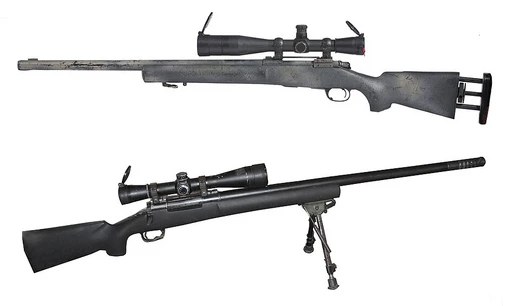
Gepárd anti-materiel rifle
Hungarian anti-materiel rifle family designed for long-range precision.

The Gepárd anti-materiel rifles are a family of Hungarian weapons manufactured by Sero International Kft., designed to destroy unarmored and lightly armored targets. These long-range large-caliber rifles have high accuracy and muzzle velocity. The project, led by Ferenc Földi of the Institute of Military Technology of the Hungarian People's Army, began in 1987 when the Hungarian People's Army sought a compact, mobile weapon capable of damaging lightly armored targets.
Quick Facts
- Origin
- Hungarian People's Republic
- Is Ranged
- Yes
- Service
- 1990–present
- Designer
- Engineer Major Ferenc Földi
- Design Date
- 1987–1990
- Manufacturer
- Sero International Kft.
- Production Date
- 1991–present
- Number
- 123 M1, M1A1, M1A2; over 200 M1-M6
- Variants
- M1A1, M1A2, M2/M2A1, M3, M4, M5, M6
- Weight
- 17.5 kg
- Length
- 157 cm
- Part Length
- 110 cm
Facts from the source article.
Lore & Background
The first Gepárd to enter service was the M1, a single-shot rifle using the heavy 12.7×108mm cartridge. It featured a long barrel for accuracy and a skeleton stock to reduce weight, but was complicated to reload: the user had to rotate, pull back, remove the grip assembly (shaped like a signal-flare handgun), and insert another cartridge. High recoil was addressed by adding a barrel that recoiled after each shot, a design inspired by artillery cannons. The M1 was essentially a sniper weapon for anti-terrorist police and special forces operating on the 'one shot, one kill' principle. The Hungarian army purchased 25 M1 rifles for field use as materiel destruction rifles, but did not purchase later variants. Due to the M1's great weight, sharpshooters were instructed to abandon the weapon if forced to retreat quickly, saving only the grip assembly for proof.
A semi-automatic version, the M2, reduced barrel length and weight. An even shorter paratrooper variant, the M2A2, could be fired from the hip thanks to the advanced recoil mechanism, and a fiber optic scope and eyepiece imaging system was developed (or proposed) for VIP protection. The M3 used a larger 14.5×114mm cartridge, offering increased accuracy and range, making it the most popular Gepárd. The M4 and M5 improved on the M2 with stronger materials and better reliability, featuring a more rectangular look and blackened steel finish (earlier models were olive-green). The M5 is a bolt-action rifle for military sharpshooters weighing 13 kg, while the M4 is a semi-automatic anti-materiel rifle. The M6, called 'GM6 Lynx', used 12.7×108mm and .50 BMG rounds with stronger parts, lighter weight, shorter length, and an improved scope.
Reader's Guide
The Gepárd rifle family represents a notable Hungarian contribution to anti-materiel and long-range precision weaponry, developed during the transition from communist rule to a market economy. Its production history was bumpy, with early examples assembled at the Vízgépészeti Vállalat (Hydrotechnic State Company). The M3, strictly an anti-materiel rifle, was effective against hovering helicopters, APCs, and mobile radar stations, though its accuracy degraded beyond 1000 m. The later M4 and M5 could fire either Russian or NATO 12.7 mm ammunition via a field-replaceable barrel. The GM6 Lynx saw use by Indian special forces, while M2s were used by the People's Movement for the Liberation of Azawad. The Gepárd's design elements influenced the smaller-caliber 'Szép 7.62×51mm' bolt-action sniper rifle, developed by Ferenc Szép, who also participated in Gepárd development. The family's legacy lies in its adaptation of artillery-style recoil mechanisms to a portable rifle platform, and its evolution from a single-shot precision weapon to semi-automatic and bolt-action variants serving different tactical roles.
Did You Know?
- The name 'Gepárd' means 'cheetah' in Hungarian.
- The M1's grip assembly resembles a signal-flare handgun.
- The M3 uses the 14.5×114mm cartridge and is strictly an anti-materiel rifle.
- The GM6 Lynx is also designated M6.
More in Sniper Rifles 1-22
Spotted an error? Know more?
Reader corrections go straight into our review queue. Suggest an edit · How this site is sourced