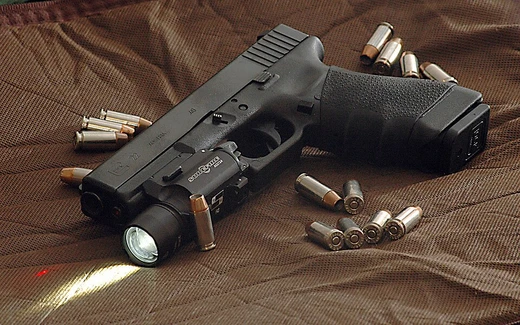
Glock
Polymer-framed pistol that revolutionized service handguns worldwide.

The Glock is a line of semi-automatic pistols made by the Austrian company Glock GmbH. They use a polymer frame, a short-recoil operating system, and a locked breech. The company also produces some rifles and one machine pistol. Company founder Gaston Glock designed the firearm. It first entered service with the Austrian military and police in 1982 as the P80, later sold commercially as the Glock 17. It won those contracts by outperforming established competitors in tests of reliability and safety. Although the market initially resisted the design because of its "plastic" construction, the Glock became the first commercially successful line of pistols to use a polymer frame.
The weapon uses Glock's proprietary "Safe Action" system, which has three independent internal safety mechanisms: a trigger safety, a firing pin safety, and a drop safety. These prevent accidental discharge without needing an external on-off switch. Glock pistols are also known for having a high magazine capacity relative to their weight and for resisting corrosion, originally achieved through a ferritic nitrocarburizing surface treatment called Tenifer.
Glock pistols are the company's most profitable product line. They are supplied to national armed forces, security agencies, and police forces in at least 48 countries, including the FBI and most U.S. police agencies. The product line has gone through six generations of design changes (Gen 1 through Gen 6). It is available in many calibers, such as 9×19mm Parabellum, .40 S&W, 10mm Auto, and .45 ACP, and in various sizes, from the full-sized Glock 17 to the subcompact Glock 26 and the "slimline" Glock 43.
The widespread adoption of the design has made the Glock popular and a focus of gun control debates. In the 2020s, the pistols faced scrutiny over the spread of "Glock switches"—illegal aftermarket auto sears that convert the firearms into machine pistols. This led to lawsuits filed by Minnesota and New Jersey in 2024, and legislation in California in 2025 (Assembly Bill 1127) aimed at forcing design changes to prevent such conversions. In October 2025, Glock announced a major "right-sizing" initiative, stopping production of over thirty variants to streamline manufacturing and introduce redesigned components to reduce the risk of full-auto conversion.
Quick Facts
- Origin
- Austria
- Is Ranged
- yes
- Service
- 1982–present
- Designer
- Gaston Glock
- Design Date
- 1979–1982
- Manufacturer
- Glock GmbH
- Number
- 20,000,000 as of 2020
- Cartridge
- 9×19mm Parabellum / 10mm Auto / .22 LR / .357 SIG / .380 ACP / .40 S&W / .45 ACP / .45 GAP
- Action
- Short recoil, locked breech, tilting barrel (straight blowback for Glock 25, 28, and 44)
- Feed
- 6-, 10-, 13-, 15-, 17-, 19-, 24-, 25-, 31-, 33-, or 40-round detachable box magazine, or 50- or 100-round detachable drum magazine
- Sights
- Iron sights
Facts from the source article.
Lore & Background
The company's founder, Gaston Glock, had no experience in firearms design when his first pistol was being prototyped, but he had extensive experience in advanced synthetic polymers. In 1980, the Austrian Armed Forces sought a new duty pistol to replace their Walther P38 handguns, listing 17 criteria including self-loading operation, 9×19mm Parabellum chambering, and resistance to accidental discharge from a 2-meter drop. Glock assembled a team of European handgun experts and within three months developed a working prototype that combined proven mechanisms with extensive use of synthetic materials. Submitted for assessment trials in early 1982, the Glock 17 outperformed eight pistols from five established manufacturers—Heckler & Koch, SIG Sauer, Beretta, FN Herstal, and Steyr Mannlicher—and was adopted as the Pistole 80.
The weapon uses the company's proprietary 'Safe Action' system, consisting of three independent internal safety mechanisms: the trigger safety, the firing pin safety, and the drop safety, preventing accidental discharge without an external on-off switch. Glock pistols are noted for high magazine capacity relative to weight and corrosion resistance originally achieved through a ferritic nitrocarburizing surface treatment called Tenifer. The product line has evolved through six generations of design changes, from the Gen 1's smoother 'pebble finish' grip to later generations with checkering and finger grooves. The Glock 17 became a standard NATO-classified sidearm with a NATO Stock Number, and by 1992 some 350,000 pistols had been sold in more than 45 countries.
Did You Know?
- The Glock 17 was named either for its 17-round magazine capacity or because it was the 17th patent procured by the company.
- Glock introduced ferritic nitrocarburizing into the firearms industry as an anticorrosion surface treatment for metal gun parts.
- The first Glock 17s imported to the US were from the AF000 series in January 1986.
- The British Armed Forces began replacing the Browning Hi-Power with the Glock 17 Gen 4 starting in 2013.
More in Semi-Automatic Pistols, Part 3 1-24
Spotted an error? Know more?
Reader corrections go straight into our review queue. Suggest an edit · How this site is sourced