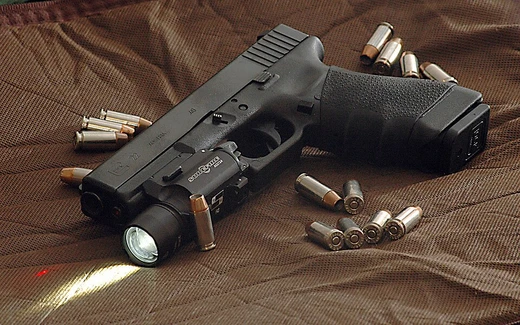
Beretta 92
A series of semi-automatic pistols designed and manufactured by Beretta of Italy.

The Beretta 92 is a series of semi-automatic pistols designed and manufactured by Beretta of Italy. It evolved from earlier Beretta designs, most notably the M1923 and M1951, incorporating an open slide design, an alloy frame, and a hinged locking block originally from the Walther P38. The 92 was designed in 1975 by Carlo Beretta, Giuseppe Mazzetti, and Vittorio Valle, with production beginning in 1976.
- Designers
- Carlo Beretta, Giuseppe Mazzetti, Vittorio Valle
- Year of design
- 1975
- Production start
- 1976
- First model production
- May 1976 to February 1983
- First model units
- Approximately 7,000 step-slide and 45,000 straight-slide
- Caliber variants
- 9×19mm (92), .40 S&W (96), 9×21mm (98)
Lore & Background
The Beretta 92 was designed in 1975 and entered production in 1976. The initial 92 model had two slide types: a 'step slide' (about 7,000 units) and a later 'straight slide' (about 45,000 units). In 1978, the 92S was introduced with a slide-mounted combined safety and decocking lever, replacing the frame-mounted thumb safety, and was adopted by Italian law enforcement and military units. The 92SB (initially called 92S-1) was designed for USAF trials and added an ambidextrous safety, a firing pin block, and a relocated magazine release. A compact version, the 92SB Compact, was produced from 1981 to 1991.
In 1984, the 92F (92SB-F) was introduced with fully interchangeable parts, a squared trigger guard, a recurved grip base, a hard-chromed bore, and a Bruniton coating. The 92FS added an enlarged hammer pin to prevent the slide from flying off in case of failure, a response to allegations of defective slides during U.S. military testing. Beretta's investigation found the slides were made to specification, and the separations were caused by overcharged ammunition. The 92FS also had a caliber conversion kit to .380 ACP for the Latin American market.
The design features an open slide for smooth feeding and ejection, a falling locking block for accuracy and suppressor compatibility, and a reversible magazine release. The magazine introduced direct feed (no feed ramp) and a double-stacked design, innovations from the earlier Model 84. Over time, Beretta replaced some metal parts with polymer and polymer-coated metal, including the recoil spring guide rod, magazine floor plate, and trigger.
Reader's Guide
The Beretta 92 series has had a significant legacy as a widely adopted military and law enforcement pistol, particularly after winning the USAF trials with the 92SB and later being used in U.S. government testing. The 92F's modifications for federal testing, including full parts interchangeability and the Bruniton coating, set a standard for large-organization service pistols. The 92FS's slide-retention feature addressed safety concerns, though the original slide failures were later attributed to out-of-spec ammunition rather than design flaws. The series has spawned numerous variants, including the double-action-only 92D, the decocker-only 92G designed for the French Gendarmerie Nationale, and the Vertec model. The Wilson Combat 92G Brigadier Tactical, produced since 2014, exemplifies continued customization with a Picatinny rail, all-steel controls, and a target barrel. The magazine design, with direct feed and double-stacked capacity, influenced later Beretta models, and after capacity-restricting laws, Beretta produced reduced-capacity and sand-resistant magazines. The 92 series remains in production in many configurations, with the 92G slide design still used on models like the M9A4.
Did You Know?
- The 92S designation means 'Sicurezza' (security) in Italian.
- The 92SB name means 'Sicurezza Blocco' (safety block), referring to the slide-mounted safety and internal firing pin block.
- The 92FS's enlarged hammer pin was designed to stop the slide from flying off if it cracked.
- The 92G was designed for the French Gendarmerie Nationale and has a decocker-only slide.
Trigger Architecture and the DA/SA Philosophy
The Beretta 92F/FS is explicitly identified in the technical literature as a representative example of the double-action/single-action trigger configuration. In this design, the shooter faces a meaningful distinction between the first and subsequent shots: the initial trigger pull demands roughly double the pressure because it must simultaneously cock the hammer and release it, whereas each following pull only needs to release an already-cocked hammer that was recocked automatically by the slide's rearward travel. This stands in contrast to double-action-only platforms like the Kel-Tec P-11, where every single pull requires identical force, or to single-action designs like the M1911, where the hammer must be manually cocked before any shot can be fired. The 92's DA/SA approach thus occupies a middle ground, offering the safety of a longer first pull while rewarding the shooter with a lighter, more precise follow-up trigger for rapid successive shots.
The Recoil-Driven Cycling Cycle
As a semi-automatic pistol, the Beretta 92 harnesses a portion of the energy generated by propellant combustion to drive its internal cycling. After a round is discharged, the slide—housing the bolt—travels rearward under recoil, performing three critical tasks in sequence: extracting the spent casing from the chamber, ejecting it from the firearm, and cocking the hammer in preparation for the next shot. A spring then drives the slide forward, pushing a fresh cartridge from the magazine into the chamber and bringing the bolt into battery. This entire sequence happens automatically after each trigger release, meaning the shooter need only pull the trigger again to fire. Most pistols of this type, including the 92, employ a short-recoil operating principle, though some alternatives use simple blowback or gas-driven mechanisms. The result is a platform that can cycle far more rapidly and hold more rounds than a revolver, whose fixed chambers must rotate into alignment one at a time.
Nomenclature and the Automatic Misnomer
The Beretta 92 belongs to a category of firearms whose naming conventions are a source of persistent confusion across languages and jurisdictions. Technically, the phrase automatic pistol designates a fully automatic machine pistol capable of discharging multiple rounds with a single sustained trigger pull—a function the 92 does not possess. In the 92's case, the fire control group severs the connection between the trigger and the firing pin the instant the trigger is released, requiring a deliberate reset before another shot can be fired. Yet in everyday American parlance, automatic pistol is routinely used as a synonym for any self-loading, magazine-fed handgun, which is precisely what the 92 is. Because true machine pistols are exceedingly rare in civilian commerce, the colloquial labels automatic, semi-automatic, and self-loading have effectively collapsed into interchangeable terms for the same class of one-round-per-trigger-pull weapon.
Carry Configuration and Readiness Doctrine
The DA/SA nature of the Beretta 92 shapes how it is conventionally carried and made ready for immediate use. The standard carry mode for a pistol of this type involves a full magazine, one round seated in the chamber, the hammer in the uncocked forward position, and the external safety disengaged. This differs fundamentally from the single-action cocked-and-locked condition popularized by Jeff Cooper, which requires the hammer to be fully cocked and the thumb safety engaged—a configuration that, on many SA pistols, is ergonomically awkward for left-handed shooters because the safety lever sits on the left side of the frame. The 92's DA/SA design sidesteps this particular handedness issue for the first shot, since the trigger itself performs the cocking function. However, the 92 still relies on a removable box magazine inserted into the grip for its ammunition supply, and the first round must be manually chambered by racking the slide before the automatic cycling sequence can begin.
More in Semi-Automatic Pistols, Part 3 1-24
Spotted an error? Know more?
Reader corrections go straight into our review queue. Suggest an edit · How this site is sourced