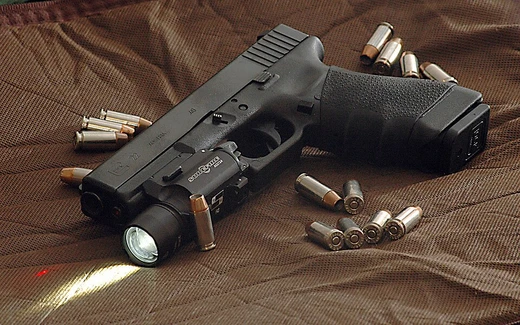
Bersa Thunder 9
Full-size short-recoil pistol evolved from the Model 90.

The Bersa Thunder 9 is a full-size, semi-automatic pistol built at the company’s Ramos Mejia plant in Argentina. It grew out of the Model 90, which was Bersa’s first full-size 9mm Luger handgun, released in 1989. When the company rebranded its entire pistol lineup as “Thunder” in 1994, the Model 90 received upgrades: a match barrel, improved sights, better ergonomics, a lighter weight, higher magazine capacity, and a redesigned fire control group. This updated version became the full-size model in the Thunder series. The pistol is also marketed as the Firestorm or FS 9.
The Thunder 9 has little in common with other Bersa handguns. While smaller Thunders use a blowback action similar to the Walther PPK, the full-size models—including the Thunder 9, Thunder 40, and Thunder 45—are short-recoil designs built to handle higher-pressure cartridges. The number in the name indicates the caliber: 9mm Luger, .40 S&W, or .45 ACP.
The gun resembles the Walther P88. Its slide and barrel are made of high-strength steel, and the frame is aluminum alloy. Finishes include black matte, nickel, and a two-tone option with a nickel slide and satin black frame; all are non-reflective. The wraparound polymer grips are integrated into the design. The trigger operates in double-action for the first shot and single-action for subsequent shots. The magazine is double-stack, and the slide locks open after the last round. The magazine release can be reversed for left-handed users, and a chamber indicator shows when a round is loaded.
The pistol has an ambidextrous safety that also serves as a decocker, along with emphasized sights, a combat trigger guard, and a firing pin block. A version introduced after 2000, called the Pro, adds an accessory mounting groove on the frame. The gun will not fire unless the trigger is fully pulled, preventing accidental discharge from drops. The Thunder Ultra Compact includes a key-operated security lock on the left side of the frame; when locked, the hammer cannot be cocked, the trigger won’t work in double-action, the slide won’t cycle, and the gun cannot be disassembled. The Thunder 9 is considered one of the easiest semi-automatic pistols to field strip for cleaning.
Compact variants of the Thunder 9, Thunder 40, and Thunder 45 were introduced in the late 1990s.
- Manufacturer
- Bersa
- Production location
- Ramos Mejia, Argentina
- Caliber
- 9mm Luger
- Action
- Short-recoil, double-action/single-action
- Magazine type
- Double stack
- Frame material
- Aluminum alloy
- Slide and barrel material
- High strength steel
Lore & Background
The Thunder 9 shares little in common with the other handguns in the company's product line. While smaller Thunders are blow-back pistols similar to the Walther PPK, the Thunder 9 is a full-size, short-recoil handgun to handle the greater pressure of its cartridge. The gun bears some resemblance to the Walther P88 pistol. The slide and barrel are high strength steel and the frame is aluminum alloy. Available finishes are black matte, nickel, and a two-tone with a nickel finished slide and satin black frame, all non-reflective. The polymer grips are integrated 'wraparound' style. The trigger is double-action for the first shot, single-action thereafter. The magazine is double stack and the slide remains open after the last round is fired. The magazine release button can be reversed for left-handed shooters and it has a 'round in the chamber' indicator. The pistol features ambidextrous safety, a decocker activated by the safety lever, emphasized sights, combat trigger guard, an integrated accessory mounting groove in the frame (added after the year 2000, in the Pro version), and a firing pin block. The pistol will not fire unless the trigger is squeezed all the way back, protecting from accidental falling. The Thunder 9 is one of the easiest semi-automatic handguns to field strip for cleaning.
Reader's Guide
The Thunder 9 represents a significant step in Bersa's development, evolving from the Model 90 into a refined full-size service pistol. Its short-recoil operation distinguishes it from the company's smaller blow-back designs, allowing it to handle the 9mm Luger cartridge effectively. The pistol's design incorporates features such as ambidextrous safety, a decocker, and a firing pin block, contributing to its operational safety. The addition of an integrated accessory mounting groove in the Pro version after the year 2000 reflects adaptation to modern tactical needs. The Thunder 9 is also sold under the Firestorm or FS 9 name, indicating its availability in different markets. Its use by the Argentine Army and law enforcement in Argentina, as well as by the Bangladesh Army and Border Guard Bangladesh, among others, demonstrates its adoption as a service sidearm. The pistol's ease of field stripping is noted as a practical advantage for maintenance. The Thunder 9 also served as the basis for Compact variants introduced at the end of the 1990s, initially called 'Mini Thunder' and later 'Thunder Ultra Compact', which are available in 9mm Parabellum, .40 S&W, and .45 ACP, with reduced barrel lengths and +P rating for the 9mm and .45 ACP Ultra Compact versions.
Did You Know?
- The Thunder 9 is an evolution of the Model 90, Bersa's first full-size 9mm Luger pistol introduced in 1989.
- The number after 'Thunder' identifies the cartridge fired, so Thunder 9 is for 9mm Luger.
- The Thunder 9 is also sold under the names Firestorm or FS 9.
- The Thunder Ultra Compact features an individual security key to activate a locking system.
Position Within the Thunder Lineup
The Bersa Thunder 9 occupies a defined slot inside a broader family of compact semi-automatic pistols produced by the Argentine manufacturer Bersa, S.A. The Thunder series, as catalogued by the company, spans a range of calibers and sizes, encompassing the Thunder 22, Thunder 22-6, Thunder 380, Thunder 9, Mini Thunder 9, Mini Thunder 40, and Mini Thunder 45. Rather than treating each model as an isolated product, Bersa built the lineup around a shared mechanical and ergonomic philosophy, so that the Thunder 9 inherits the same structural language as its siblings. This family approach carries a practical benefit: components across the compact Thunder series are designed to be interchangeable. A shooter who owns a Thunder 9 therefore taps into a wider pool of spare parts and aftermarket support than a gun tied to a single, stand-alone platform would enjoy. The series also draws design cues from the Walther PPK, lending the Thunder 9 a recognizable silhouette in the world of small, semi-automatic handguns.
Shared Engineering DNA
Across the Thunder series, including the Thunder 9, Bersa relies on a blowback, fixed-barrel operating system housed in a light aluminum alloy frame. The fixed barrel and the nearly straight-in alignment between the chamber and the topmost round in the magazine work together to promote reliable chambering and smooth cycling, while the blowback mechanism theoretically contributes to consistent point of impact. To keep the overall weight low for comfortable carry, the aluminum frame trims mass without sacrificing enough heft to let recoil feel punishing. A long rearward tang extends over the grips, shielding the shooter's thumb web from the kind of hammer-bite or slide-bite that plagues smaller pistols. Safety is layered: a slide-mounted manual safety and decocker blocks the hammer, a magazine disconnect prevents any round from firing without a magazine seated, a long double-action first pull adds a deliberate break, and an inertial firing pin guards against accidental discharge. Some variants add a key-operated trigger lock or an automatic firing pin block, and a rear sight windage adjustment lets the owner fine-tune aim.
Designed for the Everyday Concealed-Carry Shooter
The Thunder 9 was conceived with the general civilian market in mind, and its compact dimensions place it squarely in the concealed-carry segment. The lightweight aluminum frame makes the pistol easy to tuck into a waistband or ankle holster for daily wear, while the retained mass of the frame still provides enough inertia to keep felt recoil manageable. The magazine well incorporates an extended grip section so that every finger of the firing hand has a natural resting place, improving control during rapid follow-up shots. Because the platform is a semi-automatic with a blowback action, the shooter benefits from the consistent trigger feel and manageable slide weight that come with that design, without the added complexity of a tilting-barrel system. The result is a small, self-contained handgun that Bersa positioned as a practical, no-frills option for people who want a reliable sidearm for personal protection or range practice without stepping into the size and weight of a full-service pistol.
Parts, Longevity, and the Post-Production Era
Although several Thunder-series models, including the closely related Thunder 32, have seen their production runs end—Bersa discontinued the Thunder 32 in June 2012—the Thunder 9 is not left without support. Bersa and its import partner Eagle Imports continue to stock replacement components on their shared website, and because the compact Thunder models were engineered with interchangeable parts, a Thunder 9 owner can draw from a broader catalog of springs, magazines, and small hardware than a single-model platform would allow. This modular philosophy means that even after a particular variant leaves the production line, the underlying mechanical ecosystem persists. Shooters who purchased a Thunder 9 during its active years can still source the springs, grip panels, and other serviceable items needed to keep the pistol functioning safely. In a market where discontinued handguns often become difficult to maintain, the Thunder 9's place in a shared-parts family gives it a practical longevity that extends well beyond its original shelf life.
More in Semi-Automatic Pistols, Part 3 1-24
Spotted an error? Know more?
Reader corrections go straight into our review queue. Suggest an edit · How this site is sourced