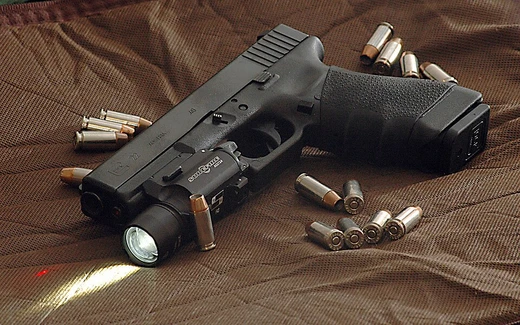
Browning Hi-Power
A pioneering 9mm service pistol with a 13-round double-stack magazine.

The Browning Hi-Power is a single-action, semi-automatic pistol originally designed by John Browning and completed by Dieudonné Saive at FN Herstal. Introduced in 1935, it was notable for its 13-round double-stack magazine, which nearly doubled the capacity of contemporary service pistols such as the Walther P38 and Colt M1911. It became one of the most widely used military pistols in history, adopted by the armed forces of over 50 countries.
- Designer
- John Browning (completed by Dieudonné Saive)
- Manufacturer
- FN Herstal
- Calibers
- 9×19mm Parabellum, .40 S&W
- Action
- Single-action, locked-breech recoil-operated
- Magazine capacity
- 13 rounds (original); later 17 rounds (2022 model)
- Weight
- Not exceeding 1 kg (2.2 lb) per French requirement
- Years of production
- 1935–2018; resumed in 2022
Lore & Background
The Hi-Power was developed in response to a French military requirement for a compact service pistol with a magazine capacity of at least 10 rounds, an external hammer, a safety catch, and a magazine disconnect device. The French also demanded a caliber of 9mm or larger, a bullet mass around 8 g, and a muzzle velocity of 350 m/s, all within a weight of 1 kg. John Browning built two prototypes—one blowback, one locked-breech—and filed a patent in the United States in 1923. The locked-breech design was selected, and Dieudonné Saive later integrated features from the Colt M1911 after its patents expired in 1928. By 1931 the design incorporated a 13-round magazine, a curved rear grip strap, and an integral barrel bushing. The Belgian Army bought 1,000 pistols for field trials, and the pistol entered Belgian service in 1935 as the Browning P-35.
During World War II, the FN factory in Belgium was occupied by Nazi Germany, which produced the pistol for its forces under the designation "9mm Pistole 640(b)". Meanwhile, FN moved production to John Inglis and Company in Canada, where the name was changed to "Hi-Power". Inglis produced two versions: one with an adjustable rear sight and detachable shoulder stock for a Nationalist Chinese contract, and one with a fixed rear sight. These were used by British airborne forces, the SOE, the OSS, and the SAS. After the war, production returned to Belgium, and the Hi-Power was adopted by over 50 armies in 93 countries, including many NATO nations and Commonwealth forces.
Reader's Guide
The Browning Hi-Power's significance lies in its pioneering use of a double-stack detachable box magazine, which set a new standard for service pistol capacity. From 1935 until the introduction of the 15-round MAB PA-15 in 1966, it was the only 9mm semi-automatic pistol available with such a magazine. Its widespread adoption by over 50 countries and use by both Allied and Axis forces during World War II cemented its reputation as a reliable and influential military sidearm. Licensed and unlicensed copies were produced in Argentina, Hungary, India, Bulgaria, and Israel, further extending its global reach. After 82 years of continuous production, FN Herstal discontinued the Hi-Power in early 2018, but new clones from companies such as GİRSAN, TİSAŞ, and Springfield Armory soon filled the void. In 2022, FN announced a resumed production of the Browning Hi-Power, though the new "FN High Power" is a different design, lacking Browning-style locking lugs and incorporating features such as an ambidextrous slide lock, a simplified takedown method, and 17-round magazines. The Hi-Power remains a benchmark in pistol design, influencing countless subsequent firearms.
Did You Know?
- The Hi-Power was the only 9mm semi-automatic pistol with a double-stack magazine from 1935 until the 15-round MAB PA-15 appeared in 1966.
- During World War II, the Hi-Power was produced for both the Axis (under German occupation) and the Allies (in Canada).
- Former Iraqi ruler Saddam Hussein often carried a Browning Hi-Power.
- The 2022 FN High Power is a different design from the original, lacking Browning-style locking lugs.
From French Specification to Belgian Service Pistol
The Hi-Power's origins trace to a French military specification demanding a compact sidearm with at least ten rounds, a magazine disconnect, an external hammer, and a safety catch, all while remaining robust and easy to field-strip. The French also required reliable lethality at fifty meters, pointing toward 9mm caliber, roughly 120-grain projectiles, and muzzle velocities near 1,100 feet per second, all under a weight ceiling of about 2.2 pounds. FN Herstal turned to John Browning, who had already licensed his M1911 to Colt and therefore needed to engineer something entirely fresh. He built two prototypes in Utah—one blowback, one locked-breech—both using Dieudonné Saive's staggered magazine to pack more rounds into a manageable grip. The locked-breech version, initially striker-fired with a sixteen-round box, was selected for further trials. After Browning's death in 1926, Saive carried the project forward, integrating Colt's previously patented barrel-bushing and takedown sequence once those patents lapsed in 1928. By 1931 the design had settled on a thirteen-round magazine, and the Belgian Army purchased a thousand examples for field testing. France ultimately passed in favor of the lower-capacity Modèle 1935, but Belgium adopted the pistol in 1935 as the P-35, and it went on to define a new era of high-capacity service handguns.
Wartime Production and a Name That Stuck
When Nazi Germany occupied Belgium in 1940, the Wehrmacht seized the FN Herstal plant and put it to work producing the pistol for the German military under the designation Pistole 640(b), the b standing for belgisch, or Belgian. Simultaneously, FN engineers relocated their production line to a John Inglis and Company facility in Canada, where they continued building the gun for Allied forces. It was during this Canadian run that the name shifted from High Power to Hi-Power, a shortened form that stuck even after manufacturing returned to Belgian soil. The pistol accumulated a rich set of nicknames over the decades—HP, BHP, P-35, HP-35, GP from the French grande puissance, and BAP for Browning Automatic Pistol—reflecting its many roles and the countries that fielded it. The fact that the same basic design served both sides of a global conflict underscores how central the Hi-Power had become to mid-century military thinking. Its thirteen-round double-stack magazine, nearly double the capacity of contemporaries like the Walther P38 or Colt M1911, made it a standout choice for armed forces seeking a compact yet high-capacity sidearm, and that advantage carried it well beyond the war years into decades of continued service.
A Pistol for the World
Few handguns in history have achieved the geographic spread of the Hi-Power. Over the course of its service life, it was adopted by the armed forces of more than fifty nations, making it one of the most widely deployed military pistols ever produced. While the vast majority of examples were manufactured by FN Herstal in Belgium, licensed and unlicensed copies were also built in countries including Argentina, Hungary, India, Bulgaria, and Israel, each adapting the design to local production capabilities and preferences. The pistol's dominance in the 9mm semi-automatic category was nearly unbroken for three decades: from its 1935 introduction until the MAB PA-15 appeared in 1966, it was the only 9mm semi-automatic on the market offering a double-stack detachable box magazine. That thirteen-round capacity was a quantum leap over the single-stack mags of the era, and it set a benchmark that competitors would chase for years. The Hi-Power's sheer ubiquity—on the desks of officers, in the holsters of infantry, and in the arsenals of police forces across five continents—cements its place as a defining sidearm of the twentieth century.
Discontinuation, Clones, and a Modern Rebirth
After eighty-two years of continuous production, Browning Arms ended Hi-Power manufacturing in early 2018, leaving a conspicuous gap in the market. Between 2019 and 2022, several firearm companies—including GİRSAN, TİSAŞ, and Springfield Armory—rushed to fill the void with their own Hi-Power-inspired designs. These clones competed aggressively, differentiating themselves through new finishes, enhanced sighting systems, redesigned hammers, bevelled magazine wells, improved triggers, and increased magazine capacities. Then in 2022, FN Herstal announced it would resume production under the FN High Power banner. The new model introduced a fully ambidextrous slide lock, a simplified takedown procedure, an enlarged ejection port, a reversible magazine release, wider slide serrations, a broader range of finish colors, and seventeen-round magazines. Despite its visual kinship with the classic, the 2022 design is in fact a different pistol: notably, it lacks the Browning-style locking lugs that characterized the original. The Hi-Power's story, then, is one of remarkable endurance, competitive revival, and cautious reinvention.
More in Semi-Automatic Pistols, Part 3 1-24
Spotted an error? Know more?
Reader corrections go straight into our review queue. Suggest an edit · How this site is sourced