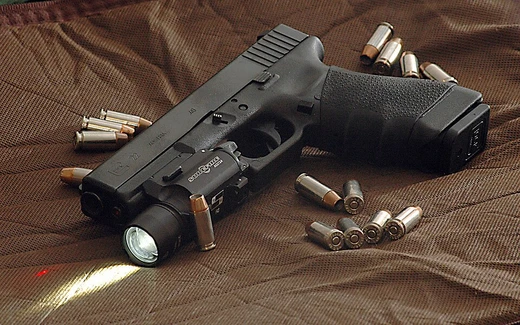
CZ 85
Ambidextrous update of the CZ 75, designed to counter unlicensed copies.

The CZ 85 is a semi-automatic pistol derived from the CZ 75, originally produced by Česká Zbrojovka in Czechoslovakia (now the Czech Republic). It was created because the CZ 75 lacked patent protection, resulting in unlicensed copies abroad.
The CZ 85 is an improved version of the CZ 75, with minor internal modifications for better reliability. It features an ambidextrous safety and slide stop, making it usable by both left- and right-handed shooters.
Variants include the CZ 85B, an updated model with a firing pin block safety, squared trigger guard, ring hammer, and tri-dot sights. It is chambered in 9×19mm (16-round magazines) and .40 S&W (10-round magazines). The CZ 85BD is the same as the 85B but uses a decocking lever instead of a safety. The CZ 85 Compact is a limited-production compact version in .40 S&W with an under-barrel accessory rail, identical to the current CZ 75 compact in that caliber. The CZ 85 Combat has an adjustable rear sight, extended magazine release, drop-free magazine, and overtravel adjustment on the trigger; it lacks a firing pin safety to allow easy firing pin replacement without special fitting. The NZ 85B is a Chinese Norinco copy.
- Manufacturer
- Česká Zbrojovka
- Country of origin
- Czechoslovakia (now Czech Republic)
- Calibers
- 9×19mm, .40 S&W
- Magazine capacity (9mm)
- 16 rounds
- Magazine capacity (.40 s&w)
- 10 rounds
Lore & Background
The CZ 85 was developed because the CZ 75 had no patents protecting the design, and the CZ 75 was copied in other countries with unlicensed versions. It is an updated version of the CZ 75, with slight changes made to internal parts to increase reliability. It has an ambidextrous safety switch and slide stop, making the pistol suitable for both right- and left-handed shooters.
Variants include the CZ 85B, an up-to-date version with a firing pin block safety, squared off trigger guard, ring hammer, and tri-dot sights, available in 9×19mm and .40 S&W. The CZ 85BD is a CZ 85B with a decocking lever instead of a safety. The CZ 85 Compact is a limited production compact version with an under-barrel accessory rail, chambered in .40 S&W, identical to the current CZ 75 compact in .40 S&W. The CZ 85 Combat has an adjustable rear sight, extended magazine release, drop-free magazine, and overtravel adjustment on the trigger, but lacks a firing pin safety so that firing pins can be replaced without special fitting. The NZ 85B is a Chinese Norinco copy.
Reader's Guide
The CZ 85 represents a direct response to the widespread unlicensed copying of the CZ 75, which lacked patent protection. By introducing ambidextrous controls and internal reliability improvements, Česká Zbrojovka aimed to offer a more versatile and robust alternative to the original design. The pistol's ambidextrous safety and slide stop made it notable for left-handed shooters, a feature not common in many service pistols of its era. The various variants—including the CZ 85B with a firing pin block, the CZ 85BD with a decocker, the limited-production CZ 85 Compact, and the CZ 85 Combat with adjustable sights—show a deliberate effort to cover different market segments. The existence of the Chinese Norinco NZ 85B copy underscores the ongoing challenge of unlicensed production that the CZ 85 was originally meant to address. Despite being based on the CZ 75, the CZ 85 carved its own identity as a refined, ambidextrous service pistol.
Did You Know?
- The CZ 85B is available in 9×19mm and .40 S&W calibers.
- The NZ 85B is a Chinese Norinco copy of the CZ 85.
Origins & Design Philosophy
The CZ 75 emerged from a rich tradition of Czechoslovak arms manufacturing that had been a cornerstone of the interwar economy. After the 1948 communist takeover nationalized heavy industry and severed Western export channels, the country's weapons development took a distinctly independent path—while other Warsaw Pact nations relied on Soviet designs like the AK-47, Czechoslovakia continued producing its own arms domestically. Into this environment stepped František Koucký, one of the two brothers who had contributed to virtually every post-war CZUB weapon. Though both Kouckýs signed their work under a shared surname, making individual attribution impossible, it was František who, freshly retired by 1969, received a rare commission: complete creative freedom to design a 9×19mm Parabellum pistol from the ground up. The result was a short-recoil, locked-breech design employing a Browning-style linkless cam locking system, a staggered-column magazine, all-steel construction, and a hammer-forged barrel. First produced in 1975, it quickly earned its place among the original "wonder nines" and became the most common handgun in the Czech Republic.
The Spanish Frame Saga & Production Evolution
The early CZ 75 models, manufactured between 1975 and 1979, were built from forged steel with hand-finishing—a luxury made possible by the low cost of labor in socialist Czechoslovakia. These "short rail" pistols represented the premium tier of production. However, the company's ambitions for export volume outpaced domestic capacity. In 1977, negotiations began between the Czechoslovak exporter Merkuria and the Spanish firm Alfa in Eibar, culminating in a 1979 agreement to produce cast frames abroad. The arrangement promised lower costs but came at a price: inferior steel quality and reduced finishing. When March 1979 testing revealed cracks in the Spanish-made frames, engineers responded by strengthening both the frame and slide, which lengthened the rail and permanently altered the pistol's silhouette. Cast frames first arrived in Spain in January 1980. Although the partnership fell short of expectations, it significantly boosted output in the early 1980s. By the mid-1980s, CZ had abandoned the Spanish source entirely, developing its own in-house casting facilities. Guns produced from that point onward were machined from cast frames—a manufacturing method the company still employs today. In 2026, CZ announced the CZ 75 Legend, a modern tribute retaining the original short-rail aesthetic.
Sport Shooting Legacy & IPSC
The CZ 75's journey into competitive shooting was catalyzed by the growing popularity of IPSC matches in the Czech Republic. In 1992, CZUB established a factory team, and Stanislav Křižík designed the CZ 75 Champion, featuring a single-action trigger, a muzzle brake, and adjustable weights. The initial run of 150 pistols was chambered in 9×19mm, .40 S&W, and 9×21mm. A persistent limitation was magazine capacity, matching the standard 15 or 16 rounds in 9mm and 12 in .40 S&W. In 1998, the CZ 75 ST and CZ 75 M arrived with a redesigned frame accommodating greater modification. The ST became a competition favorite, while the M, not originally intended for red-dot optics, suffered frame wear when shooters mounted them. The 2005 CZ 75 TS addressed durability with a 132 mm barrel, a heavier 1,285 g build, and magazines holding 20 rounds of 9mm or 17 of .40 S&W. By 2013 it remained the platform for CZUB's IPSC Standard division shooters. In 2009, the CZ 75 TS Czechmate entered the market, offering 20 or 26-round magazines and shipping with a C-More Systems red-dot sight. Factory shooter Martin Kameníček reportedly fired 150,000 rounds through his example over five years, requiring only a single barrel replacement to maintain accuracy.
Geopolitical Context & Patent Secrecy
The CZ 75 was conceived in a geopolitical landscape that shaped its entire commercial trajectory. Although designed for export, the pistol was never intended for the Czechoslovak military, whose standard sidearm was the Soviet 7.62×25mm Tokarev cartridge, later replaced by the Warsaw Pact 9mm Makarov. This meant the 75 existed in a peculiar legal limbo within its own country. Koucký's domestic patents were classified as "secret patents"—a designation that effectively rendered them invisible to the public while simultaneously blocking any other manufacturer in Czechoslovakia from registering an identical design. Yet Koucký and CZUB were simultaneously forbidden from seeking patent protection abroad. The result was a design that could not be legally copied domestically but was entirely unprotected internationally, inviting a wave of clones and variants from other manufacturers. Domestically, the pistol was not even sold in Czechoslovakia until 1985, when it found an audience among sport shooters. It was only after the Velvet Revolution of 1989 that the Czech armed forces finally adopted the very pistol their industry had been building for the world.
More in Semi-Automatic Pistols, Part 3 1-24
Spotted an error? Know more?
Reader corrections go straight into our review queue. Suggest an edit · How this site is sourced