CZ 100
Hammerless DAO pistol with synthetic frame and Browning cam action.

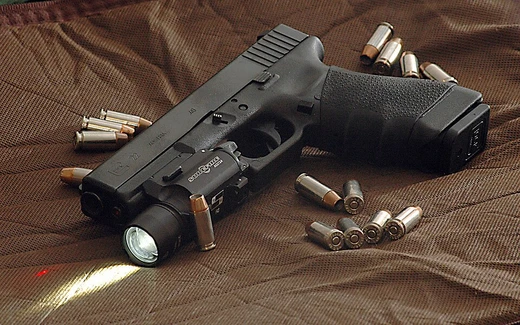
The CZ 100 is a semi-automatic pistol first produced in 1995 by Česká Zbrojovka. It operates as a hammerless, double-action-only (DAO) handgun, meaning the firing mechanism remains untensioned until the trigger is pressed. An automatic firing pin safety is included. The slide features a protrusion behind the ejection port, designed for one-handed cocking by pushing it against a fixed surface. The action uses the standard Browning cam system. In the .40 S&W version, a simple compensator is present. A tactical rail allows attachment of proprietary lasers or lights. This model was CZ’s first to incorporate synthetic materials.
Available in 9mm Parabellum (13-round magazine) or .40 S&W (10-round magazine), the pistol has a 95 mm barrel, an overall length of 177 mm, a height of 130 mm, and a width of 31 mm. It weighs 645 g, with a sight radius of 148 mm and six-groove, right-hand rifling. Production began in 1995 and continues.
Variants include the CZ 110 and the CZ 100B, reintroduced in 2000. The CZ 100B is largely identical but features adjustable sights, refined trigger and firing mechanisms, and cleaner machining on the slide and exterior steel.
In 1998, Kazakhstan purchased ten pistols for its Ministry of Internal Affairs, where they are used by police tactical units.
- Cartridge
- 9mm Parabellum or .40 S&W
- Length
- 177 mm (6.96")
- Barrel
- 95 mm (3.74")
- Weight
- 645 g (22.75 oz)
- Height
- 130 mm (5.11")
- Width
- 31 mm (1.22")
- Sight radius
- 148 mm (5.82")
- Rifling
- 6 grooves, right-hand
- Magazine
- 13-round (9mm) or 10-round (.40) detachable box
- Production years
- 1995–present
Lore & Background
The CZ 100 was introduced in 1995 as a modern semi-automatic handgun from Česká Zbrojovka. It is hammerless and double-action-only, meaning the firing system is under no tension until the trigger is pulled. An automatic firing pin safety device is included. The pistol is constructed for one-handed cocking, featuring a protrusion on the slide behind the ejection port intended for pushing against the edge of a fixed surface. The action uses the usual Browning cam. The .40 S&W version has a simple compensator. A tactical rail allows for the attachment of a laser or light, but only proprietary models. It was the first of CZ's weapons to use synthetic materials.
In 2000, the CZ 100 was reintroduced as the CZ 100B, which is identical in most ways except for adjustable sights, trigger and firing mechanism work, and cleaner machining of the main slide and exterior steel. A variant designated the CZ 110 also exists. The pistol was adopted by Kazakhstan, where 10 pistols were bought in 1998 for the Ministry of Internal Affairs and used by police tactical units.
Reader's Guide
The CZ 100 represents a significant departure from earlier CZ designs, being the company's first firearm to incorporate synthetic materials in its construction. Its hammerless double-action-only system, combined with an automatic firing pin safety, emphasizes simplicity and safety for users who prefer a consistent trigger pull. The one-handed cocking feature, using a protrusion on the slide, allows the pistol to be readied against a fixed surface, a practical design for tactical or emergency situations. The inclusion of a tactical rail, though limited to proprietary accessories, and a compensator on the .40 S&W version, show attention to functional enhancements. The reintroduction as the CZ 100B in 2000 with improved sights, trigger work, and machining indicates ongoing refinement. Its adoption by Kazakhstan's police tactical units, albeit in small numbers, demonstrates its niche use in law enforcement. The CZ 100's legacy lies in its role as a transitional model for CZ, blending traditional Browning cam action with modern materials and a striker-fired-like DAO mechanism, influencing later polymer-framed CZ pistols.
Did You Know?
- It is hammerless and double-action-only, with the firing system under no tension unless the trigger is pulled.
- Kazakhstan bought 10 pistols in 1998 for its Ministry of Internal Affairs, used by police tactical units.
Origins & Design Lineage
The Astra A-100 represents the culmination of a multi-generational development program by Astra-Unceta y Cia SA, a Spanish firearms manufacturer. Production of this double-action/single-action semi-automatic pistol began in 1990, but its roots stretch back through the A-80 and A-90 predecessors. The A-80 itself was originally modeled on the SIG P220, establishing a design philosophy that the A-100 would carry forward and refine. Before reaching the commercial market, the various A-series pistols were put forward as candidates for Spanish military procurement contracts starting in the 1970s, though these bids were ultimately unsuccessful. Despite the military contract rejections, the platform found its audience in civilian and other markets, eventually being distributed across the United States by European American Armory. The A-100 thus stands as the mature expression of a design family that had been iterated over roughly two decades before its final form was realized.
Mechanical Architecture & Safety Philosophy
The A-100 employs a recoil-operated, locked breech system featuring an improved Browning-style linkless locking mechanism. Its lock-up geometry places lugs on the top of the barrel that engage corresponding lugs in the slide, a configuration shared with the Browning High Power and CZ-75, and distinctly different from the single-lug-in-ejection-port arrangement found in SIG P22X pistols. On the safety front, the pistol incorporates a manual decocking lever, a firing pin block, and a hammer safety. Notably, it omits a traditional manual safety entirely. Instead, the design relies on a deliberately long and heavy double-action trigger pull to prevent accidental discharge, a philosophy mirrored in the SIG P22X line. This means the pistol will only fire upon a conscious, full trigger stroke, reducing the likelihood of an inadvertent shot while still allowing single-action operation for follow-up rounds.
Physical Character & SIG Comparison
At first glance, the A-100 closely resembles the SIG P228 in overall size and dimension, yet several distinguishing details set it apart. Because it is constructed entirely of steel, the A-100 carries a slightly greater weight than its SIG counterpart. When the slide is fully forward, the A-100's chamber contour presents a rounded profile, whereas the SIG design features a squared-off shape. The hammer configuration also diverges: the A-100 sports a rounded hammer fitted with a lanyard hole, while the SIG uses a more conventional spur-style hammer. Frame shape differences further differentiate the two. Despite these distinctions, the pistols are not fully interchangeable in terms of magazines. However, the practical overlap is significant—many holsters designed for the SIG P228 or P229 accommodate the A-100 satisfactorily, giving owners a ready-made accessory ecosystem without needing to source A-100-specific gear.
Distribution, Naming & Operational Service
In the United States, the A-100 entered the market under two distinct banners. European American Armory handled its primary distribution, while Springfield Armory imported a variant it branded the Panther. Some specimens carry this Panther designation roll-marked on the left side of the slide, serving as a visible identifier of that import channel. Beyond the American market, the pistol found operational use in a more volatile context: the Lebanese Forces political party listed the A-80, A-90, and A-100 among the numerous semi-automatic pistols carried by its members. This placement within an armed political organization underscores the A-100's reputation as a reliable, full-size sidearm capable of service in demanding environments. The dual-identity distribution model—commercial sporting pistol in one channel, armed-organization sidearm in another—reflects the broad appeal of a well-made, all-steel double-action/single-action design.
More in Semi-Automatic Pistols, Part 3 1-24
Spotted an error? Know more?
Reader corrections go straight into our review queue. Suggest an edit · How this site is sourced