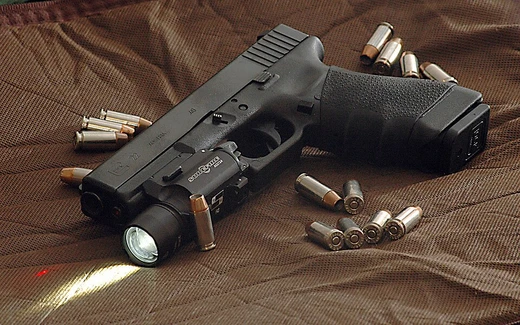
Beretta 8000
Rotating-barrel compact pistol from Beretta, later produced by Stoeger.

The Beretta 8000, also known as the Cougar, is a series of semi-automatic pistols from the Italian manufacturer Beretta. These handguns use a rotating barrel locking system, a relatively uncommon design. Introduced in 1994, the Cougar was built as a more compact option than the full-sized Beretta 92, aiming to balance concealability, ease of carry, accuracy, and firepower. The series was initially designed around the then-new .40 S&W cartridge, which made it straightforward to adapt to other calibers like .357 SIG and the less powerful 9x19mm. A .45 ACP version was later added. The pistols are intended for police use and civilian self-defense.
The Cougar is a recoil-operated, locked-breech pistol. Its rotating barrel system works by having the barrel twist during recoil to disengage from the slide; a stud on the barrel’s bottom follows a cam track in the steel frame insert to control this rotation. This design helps reduce felt recoil despite the gun’s smaller size and lighter weight compared to a standard Beretta 92FS. The frame is made from lightweight aluminum alloy. The standard F model features a double-action trigger, an exposed hammer, and ambidextrous safety/decocker levers on the slide. The D version is double-action only, with a spurless hammer and no safety/decocker levers. Magazines are double-stack for 9mm, .357 SIG, and .40 caliber models, while the .45 ACP uses a staggered-column magazine.
The 8000 series comes in several calibers and configurations, designated F, G, or D. Caliber variants include the 8000 in 9x19mm with a 15-round magazine, the 8000F in .41 AE, the lighter and more compact 8000L in 9x19mm with 13 or 15 rounds, the 8357 in .357 SIG with 11 rounds, the 8040 in .40 S&W with 11 rounds, and the 8045 in .45 ACP with 8 rounds. European models were also offered in .41 Action Express and 9x21mm. The F configuration is the basic DA/SA version with an exposed hammer and ambidextrous safety/decocker levers. The D configuration is double-action only with a spurless hammer and no levers. The G configuration is a DA/SA variant with a decock-only feature—it has an exposed hammer and ambidextrous decocking levers but no manual safety. The T configuration adds a tactical rail.
- Manufacturer
- Beretta (Italy); later Stoeger Industries (Turkey)
- First appeared
- 1994
- Calibers
- 9×19mm, .357 SIG, .40 S&W, .45 ACP, .41 AE, 9×21mm
- Magazine capacity
- 15 rounds (9mm 8000), 11 rounds (.357 SIG, .40 S&W), 8 rounds (.45 ACP), 13 rounds (8000L), 15 rounds (8000L Type P)
- Weight reduction (mini variant)
- 140 g less than respective models
- Barrel length (lapd 8045f)
- 4 inches
- Production period (8045 cougar)
- 1998–2004
Lore & Background
The Beretta 8000 Cougar series uses a relatively rare rotating barrel locking system, in which the barrel rotates on recoil to unlock itself from the slide. The rotating motion is controlled by a stud on the barrel's bottom that follows a cam track in the steel frame insert. This design allows for lower recoil despite a smaller overall size and lower weight than a standard Beretta 92FS. The frame is made from lightweight aluminum alloy.
The basic version is the F model, with double-action trigger, exposed hammer, and ambidextrous safety/decocker levers on the slide. The D version is double-action only with a spurless hammer and no safety/decocker levers. The G specification is a DA/SA variant with a decock-only feature, exposed hammer, and ambidextrous decocking levers but no safety. The T specification includes a tactical rail. Cougar pistols use double-stack magazines in 9mm, .357 SIG, and .40 caliber models, and staggered column magazines in .45 caliber models.
In 2004, following Beretta's acquisition of Stoeger Industries through Benelli, marketing and distribution of the Cougar was transferred to Stoeger. In 2006, Stoeger Cougars began being sold in 9×19mm, .45 ACP, and .40 S&W, made in Turkey on Beretta factory tooling. Stoeger also added a more compact-sized Cougar pistol with a reduced magazine capacity of 13 rounds. The Stoeger Cougar was quietly discontinued around 2017, but the pistols reappeared on Stoeger's Turkish website as of February 2024.
Reader's Guide
The Beretta 8000 Cougar series is significant as a compact alternative to the full-sized Beretta 92, offering a rotating barrel locking system that reduces recoil while maintaining accuracy and firepower. Its development around the .40 S&W cartridge allowed versatility across multiple calibers, including .357 SIG and 9×19mm, and later .45 ACP. The series saw adoption by various law enforcement agencies, including the North Carolina Highway Patrol (Model 8357 in .357 SIG), the Los Angeles Police Department (8045F with a 4-inch barrel), the Utah Highway Patrol (Model 8040 in .40 S&W), and the New York City Police Department (8000D for off-duty and backup carry). The 8045 Cougar was produced between 1998 and 2004, with a special 8045 Cat Pack offered in 1999. The transfer of production to Stoeger in Turkey extended the model's availability until around 2017, with a brief reappearance in 2024. The Cougar's legacy lies in its innovative rotating barrel design and its role as a compact service pistol for both police and civilian use.
Did You Know?
- The Beretta 8000 Cougar uses a rotating barrel locking system, a relatively rare design in semi-automatic pistols.
- The 8045 Cougar was produced between 1998 and 2004, and no factory 8045 Cougars were made in the G configuration.
- In 1999, Beretta USA offered 2000 special edition 8045 Cat Pack kits with charcoal laminate grips and a lapel pin.
- The Stoeger Cougar was made in Turkey on Beretta factory tooling and was discontinued around 2017, but reappeared on Stoeger's Turkish website in February 2024.
Design Evolution and Safety Mechanism Overhaul
The Beretta 70 series marked a decisive step forward from the M1934/35 pistols it succeeded. The most visible change concerned the safety control. The predecessor's 180-degree swivel lever was clunky and virtually impossible to manipulate with the firing hand. Beretta first substituted a cross-bolt design borrowed from the M1951, yet this proved equally awkward, prone to accidental engagement depending on the shooter's grip. After a brief period, the cross-bolt gave way to a thumb-activated, frame-mounted lever that became standard across Beretta's compact line from the 1960s through the 1980s. Beyond the safety, the frame's grip angle was reworked so the hand seated more naturally when pointing at a target, and the trigger was redesigned to lower the average pull weight. The slide stop, initially a follower-based hold-open that caused the slide to slam forward upon magazine removal, was replaced with a dedicated lever derived from the M1951. The trigger guard received a longer taper for improved looks, and a thumb shelf was later added to the left grip panel to satisfy the 1968 U.S. Gun Control Act.
The Model Family and Specialized Variants
The 70 series expanded into a broad family of variants tailored to distinct roles. The original Model 70, nicknamed Puma, came in .32 ACP with brown plastic wrap-around grips and the cross-bolt safety. The 70s adopted a steel frame and offered .22 LR, .32 ACP, and .380 ACP chamberings while introducing the conventional thumb safety. For lighter carry, the Model 71 swapped the steel frame for aluminum alloy, shedding roughly 200 grams, and was sold exclusively in .22 LR under the Jaguar name. The Model 72, also a Jaguar, paired a short self-defense barrel with a longer target barrel. Models 73, 74, and 75 were dedicated target pistols with extended barrels; the 74 added adjustable barrel-mounted sights, while the 75 retained the compact frame. The Model 76, produced from 1971 to 1985, featured a large integrated barrel shroud, a mounting rail for optical sights, and a rear sight attached to the shroud for a longer sight radius. It was offered with plastic (76P) or wooden (76W) grips.
Production Timeline and Version Transitions
The base Model 70 series without any letter suffix was manufactured between 1958 and 1968. During this window, the frame-mounted thumb safety was adopted, replacing the earlier cross-bolt design. The T version, produced from 1969 to 1975, offered a 9-round magazine—adding one round over base models—and a lengthened 152 mm target barrel. In 1977, the S version arrived, introducing a new magazine safety and transitioning the .32 ACP chambering to .380 ACP. The .22 caliber S guns received adjustable rear sights, while the .380 did not. Production of the S version ended in 1985. In a brief marketing episode in the late 1960s, the series was sold in the United States under 100-series numbering: the Model 100 paired a 150 mm barrel with the .22 frame, the 101 matched the Model 74, and the 102 corresponded to the Model 76. This alternate numbering was abandoned in the mid-1970s when the original Model 70 designation was restored.
International Service and Cultural Footprint
The Beretta 70 found service well beyond Italy's borders. Italian police forces adopted the pistol as part of their standard equipment. In Israel, the 70 series entered the hands of several elite units, including Sky Marshals, Mossad, Sayeret Matkal, and the Israeli Police. Libya also fielded the weapon. Perhaps most notably, Iraq produced the pistol under license beginning in 1980, marketing it domestically as the Tariq. The gun's versatility across calibers, from .22 LR to .380 ACP, and its availability in both compact and full-size frames made it suitable for a wide range of operational roles, from concealed carry to dedicated target work. The series also gained cultural visibility through appearances in film, cementing its place in popular imagination alongside its practical service record. Beretta's decision to offer the 70 under multiple commercial names—Falcon, New Puma, New Sable, Jaguar, and Cougar—further broadened its market reach across different regions and customer segments during its production run.
More in Semi-Automatic Pistols, Part 3 1-24
Spotted an error? Know more?
Reader corrections go straight into our review queue. Suggest an edit · How this site is sourced