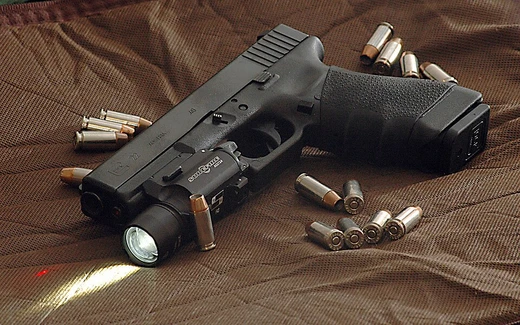
CZ 75 Tactical Sports
A competition pistol designed for IPSC practical shooting divisions.

The CZ 75 Tactical Sports is a Czech single-action semi-automatic pistol designed specifically for practical shooting competitions. It serves as the successor to the CZ 75 Standard IPSC model, offering improvements in trigger mechanism, magazine capacity, and durability.
- Barrel length
- 132 mm
- Weight
- 1,285 g
- Calibers
- .40 S&W and 9mm
- Magazine capacity (.40 s&w)
- 17 cartridges
- Magazine capacity (9mm)
- 20 cartridges
- Discontinued
- 2018
Lore & Background
The CZ 75 Tactical Sports (TS) was developed as the successor to the CZ 75 Standard IPSC model, which was part of a line of pistols manufactured for two IPSC divisions: Modified (75 M IPSC) and Standard (75 ST IPSC). Though nearly identical in external appearance to its predecessor, the TS introduced enhancements to the trigger mechanism, magazine capacity, and overall durability. It features a longer barrel of 132 mm and a higher weight of 1,285 g compared to the standard model.
The pistol is offered in two calibers: .40 S&W, which holds 17 cartridges in the magazine, and 9mm, which holds 20 cartridges. The .40 S&W caliber provides a score advantage under IPSC rules by qualifying as a 'major' caliber. The 9mm version appeals to shooters who do not reload ammunition, those in countries where major calibers are legally restricted, and those seeking low recoil and high magazine capacity. As of 2013, the model was used by CZUB's factory shooters in the IPSC Standard division. Production of the CZ 75 TS was officially discontinued in 2018.
Reader's Guide
The CZ 75 Tactical Sports holds significance as a dedicated competition pistol tailored for IPSC practical shooting, particularly the Standard division. Its design improvements over the earlier Standard IPSC model—such as a refined trigger, increased magazine capacity, and enhanced durability—made it a reliable tool for competitive shooters. The availability of two calibers allowed shooters to choose between the scoring advantage of the .40 S&W major caliber or the lower recoil and higher capacity of the 9mm version, accommodating different competition strategies and legal restrictions. The pistol's legacy includes its use by CZUB's factory team in IPSC Standard division until its discontinuation in 2018. Additionally, CZ Custom offered a magazine extender for the .40 S&W version, increasing capacity to 20 rounds, though this modification rendered the pistol ineligible for IPSC Standard Division while remaining legal for USPSA Limited Division. The model also spawned variants such as the CZ 75 Tactical Sports Open and the CZ 75 TS Czechmate, the latter designed for IPSC Open Division with a compensator and electronic red dot sight.
Did You Know?
- The CZ 75 TS was officially discontinued for production in 2018.
- The .40 S&W version offers a score advantage as a 'major' caliber under IPSC rules.
- CZ Custom marketed a magazine extender for the .40 S&W version, increasing capacity from 17 to 20 rounds.
- The CZ 75 TS Czechmate variant includes a compensator and electronic red dot sight for IPSC Open Division.
A Designer's Freedom in a Closed Economy
By 1969, František Koucký had just retired from the armament work he and his brother Josef had carried out across all of CZUB's post-war firearms. The two brothers had always submitted their designs under the shared surname alone, leaving it permanently unclear which mind produced any given idea. Yet when the company approached the newly retired Koucký with a commission to create a 9×19mm Parabellum pistol, something shifted: for the first time in his career he was granted total creative liberty to build the entire weapon from the ground up. The result, unveiled in 1975, became one of the original "wonder nines," distinguished by its staggered-column magazine, all-steel build, and hammer-forged barrel. Ironically, the pistol was conceived for export markets, since the domestic military standard was the Soviet 7.62×25mm Tokarev. Koucký's domestic patents were classified as "secret," shielding the design from competitors within Czechoslovakia while simultaneously barring the company from seeking foreign patent protection. That legal vacuum invited a wave of imitators worldwide, yet the original's reputation endured.
The Spanish Frame Experiment
In the late 1970s, Česká Zbrojovka faced a practical dilemma: demand for the CZ 75 outstripped what its own workshops could supply at a competitive export price. Negotiations began in 1977 between the state exporter Merkuria and the Spanish firm Alfa in Eibar, culminating in a 1979 agreement for Alfa to cast replacement frames. The trade-off was clear—lower cost in exchange for inferior steel and reduced finishing compared to the hand-finished, forged-steel originals produced between 1975 and 1979. The arrangement quickly ran into trouble. By March 1979, testing of the Spanish cast frames exposed dangerous cracks, forcing CZ to redesign and strengthen both the frame and the slide, which in turn lengthened the rail profile of the second-generation pistol. The first batch of cast carcasses actually reached Spain in January 1980. Although the partnership fell short of CZ's ambitions, it did boost output meaningfully through the early 1980s. By the mid-1980s the Spanish source was abandoned entirely. CZ then invested in its own in-house casting facilities, perfecting a process of machining guns from cast frames—a manufacturing method the company still relies on today.
Forging a Competition Pistol
The rise of IPSC shooting in the Czech Republic gave CZUB a new mission. In 1992 the company assembled a factory competition team, whose members initially competed with standard CZ 75s and CZ 85s. That same year, designer Stanislav Křižík produced the CZ 75 Champion, adding a single-action trigger, a muzzle brake, and adjustable weights. A run of 150 examples was built in 9×19mm Parabellum, .40 S&W, and 9×21mm. The Champion's persistent weakness was magazine capacity—identical to the standard model at 15 or 16 rounds in 9mm and 12 in .40 S&W. The next leap came in 1998 with the CZ 75 ST and CZ 75 M, both built on a revised frame that accepted more extensive modifications. The ST quickly became a favorite, while the M, not engineered with red-dot optics in mind, suffered from a limited frame life when used that way. To address durability, CZ introduced the CZ 75 TS in 2005. It carried a longer 132 mm barrel, weighed 1,285 grams, and accepted high-capacity magazines holding 20 rounds of 9mm or 17 of .40 S&W. By 2013 it served CZUB's IPSC Standard division shooters, with a custom Tactical Sports Open variant available.
Built to Outlast the Shooter
The CZ 75 TS Czechmate, launched in 2009, represented the culmination of a decade of iterative refinement. Developed from the TS Open platform, it was offered in 9×19mm Parabellum and 9×21mm with magazine options of 20 or 26 rounds, and shipped as standard with a red-dot sight manufactured by the American company C-More Systems. The pistol's durability claim is perhaps best illustrated by factory shooter Martin Kameníček, who pushed 150,000 rounds through his TS in just five years. In that entire span he replaced the barrel only once to preserve accuracy—a testament to the robustness of the extended 132 mm barrel and the reinforced frame architecture. The pistol's broader legacy extends well beyond the range: it became the most commonly carried handgun in the Czech Republic, was adopted by the nation's armed forces only after the 1989 Velvet Revolution (having first been sold domestically in 1985 to sport shooters), and achieved distribution across the globe. In 2026 CZ announced the CZ 75 Legend, a new variant that deliberately preserves the short-rail silhouette of the earliest 1975–1979 forged-steel models, closing the circle back to the design that started it all.
More in Semi-Automatic Pistols, Part 3 1-24
Spotted an error? Know more?
Reader corrections go straight into our review queue. Suggest an edit · How this site is sourced