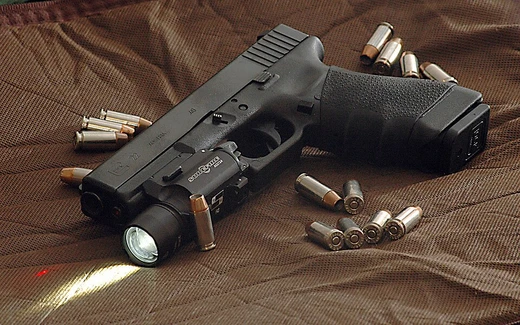
Caracal pistol
First UAE-made pistol series, adopted by multiple armed forces.

The Caracal pistol is a series of semi-automatic pistols produced by Caracal International LLC, which is part of Tawazun Holding based in the United Arab Emirates. Development began in 2002 when Austrian firearms designer Wilhelm Bubits, who had previously worked on the Steyr M pistol, teamed up with weapons specialists from the UAE to create a new line of pistols and accessories. This partnership resulted in the Caracal pistol.
However, the original Caracal pistol line faced serious problems. Due to faulty heat treatment of slides and poor quality control, the pistols were prone to catastrophic failures. As a result, the manufacturer removed the original line from the market in October 2013.
A recall was issued on September 9, 2013, for all Model C pistols. The company stated that after a full investigation, it was initiating a voluntary recall because customer safety was paramount. The recall covered all Model C pistols, including those with serial numbers starting with letters such as HM, AA, AD, AG, CA, CB, CC, CD, CE, CF, CG, CH, CI, CJ, CK, CL, CM, CN, CP, CR, and CS. Owners were instructed not to load or fire their pistols and to contact customer care to arrange a return. Caracal offered a full refund or vouchers for other products, noting that the safety issues could not be fixed through repairs. In October 2016, Caracal USA announced that recalled pistols would be replaced with a Model F pistol featuring a redesigned trigger safety, trigger bar, and firing pin unit.
The Caracal pistol series is the first made in the United Arab Emirates and serves as the service pistol for the UAE Armed Forces. In February 2007, 25,000 Caracal F pistols in 9 mm were ordered by various armies and security forces from Gulf Cooperation Council countries. By April 2008, the pistol had become the new service sidearm for the UAE, Bahrain, and Jordan. On November 17, 2008, the UAE and Algeria set up a joint committee to test the Caracal pistol for potential adoption by Algeria.
Users of the Caracal pistol include Algeria, Jordan (used by the Jordanian Armed Forces and Jordanian police units), Libya (used by the Libyan National Army), and the United Arab Emirates (used by the UAE Armed Forces, Abu Dhabi Police Force, and Dubai Police Force).
- Manufacturer
- Caracal International LLC (subsidiary of Tawazun Holding)
- Country of origin
- United Arab Emirates
- Designer
- Wilhelm Bubits
- Development began
- 2002
- Service pistol of
- United Arab Emirates, Bahrain, Jordan (as of April 2008)
- Notable order
- 25,000 Caracal F pistols in 9 mm ordered by Gulf Cooperation Council countries (February 2007)
- Recall issued
- September 9, 2013 (all Model C pistols)
Lore & Background
Development of the Caracal pistol began in 2002 when Austrian firearms designer Wilhelm Bubits, who had previously designed the Steyr M pistol, started working with weapons experts from the United Arab Emirates. This collaboration led to the creation of the Caracal pistol series. The pistols were manufactured by Caracal International LLC, a subsidiary of Tawazun Holding.
Issues with heat treatment of slides and improper quality control caused a tendency for catastrophic failures. As a result, in October 2013 the original Caracal pistol line was delisted by the manufacturer. On September 9, 2013, a recall was issued for all Model C pistols, stating that the safety of customers was paramount and that potential safety issues could not be addressed through repair. The recall affected all Model C pistols, including those with serial numbers starting with specified letter prefixes. In October 2016, Caracal USA announced that recalled pistols would be replaced with a Model F pistol upgraded with a redesigned trigger safety, trigger bar, and firing pin unit.
The Caracal pistol series was adopted as the service pistol of the United Arab Emirates Armed Forces. In February 2007, 25,000 Caracal F pistols in 9 mm were ordered by various armies and security forces of Gulf Cooperation Council countries. By April 2008, the pistol was the new service pistol of the United Arab Emirates, Bahrain, and Jordan. In November 2008, the United Arab Emirates and Algeria established a joint committee to test the Caracal pistol for further adoption by Algeria.
Reader's Guide
The Caracal pistol series holds significance as the first firearm designed and manufactured in the United Arab Emirates, marking a milestone in the region's defense industry. Its development, led by Austrian designer Wilhelm Bubits, brought modern pistol design to the UAE and resulted in adoption by multiple national armed forces and police units, including those of the United Arab Emirates, Bahrain, and Jordan. The pistol's legacy is tempered by serious quality control issues: improper heat treatment of slides led to catastrophic failures, forcing a manufacturer-initiated delisting of the original line in October 2013 and a full recall of all Model C pistols in September 2013. The recall, which offered full refunds or vouchers, could not be resolved through repair. In 2016, Caracal USA offered upgraded Model F pistols as replacements. Despite these setbacks, the Caracal remains in service with the UAE Armed Forces and other users, and its development spurred further collaboration, such as the 2008 joint committee with Algeria to evaluate the pistol for adoption. The series also includes the CAR 816 as a related model.
Did You Know?
- The Caracal pistol was designed by Austrian Wilhelm Bubits, who previously designed the Steyr M pistol.
- A recall of all Model C pistols was issued on September 9, 2013, due to safety issues that could not be repaired.
- The Caracal is the service pistol of the United Arab Emirates, Bahrain, and Jordan as of April 2008.
- In October 2016, Caracal USA announced recalled pistols would be replaced with an upgraded Model F.
The AF-Speedlock: A Straight-Line Alternative to Tilting Barrels
The defining engineering choice behind the Strike One is its AF-Speedlock system, which departs from the familiar Browning-style tilting barrel found in so many service pistols. Rather than pivoting downward, the barrel travels in a straight line throughout the entire cycling process. A Y-shaped locking component engages both the barrel and the bolt at the start of recoil. As the action cycles, that fork drops roughly halfway through the stroke, freeing the barrel to stop while the bolt continues rearward to eject the spent shell and chamber a fresh round. On the forward return, the fork re-engages and the two components advance as a unit. Arsenal Firearms highlighted that eliminating the tilt gives the pistol a measurable accuracy advantage over conventional short-recoil, tilting-barrel designs, a claim that resonated with shooters seeking a mechanically simpler and potentially more durable operating cycle.
A 12-Millimeter Bore Axis: Handling That Sets It Apart
One of the Strike One's most immediately noticeable traits is its remarkably low bore axis. Measured from the centerline of the barrel to the top of the grip, the distance is just 12 millimeters, roughly 0.47 inches. That figure places it well below every major 9×19mm competitor Arsenal Firearms cited in its own comparisons: the Caracal F sits at 18 mm, the Glock 17 at 20 mm, the Tanfoglio Force at 30 mm, and the Heckler & Koch USP Compact at 32 mm. Even the Beretta 92 and the Beretta Px4 Compact, both locked-breech short-recoil designs, measure 34 mm. In practical terms, a lower axis means less muzzle rise and a more natural sight picture during rapid follow-up shots, a benefit that becomes especially apparent in high-stress defensive or competitive shooting scenarios where split-second reacquisition of the target matters most.
Ammunition Flexibility and Military-Grade Options
Arsenal Firearms engineered the Strike One to handle a broad spread of centerfire pistol cartridges while maintaining a single platform. Standard chamberings include 9×19mm Parabellum, 9×21mm IMI, .357 SIG, and .40 S&W. The frame is rated for +P+ pressure levels, and the company specifically tuned the action for Russian military rounds 7N21 and 7N31, whose ballistic performance closely mirrors .357 SIG. Notably, there is no mention of 10mm Auto or .45 ACP variants, though a .38 Super version was under consideration to satisfy Italian civilian law, which prohibits private owners from carrying the same caliber as military and police forces. Beyond the semi-automatic civilian models, a fully automatic variant was offered to the Russian Armed Forces, and a longer-barreled 300 mm configuration was also made available for specialized applications.
From Strike One to Stryk to Archon: The US Market Saga
The Strike One's journey into the American market took several twists. At the 2016 SHOT Show, Arsenal Firearms announced a partnership with Salient Arms International and PRIME Ammunition under the banner of Prime Manufacturing Group, with the goal of producing a redesigned, lower-cost version called the Stryk domestically. The Stryk-A retained the original dimensions, while the Stryk-B offered a more compact package with a 15-round magazine. Production of the newer Stryk-A/B models shifted to Swiss company RUAG, with manufacturing in Germany and Hungary. In 2018, a potential trademark dispute forced Arsenal Firearms USA to rebrand as Archon Firearms, and the compact model became the Archon Type B. Meanwhile, SAI continued selling remaining inventory of the original Tier One Strike One. The American variants added Glock-compatible sights with a fiber-optic front, improved grip surfaces, a flat-faced short-reset trigger, and a revised slide profile.
More in Semi-Automatic Pistols, Part 3 1-24
Spotted an error? Know more?
Reader corrections go straight into our review queue. Suggest an edit · How this site is sourced